
18th Edition Amendment 2: Key Changes Explained
A summary of the major changes introduced by Amendment 2 to BS 7671 and what they mean for practising electricians.
In this guide
What Is Amendment 2?
Amendment 2 to BS 7671:2018 was published in March 2022 and became mandatory for all new electrical installations from 27 March 2023. It is the most substantial update to the 18th Edition since its original publication, introducing new sections, modifying existing regulations, and reflecting the rapid growth of distributed energy generation, electric vehicles, and energy storage systems across the UK.
The official designation of the standard with Amendment 2 incorporated is BS 7671:2018+A2:2022. This replaced the previous BS 7671:2018+A1:2020. The "+A2:2022" suffix indicates that both Amendment 1 (2020) and Amendment 2 (2022) are incorporated into the text. It has itself since been superseded by BS 7671:2018+A4:2026, the current edition.
Amendment 2 does not replace the entire 18th Edition. It modifies, adds to, and clarifies specific regulations within the existing structure. The core principles of BS 7671 remain unchanged — the amendment responds to technological developments and emerging safety considerations that have arisen since 2018.
Transition Period
The transition period for Amendment 2 ran from March 2022 to 27 March 2023. During this period, installations could comply with either BS 7671:2018+A1:2020 or the new BS 7671:2018+A2:2022. From 27 March 2023, all new work must comply with the Amendment 2 version. Work that was substantially started before this date could be completed under the previous version.
Part 8, Chapter 82: Prosumer's Electrical Installations
The most significant addition in Amendment 2 is the new Part 8, containing Chapter 82, which covers prosumer's electrical installations (PEIs). A "prosumer" is defined as an entity or party which can be both a producer and a consumer of electrical energy. This applies to any premises with on-site generation or energy storage — most commonly solar photovoltaic (PV) panels, battery storage systems, and micro-wind turbines.
Before Chapter 82, the requirements for these installations were scattered across various parts of BS 7671, IET guidance notes, and manufacturer instructions. Amendment 2 consolidates these requirements into a single, coherent chapter, making it much clearer for installers to design and install prosumer systems correctly.
What Chapter 82 Covers
- ✓Regulation 821 defines the scope: low voltage installations that include local production and/or storage of energy, designated as prosumer's electrical installations (PEIs)
- ✓Section 822 covers the interaction between smart grids and PEIs, including dynamic power demand/response and load shedding via an energy management system
- ✓Sections 823 and 824 set out the PEI concept and the types of PEI — individual, collective and shared — together with their operating modes (connected to the public network, island mode, and stand-alone)
- ✓Section 825 covers electrical energy management systems (EEMS), which coordinate generation, storage, and loads within the installation
- ✓Section 826 addresses technical issues: safety, interaction with the public network, energy storage, design for flexibility of loads and generators, electric vehicle charging, selectivity between protective devices, and testing and verification
Chapter 82 works in conjunction with the IET Code of Practice for Electrical Energy Storage Systems and the IET Code of Practice for Grid-Connected Solar Photovoltaic Systems. Electricians installing solar PV and battery storage should be familiar with all three documents.
Related Course
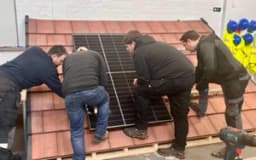
Solar PV & Battery Storage
Our Solar PV & Battery Storage course covers Section 716 requirements in full detail.
Section 722: Electric Vehicle Charging Updates
Section 722 (Supplies for Electric Vehicles) was already present in the original 18th Edition, but Amendment 2 introduces significant updates to reflect the rapid growth of EV charging infrastructure and the evolving technical requirements of modern charge points.
Key Changes to Section 722
Regulation 722.531.3.101 sets out the RCD requirements for EV charging circuits. Each charging point incorporating a socket-outlet or vehicle connector must be individually protected by an RCD with a rated residual operating current not exceeding 30 mA. Protection against DC fault currents is also required: if the charging equipment provides this itself, a Type A (or Type F) RCD is acceptable. If it does not, you need a Type B RCD, a Type A or Type F RCD in conjunction with an RDC-DD, or an RDC-PD conforming to BS IEC 62955. Amendment 2 also made significant changes to Regulation 722.411.4.1 on the use of PME earthing for EV charging.
Regulation 722.533.101 requires each EV charging point to be supplied individually by a final circuit with its own overcurrent protective device. This prevents the EV charger from affecting other circuits and simplifies fault finding.
The amendment also addresses the interaction between EV charging and prosumer installations. Where a property has both solar PV/battery storage and an EV charger, the combined requirements of Section 716 and Section 722 must be considered, including load management and the potential for back-feeding.
Related Course
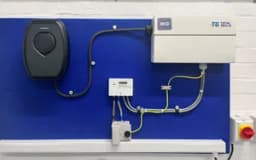
EV Charging (2921)
Our EV Charging Installation course covers the updated Section 722 requirements.
Arc Fault Detection Devices (AFDDs)
One of the most discussed changes in Amendment 2 is the redrafted Regulation 421.1.7, which now requires — and in other cases recommends — the use of arc fault detection devices (AFDDs) in certain types of installations.
What Are AFDDs?
An arc fault detection device monitors the electrical waveform on a circuit and detects the characteristic signature of a dangerous arc fault. Arc faults can occur in damaged cables, loose connections, or degraded insulation, and they can generate enough heat to start a fire. Conventional circuit breakers and RCDs cannot reliably detect arc faults because the current may remain within normal operating ranges.
AFDDs complying with BS EN 62606 are designed to detect both series arcs (where a single conductor is broken or damaged) and parallel arcs (where current arcs between live conductors or between live and earth). When a dangerous arc is detected, the AFDD disconnects the circuit within milliseconds.
When Are AFDDs Required?
Under the Amendment 2 wording of Regulation 421.1.7, AFDDs conforming to BS EN 62606 must be provided for single-phase AC final circuits supplying socket-outlets with a rated current not exceeding 32 A in:
- ✓High rise residential buildings — assumed to be residential buildings over 18 m in height or more than six storeys
- ✓Houses in multiple occupation (HMOs)
- ✓Purpose-built student accommodation
- ✓Care homes
For all other premises, AFDDs are recommended (but not required) for single-phase AC final circuits supplying socket-outlets not exceeding 32 A. Where used, AFDDs must be placed at the origin of the circuit to be protected.
Recommended vs Required
Outside the four mandatory building types, the word "recommended" in BS 7671 carries specific weight. It is not a mandatory requirement, but it means the designer must consider whether AFDDs are appropriate and should be able to justify their decision not to install them if challenged. Competent person schemes may interpret "recommended" more strictly, so check with your scheme provider. The cost of AFDDs has decreased significantly since their introduction, making them increasingly viable for standard domestic installations.
Surge Protective Devices (SPDs)
Amendment 2 strengthens the requirements for surge protective devices that were introduced in the original 18th Edition. Regulation 443.4.1 was redrafted: protection against transient overvoltages must be provided where an overvoltage could result in serious injury to, or loss of, human life, or significant financial or data loss. In all other cases, protection must still be provided unless the owner of the installation declares that the risk of damage is tolerable and accepts it. The old risk-assessment calculation method (Regulation 443.5) was deleted by Amendment 2.
In practice, the proliferation of sensitive electronic equipment in modern homes and businesses — along with the growth of solar PV and EV charging — means that SPDs are now recommended for most new installations. Type 2 SPDs installed at the consumer unit provide a cost-effective first line of defence against transient overvoltages caused by lightning strikes and switching events on the supply network.
Overvoltage protection is a particularly important design consideration for prosumer installations: solar PV arrays and battery storage systems are susceptible to lightning-induced overvoltages due to the extended cable runs between roof-mounted panels and ground-level inverters.
Other Notable Changes
Beyond the headline changes, Amendment 2 includes numerous smaller modifications and clarifications that affect day-to-day electrical work.
Updated Definitions (Part 2)
Part 2 of BS 7671 has been expanded with new definitions reflecting the technologies addressed in Amendment 2. Key additions include "prosumer's electrical installation", "energy storage system (ESS)", "electrical energy storage system (EESS)", and "onshore power supply". These definitions are important because they establish the precise scope of the associated regulations.
Section 710: Medical Locations
Section 710 has been updated to align with the latest requirements for electrical installations in hospitals, clinics, and other medical facilities. Changes include updated requirements for insulation monitoring devices in IT medical systems and clarified requirements for standby power supplies.
Onshore Power Supply for Boats and Vehicles
New requirements have been added for onshore power supply installations, reflecting the growth of electrical connections for boats in marinas and vehicles in campsites. These installations present specific safety challenges due to the combination of outdoor exposure, water proximity, and connections to movable equipment.
Energy Efficiency (Appendix 17)
Appendix 17, originally introduced in the 2018 edition, has been further developed. (Under Amendment 4 it has since been replaced by Chapter 81.) It provides guidance on how electrical installation design can contribute to energy efficiency — including power factor correction, efficient lighting design, and the consideration of energy storage as part of the installation design process. While not mandatory in the traditional sense, Appendix 17 reflects the growing importance of sustainability in electrical installation design.
What Amendment 2 Means for Practising Electricians
For working electricians, the practical impact of Amendment 2 can be summarised in a few key areas:
- ✓Solar PV and battery storage installations now have a clear regulatory framework in Part 8 (Chapter 82), replacing the previous patchwork of guidance documents
- ✓EV charger installations must comply with the updated Section 722 requirements, particularly regarding RCD selection and dedicated circuits
- ✓AFDDs should be considered for domestic and certain commercial installations, and the design decision should be documented
- ✓SPDs are effectively standard for most new installations, especially those with PV, battery storage, or EV charging
- ✓Labelling requirements have been strengthened for installations with multiple sources of supply (prosumer installations)
- ✓The 2382-22 exam introduced questions on Amendment 2 content; the current exam is now the 2382-26, based on Amendment 4
If you hold a 2382 certificate from before Amendment 2, it is strongly recommended that you update to the current 2382-26. Most competent person schemes require this, and it demonstrates to clients and employers that your knowledge is current. See Amendment 4 for the latest changes.
Related Course
18th Edition (2382)
Our 18th Edition course covers BS 7671:2018+A4:2026 — the current standard, including the Amendment 2 changes carried forward.
Frequently Asked Questions
Frequently Asked Questions
When did Amendment 2 come into effect?
Do I need to retake the 18th Edition exam for Amendment 2?
Are AFDDs mandatory under Amendment 2?
What is a prosumer installation?
Does Amendment 2 change the EV charging regulations?
Where can I buy BS 7671 with Amendment 2 included?
Ready to Start Training?
Browse our City & Guilds accredited courses and take the next step in your electrical career.
Related Guides
What Is the 18th Edition? BS 7671 Explained
A plain-English guide to the 18th Edition wiring regulations — what they are, why they matter, key changes, and who needs the qualification.
Read guide18th Edition Exam: What to Expect & How to Pass
Practical guidance for the 2382-26 exam — format, pass mark, question types, revision tips, and common mistakes to avoid.
Read guide18th Edition Amendment 4: What Electricians Need to Know
Everything about BS 7671 Amendment 4 (2026) — key changes, timeline, the new 2382-26 exam, and what it means for practising electricians.
Read guide18th Edition Update: 2382-22 to 2382-26 (2026 Guide)
Updating from 2382-22 to 2382-26 (BS 7671:2018+A4:2026)? Your certificate doesn’t expire, but schemes expect the current qualification. From £150.
Read guide