
18th Edition Amendment 4: What Electricians Need to Know
Everything about BS 7671 Amendment 4 (2026) — key changes, timeline, the new 2382-26 exam, and what it means for practising electricians.
In this guide
What Is Amendment 4?
Amendment 4 to BS 7671:2018 is the fourth and largest amendment to the 18th Edition of the IET Wiring Regulations. Published on 15 April 2026, it has been signed off by both the IET and BSI. The official designation of the updated standard is BS 7671:2018+A4:2026, sometimes referred to in the industry as "The Orange Book".
This is the most substantial update since the 18th Edition was first published in 2018. It introduces five entirely new technical sections and significantly revises others, bringing the regulations up to date with modern electrical technologies including battery energy storage, smart building systems, and Power over Ethernet.
Like previous amendments, Amendment 4 does not replace the entire 18th Edition. It modifies, adds to, and updates specific regulations within the existing structure. The core principles of BS 7671 remain unchanged.
Key Dates
15 April 2026 — Amendment 4 published, can be implemented immediately.
15 April – 15 October 2026 — Six-month transition period. Work may comply with either the previous version or Amendment 4.
15 October 2026 — Previous version withdrawn. All new work and alterations must comply with BS 7671:2018+A4:2026.
Chapter 57: Battery Energy Storage Systems
The most significant addition in Amendment 4 is the new Chapter 57, which covers stationary secondary batteries and electrical energy storage systems (EESS). For the first time, battery energy storage is brought directly under BS 7671 with enforceable requirements rather than relying on separate codes of practice.
The growth of domestic solar-plus-storage installations, commercial battery systems, and grid-scale energy storage has made dedicated regulation essential. Chapter 57 provides a clear framework for the safe design, installation, and testing of these systems.
Key Requirements
- ✓Protection, isolation, ventilation, fire segregation, and testing requirements for battery energy storage systems
- ✓Strict rules on battery location in domestic premises — restrictions on installation in high-risk areas such as lofts and escape routes
- ✓Requirements for fire-rated enclosures and separation distances from combustible materials
- ✓Ventilation requirements to prevent accumulation of flammable gases from certain battery chemistries
- ✓Testing and commissioning procedures specific to energy storage systems
Chapter 57 applies to solar-plus-storage, home battery retrofits, commercial energy storage, and hybrid installations. Any electrician installing or maintaining battery storage systems will need to be familiar with these requirements from October 2026.
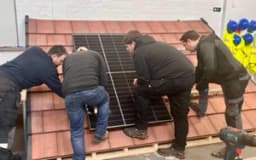
Related Course
Solar PV & Battery Storage
Our Solar PV & Battery Storage course covers energy storage installation including the new Chapter 57 requirements.
Section 716: Power over Ethernet (PoE)
Amendment 4 introduces new Section 716 covering Power over Ethernet (PoE) installations. PoE delivers extra-low voltage DC power using balanced data cabling, and is increasingly used in modern buildings for lighting, access control, CCTV, wireless access points, and smart building services.
As PoE systems now deliver higher power levels (up to 90W per port under IEEE 802.3bt), the wiring regulations have been updated to address the specific safety considerations. Section 716 sets out requirements for cable selection, temperature management in cable bundles, protection against electric shock, and the interaction between PoE circuits and conventional mains circuits.
This section is particularly relevant for electricians working on commercial fit-outs, office refurbishments, and smart building projects where PoE lighting and building management systems are becoming the norm.
Section 545: Functional Earthing for ICT Systems
The new Section 545 addresses functional earthing and equipotential bonding specifically for information and communication technology (ICT) systems. This section clearly distinguishes between functional earthing (required for equipment to operate correctly) and protective earthing (required for safety).
Modern buildings contain increasingly complex ICT infrastructure — data centres, server rooms, structured cabling networks, and telecommunications equipment. Section 545 provides the regulatory framework for ensuring these systems are earthed correctly, both for reliable operation and for safety in fault conditions.
Low-Voltage Generators
Amendment 4 introduces new requirements for low-voltage generating sets used as additional power sources operating in parallel with other sources. This covers standby generators, combined heat and power (CHP) units, and other generating plant that may operate alongside the public supply or battery storage systems.
The requirements address protection against electric shock during parallel operation, isolation procedures, earthing arrangements, and the interaction between multiple sources of supply. This is an area where previous editions provided limited guidance, and Amendment 4 closes that gap.
Energy Efficiency Design Framework
A new chapter on energy efficiency establishes a design framework for energy-efficient electrical installations. While Appendix 17 in earlier amendments provided non-mandatory guidance, Amendment 4 elevates this into a more structured framework within the main body of the regulations.
The framework covers considerations including power factor correction, efficient cable sizing, lighting design optimisation, and the integration of energy storage and on-site generation into the overall installation design. This reflects the growing regulatory and commercial emphasis on building energy performance and the UK's net-zero commitments.
Section 710: Medical Locations
Section 710 receives a major revision in Amendment 4. Medical locations — hospitals, clinics, dental surgeries, and other healthcare facilities — have some of the most demanding electrical installation requirements in BS 7671.
Key updates include a new schedule of test results for recording the resistance of supplementary protective equipotential bonding conductors. This standardises the documentation that must be completed when testing medical location installations, making it clearer for both installers and those verifying the work.
The revisions also update requirements for insulation monitoring devices in IT medical systems and clarify the classification of medical locations (Groups 0, 1, and 2) to align with current healthcare standards.
The New 2382-26 Qualification
City & Guilds is replacing the current 2382-22 qualification with the 2382-26 to reflect the updated regulations. The "-26" suffix indicates the 2026 amendment.
Transition Timeline
- ✓15 April 2026 — 2382-26 exam becomes available
- ✓April to 15 October 2026 — training providers can offer either 2382-22 or 2382-26
- ✓16 October 2026 — 2382-22 withdrawn, only 2382-26 available
The exam format remains the same: 60 multiple-choice questions, two-hour time limit, open-book (BS 7671 only), 60% pass mark. The difference is the content — the 2382-26 includes questions on Amendment 4 material, and candidates must use BS 7671:2018+A4:2026.
Which Book Do I Need?
For the 2382-26 exam, you will need BS 7671:2018+A4:2026. Earlier printings (including those marked +A2:2022) do not contain the Amendment 4 content and cannot be used for the new exam. The updated edition is available from the IET website and major bookshops from 15 April 2026.
Related Course
18th Edition (2382)
Our 18th Edition course now covers the 2382-26 qualification to the Amendment 4 / Orange Book standard.
What Amendment 4 Means for Practising Electricians
For working electricians, Amendment 4 has practical implications across several areas:
- ✓Battery storage installations now have enforceable requirements in Chapter 57, replacing the previous patchwork of codes of practice — particularly important for solar-plus-storage work
- ✓Domestic battery locations are restricted — high-risk areas such as lofts and escape routes face new limitations, and adequate ventilation is required
- ✓Power over Ethernet installations (lighting, access control, smart building systems) must comply with the new Section 716
- ✓ICT earthing has dedicated requirements in Section 545, affecting data centre and server room installations
- ✓Standby generators and parallel operation of supply sources have clearer regulatory requirements
- ✓Energy efficiency must be considered as part of installation design, not just as optional good practice
- ✓Medical location testing has new standardised documentation requirements
- ✓The 2382-26 exam will include questions on all Amendment 4 content
If you hold a 2382-22 certificate, it remains valid, but updating to the 2382-26 (2-day classroom course) or the exam-only option (£150 centre / £200 remote) is strongly recommended. Most competent person schemes will expect electricians to demonstrate current knowledge of the wiring regulations, and clients increasingly ask for evidence of up-to-date qualifications. See our 2382-22 to 2382-26 update guide for a full comparison of both routes and what to expect from the updated exam.
Amendment 2 vs Amendment 4
Amendment 2 (2022) focused on prosumer installations (Part 8, Chapter 82), EV charging updates (Section 722), arc fault detection recommendations (Regulation 421.1.7), and surge protective device requirements. It was driven primarily by the growth of solar PV, battery storage, and electric vehicles.
Amendment 4 (2026) is larger in scope. While Amendment 2 added one major new section, Amendment 4 introduces five. It extends the regulations into areas previously covered only by guidance documents — battery storage gets its own chapter, PoE and ICT earthing get dedicated sections, and energy efficiency moves from an appendix to a design framework. The revision to Section 710 (medical locations) is also more extensive than the Amendment 2 changes to the same section.
Note that Amendment 4 incorporates all previous amendments. BS 7671:2018+A4:2026 includes the content from Amendment 1 (2020), Amendment 2 (2022), and Amendment 3 (2024), so you do not need separate copies of earlier amendments.
Frequently Asked Questions
Frequently Asked Questions
When does Amendment 4 come into effect?
Do I need to retake the 18th Edition exam for Amendment 4?
What is the difference between the 2382-22 and the 2382-26?
When can I sit the new 2382-26 exam?
Do I need to buy a new copy of BS 7671?
What are the biggest changes in Amendment 4?
Does Amendment 4 affect domestic electricians?
Why is Amendment 4 called "The Orange Book"?
Ready to Start Training?
Browse our City & Guilds accredited courses and take the next step in your electrical career.
Related Guides
What Is the 18th Edition? BS 7671 Explained
A plain-English guide to the 18th Edition wiring regulations — what they are, why they matter, key changes, and who needs the qualification.
Read guide18th Edition Exam: What to Expect & How to Pass
Practical guidance for the 2382-26 exam — format, pass mark, question types, revision tips, and common mistakes to avoid.
Read guide18th Edition Amendment 2: Key Changes Explained
A summary of the major changes introduced by Amendment 2 to BS 7671 and what they mean for practising electricians.
Read guide18th Edition Update: 2382-22 to 2382-26 (2026 Guide)
Updating from 2382-22 to 2382-26 (BS 7671:2018+A4:2026)? Your certificate doesn’t expire, but schemes expect the current qualification. From £150.
Read guide