
ECS Card Types, Costs & How to Apply (2026 Guide)
Every ECS card type explained — Trainee, Registered, Gold, Labourer and more. Requirements, costs (~£36), colours, and how to apply for each card in 2026.
In this guide
What Is the Electrotechnical Certification Scheme?
The Electrotechnical Certification Scheme (ECS) is the industry-recognised card scheme for electricians and other electrotechnical workers in the United Kingdom. Managed by the Joint Industry Board (JIB), the ECS card proves that the cardholder has the appropriate qualifications and competence for their role. It operates as a partner scheme within the wider CSCS (Construction Skills Certification Scheme) family, meaning ECS cards are accepted at any site that recognises CSCS cards.
On virtually every commercial and industrial construction site in the UK, you will be asked to show your ECS card at the gate. Without one, you cannot get on site. Even in domestic work, the ECS card is increasingly seen as a mark of professionalism that gives customers confidence in your abilities.
The scheme covers a wide range of roles from trainees through to fully qualified installation electricians, and includes specialist cards for maintenance, highway electrical, fire, emergency, and security systems (FESS) disciplines. The card you receive depends on the qualifications you hold and your level of on-site competence.
Key Fact
There are over 175,000 registered ECS cardholders in the UK. The scheme was established by the JIB in partnership with industry bodies to ensure a consistent standard of competence across the electrotechnical sector. Every cardholder can be verified instantly using the ECS Card Check app, available free on iOS and Android.
At a Glance: The 6 Main Card Types
Trainee Electrician
Starting your journey
Enrolled on training + HSEAP
Electrical Labourer
Supporting role
Level 1/2 qualification + HSEAP
Registered Electrician
Qualified, pre-NVQ
L2 + L3 + 18th Ed + 2391 + HSEAP
Experienced Worker
3+ years experience
L3 technical cert + 18th Ed + HSEAP
Installation Electrician
Fully qualified (Gold)
All blue quals + NVQ L3 + AM2 + HSEAP
Approved Electrician
Via experienced worker route (Gold)
EWA completion + 18th Ed + HSEAP
Do Electricians Need a CSCS Card?
No — electricians do not need a standard CSCS card. The CSCS scheme covers general construction trades such as bricklaying, carpentry, and plastering, while the electrotechnical industry has its own equivalent: the ECS card, managed by the JIB as an official CSCS partner scheme. When job adverts or agencies ask for CSCS for electricians, they almost always mean an ECS card.
Because the ECS card carries the CSCS hologram and works with the same site access systems, it is accepted at every site that requires a CSCS card. If a site manager or agency specifically asks to see your "CSCS card", present your ECS card — it satisfies the requirement in full, and you never need to hold both cards.
Quick Answer
Electricians do not need a CSCS card. The ECS card is the electrotechnical equivalent, issued by the JIB as a CSCS partner scheme. It carries the CSCS hologram, is accepted on every site that requires CSCS, and is the card employers mean when they ask for CSCS for electricians.
The Electrical Labourer and Trainee Card Route — Getting On Site Without Full Qualifications
You do not need to be fully qualified to start working on construction sites. The ECS scheme provides two entry-level cards — the electrical labourer card and the Trainee Electrician card — that get you on site, earning and learning, while you work towards your full qualifications.
The electrical labourer card (yellow) is the fastest way onto site. It requires a relevant Level 1 or Level 2 qualification in Building Services Engineering or Electrotechnical, plus a pass in the ECS Health, Safety and Environmental Assessment (HSEAP). It permits supporting tasks only — cable pulling, chasing walls, and fixing containment — always under the supervision of a qualified electrician. You cannot carry out electrical connections, testing, or inspection work.
The Trainee Electrician card (white with red stripe) is the next step once you enrol on a recognised training programme such as the Level 2 Diploma in Electrical Installation (2365). Once enrolled and having attempted your first exam or assessment, your training provider can sponsor your application, and the card gives you site access for the duration of your training programme (up to 24 months).
How the Two Cards Work Together
- ✓Start with the electrical labourer card if you have a relevant Level 1 or 2 qualification and want immediate site access in a supporting role
- ✓Enrol on the Level 2 Diploma (2365) and attempt your first exam or assessment to become eligible for the Trainee Electrician card
- ✓Use your time on site to build experience alongside qualified electricians while completing your diplomas
- ✓Progress to the Registered Electrician (blue) card once you hold Level 2, Level 3, 18th Edition, and 2391
- ✓Both entry-level cards require a valid HSEAP pass — prepare with our free practice quiz linked below
Whichever route you take, the first step is passing the HSEAP. See our ECS Health and Safety Test guide for the test format, pass mark, and a free interactive practice quiz with all 327 official revision questions.
ECS vs CSCS Cards — What Is the Difference?
One of the most common points of confusion for people entering the electrical trade is the difference between ECS and CSCS cards. Both serve the same fundamental purpose — proving that you are qualified and competent to work on construction sites — but they cover different trades.
How the Schemes Relate
The ECS scheme is a partner card scheme that sits within the CSCS family. The CSCS umbrella covers over 30 partner schemes, each managed by the relevant trade body. For the electrotechnical sector, that body is the JIB. This means your ECS card carries the CSCS logo and is accepted at any site that requires a CSCS card — you do not need both.
Key Differences
- ✓CSCS cards are for general construction trades (bricklaying, carpentry, plastering, plumbing). ECS cards are specifically for the electrotechnical industry.
- ✓CSCS cards are managed centrally by CSCS Ltd. ECS cards are managed by the JIB on behalf of the electrotechnical sector.
- ✓The CSCS scheme uses the CITB Health, Safety and Environment test. The ECS scheme uses its own Health, Safety and Environmental Assessment (HSEAP) — the CITB test is NOT accepted for ECS applications.
- ✓ECS cards map to specific JIB-defined electrical roles (Installation Electrician, Maintenance Electrician, Highway Electrical). CSCS cards map to NVQ levels across general construction.
- ✓Both carry the same CSCS hologram and are scanned by the same site access systems.
Why Job Ads Say "CSCS Card Required"
Many job advertisements for electricians state "CSCS card required" when they actually mean an ECS card. This is because site managers and recruitment agencies use "CSCS" as a generic term for any card in the CSCS partner scheme family. If you are an electrician applying for a site-based role, your ECS card satisfies this requirement. You do not need a separate CSCS card.
For a detailed side-by-side comparison, see our CSCS Card vs ECS Card guide.
Important
The CITB Health, Safety and Environment test (used for standard CSCS cards) is not accepted for ECS card applications. You must pass the ECS-specific HSEAP assessment. If you have already passed the CITB test for another trade card, you will still need to take the HSEAP separately.
ECS Card Types Explained
The ECS scheme includes several card types, each corresponding to a different level of qualification and competence. The table below gives you a quick overview of the main card types, then each is explained in detail further down.
Quick Answer — The Main ECS Card Types
The main ECS cards in order of progression: the yellow Electrical Labourer card (supporting work only), the red-stripe Trainee Electrician card (enrolled learners), the blue Registered Electrician card (Level 2 and 3 diplomas, 18th Edition, 2391), and the Gold Card (all blue-card qualifications plus NVQ Level 3). Every card requires a valid ECS HSEAP pass.
| Card Type | Colour | Qualifications Needed | Validity | Cost |
|---|---|---|---|---|
| Electrical Labourer | Yellow | Level 1/2 qualification + HSEAP | 3 years | £48 incl. VAT |
| Trainee Electrician | White / Red Stripe | Enrolled on training programme + HSEAP | 24 months (not renewable) | £48 incl. VAT |
| Apprentice | White / Red Stripe | On JIB-registered apprenticeship | Renewed annually (5-year max) | £48 incl. VAT |
| Registered Electrician | Blue | L2 + L3 Diplomas, 18th Edition, 2391, HSEAP | 3 years | £48 incl. VAT |
| Domestic Electrician | Blue | Same as Registered Electrician (domestic scope) | 3 years | £48 incl. VAT |
| Experienced Worker | Brown Stripe | L3 technical cert + 18th Edition + HSEAP | 18 months (not renewable) | £48 incl. VAT |
| Experienced Worker (EWA) | Gold Stripe | Enrolled on EWA + underlying quals + HSEAP | 18 months (not renewable) | £48 incl. VAT |
| Installation Electrician (Gold Card) | Gold | All blue card quals + NVQ Level 3 + AM2 + HSEAP | 3 years | £48 incl. VAT |
| Approved Electrician (Gold Card) | Gold | Completed EWA to Level 3 + 18th Edition + HSEAP | 3 years | £48 incl. VAT |
| Maintenance Electrician | Gold | Maintenance-specific qualifications + HSEAP | 3 years | £48 incl. VAT |
Fees shown are approximate and based on 2025-2026 JIB pricing for direct applicants (non-JIB members). JIB member employers may receive discounted or free initial cards. Check ecscard.org.uk for the latest fees.
Trainee Electrician Card (White with Red Stripe)
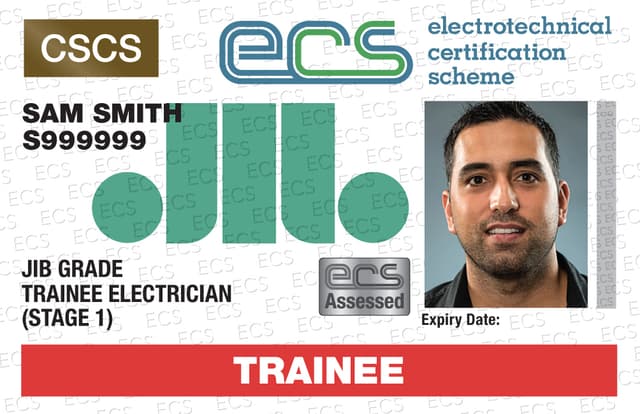
The Trainee Electrician card is designed for individuals who are actively enrolled on a recognised electrotechnical training programme and working towards their full qualifications. It is the entry-level card for adult learners taking the adult diploma route or another approved qualification programme.
To obtain a Trainee Electrician card, you need to be enrolled on a recognised electrotechnical training programme and have attempted your first exam or assessment. This includes the City and Guilds 2365 Diploma in Electrical Installation at Level 2 or Level 3. Your training provider must sponsor your application. Total Skills provides this sponsorship for students enrolled on our diploma courses.
- ✓Must be actively enrolled on a recognised electrical training programme
- ✓Training provider must sponsor the application
- ✓Provides site access while you are completing your qualifications
- ✓All work must be carried out under supervision of a qualified electrician
- ✓Valid for 24 months — cannot be renewed; you must upgrade to the next card type once your training is complete
- ✓Must be upgraded once qualifications are completed
- ✓Requires a valid HSEAP pass
The Trainee Electrician card allows you to gain valuable on-site experience while you study. Many employers require even trainees to hold a valid ECS card before they can access construction sites, making this card essential if your training includes any site-based work.

Related Course
Level 2 Diploma (2365)
Once you enrol on the Level 2 Diploma and attempt your first exam or assessment, you qualify for a Trainee Electrician ECS card. Total Skills sponsors card applications.
Registered Electrician Card (Blue)
The Registered Electrician card, commonly known as the blue card, is for electricians who hold recognised qualifications but have not yet completed the NVQ Level 3 on-site assessment. This is the card most commonly held by electricians who have completed their classroom-based qualifications and are building practical experience.
To qualify for the Registered Electrician card, you typically need a combination of the following qualifications:
- ✓City and Guilds 2365 Level 2 and Level 3 Diplomas in Electrical Installation (or equivalent)
- ✓Current 18th Edition Wiring Regulations certificate (BS 7671, City and Guilds 2382)
- ✓City and Guilds 2391 Inspection and Testing qualification
- ✓A valid HSEAP pass (taken within the last two years)
The Registered Electrician card gives you full site access and demonstrates that you hold the technical qualifications expected of a competent electrician. Many electricians work for several years with this card before progressing to the Gold Card via the NVQ route.
It is important to understand that the blue card is not a lesser qualification. Electricians holding this card are fully capable of carrying out electrical installations. The distinction between the blue card and the Gold Card is that the Gold Card additionally requires demonstrated on-site competence via the NVQ.
For more on the required qualifications, see our guides on the 18th Edition Wiring Regulations and 2391 Inspection and Testing.
Related Course
18th Edition (2382)
The 18th Edition is a core requirement for the Registered Electrician card.
Installation Electrician Gold Card
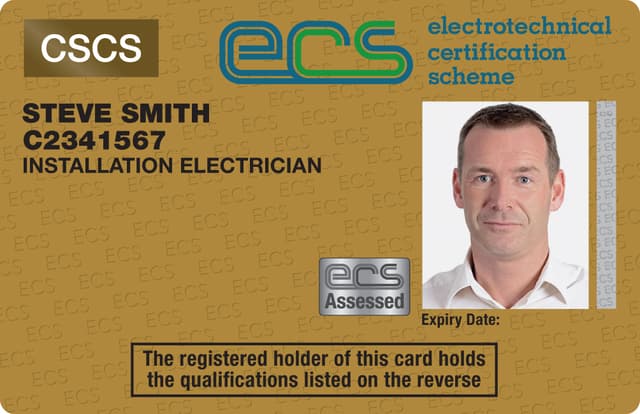
The ECS Gold Card is the highest standard card for installation electricians and is considered the industry benchmark for a fully qualified electrician. It confirms that the holder has both the technical qualifications and proven on-site competence to carry out electrical installations to the required standard.
To obtain the Gold Card, you need all of the qualifications required for the Registered Electrician card, plus the NVQ Level 3 in Electrical Installation (City and Guilds 2357 or equivalent). The NVQ is an on-site competence assessment where an assessor observes your real work and reviews a portfolio of evidence from your installations. The 2357 is being replaced by the new 5357-95 qualification from 31 October 2026.
- ✓Requires NVQ Level 3 in Electrical Installation (2357) in addition to all blue card qualifications
- ✓Demonstrates both technical knowledge and proven on-site competence
- ✓The industry benchmark recognised by all major contractors
- ✓Required for most commercial and industrial construction sites
- ✓Valid for three years with renewal requirements
- ✓Can be obtained via the experienced worker assessment if you have three or more years of experience
The Gold Card is particularly important if you want to work on large construction projects, for principal contractors, or on commercial and industrial installations. Electricians holding the Gold Card typically command higher day rates than those with lower card types, making it a worthwhile investment in your career.
For full details on what you need and how to get there, see our dedicated ECS Gold Card Requirements guide.
Related Course
5357 Level 3 Electrotechnical
The NVQ Level 3 is the final step to obtaining your Gold Card.
Which ECS Card Do I Need?
Choosing the right card depends on where you are in your career. Use the decision guide below to find the card that matches your current situation.
New to the Electrical Trade — No Qualifications
If you have no electrical qualifications and want to support electricians on site, the Electrical Labourer card (Yellow) gets you onto construction sites in a supporting role. You cannot carry out any electrical work — only cable pulling, chasing walls, and general preparation.
Currently Training — Enrolled on a Diploma or Apprenticeship
If you are enrolled on a recognised training programme such as the Level 2 Diploma (online + practical) and have attempted your first exam or assessment, apply for the Trainee Electrician card (White / Red Stripe). Total Skills sponsors card applications. This lets you gain site experience while you study.
Completed Level 2 + Level 3 + 18th Edition + 2391
Once you hold all four classroom qualifications, you qualify for the Registered Electrician card (Blue). This gives you full site access and is the card most electricians hold while building practical experience before the Gold Card.
Fully Qualified — NVQ Level 3 + AM2 Completed
If you have completed the NVQ Level 3 and AM2 assessment on top of your classroom qualifications, you qualify for the Installation Electrician Gold Card — the industry benchmark. See our ECS Gold Card Requirements guide for the full pathway.
Experienced But No NVQ — Three or More Years on Site
If you have been working as an electrician for three or more years but never completed the NVQ, the Experienced Worker Assessment (EWA) lets you demonstrate competence at Level 3 standard. This leads to an Approved Electrician Gold Card. See our Experienced Worker Route guide — but act quickly, as the C&G 2346 EWA is being withdrawn post-2026.
Domestic Work Only
If you primarily work in residential properties, the Domestic Electrician card recognises your competence specifically in domestic installation and testing. The qualification requirements are the same as the Registered Electrician card (L2, L3, 18th Edition, 2391), but the card scope denotes domestic work.
Not Sure?
Use the ECS eligibility checker at ecscard.org.uk to confirm which card your qualifications entitle you to. You can also call the JIB helpline on 01322 661600 for advice. If you are considering training with Total Skills, our team can advise which courses to take for your target card — call us on 0115 666 2366.

Related Course
Level 2 & 3 Package
The combined Level 2 + 3 Diploma package is the fastest route from beginner to the blue card (Registered Electrician). Save time and money by combining both diplomas.
Other ECS Card Categories
Beyond the three main progression cards, the ECS scheme includes several other card types for different roles within the electrotechnical industry. Understanding these helps you see where your card fits within the wider scheme.
Electrical Labourer Card (Yellow)
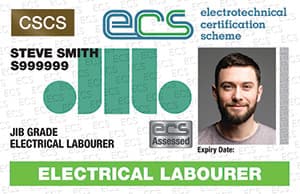
The Electrical Labourer card is for individuals who work alongside electricians in a supporting role but do not carry out electrical work themselves. This includes tasks such as chasing walls, pulling cables, fixing trunking and tray, and general site preparation. It is one of the most searched-for ECS card types because it offers a route onto construction sites without full electrical qualifications.
- ✓Requires a relevant Level 1 or Level 2 qualification (such as a Building Services Engineering or Electrotechnical qualification)
- ✓Holder must not carry out any electrical connections, testing, or inspection work
- ✓Valid for three years with HSEAP renewal required
- ✓A common starting point for people considering a career change into the electrical trade
- ✓Must work under the supervision of a qualified electrician at all times
The Electrical Labourer card can be a useful stepping stone. It gets you onto sites and working alongside qualified electricians, giving you real exposure to the trade before committing to the full diploma pathway.
Apprentice Card
Specifically for individuals on a formal electrical apprenticeship programme registered with the JIB. This card is linked to your apprenticeship provider and must be renewed annually until your apprenticeship is complete. It provides site access during your apprenticeship training, with all work carried out under supervision.
Electrician's Mate Card
For individuals who assist qualified electricians but are not themselves qualified. The holder can work under the direct supervision of a qualified electrician. This card requires an appropriate Level 2 qualification or relevant experience, plus the HSEAP assessment.
Domestic Electrician Card
The Domestic Electrician card is designed for electricians who primarily work in residential properties rather than on construction sites. It recognises competence in domestic electrical installation, testing, and certification. To qualify, you need the same core qualifications as the Registered Electrician (Level 2 and 3 Diplomas, 18th Edition, and 2391), but the card specifically denotes domestic scope.
While many domestic electricians choose not to hold an ECS card because site access is not their primary concern, having one demonstrates professionalism to homeowners, letting agents, and property management companies. It is also useful if you occasionally take on new-build or renovation work that involves site access requirements.
Maintenance Electrician Card
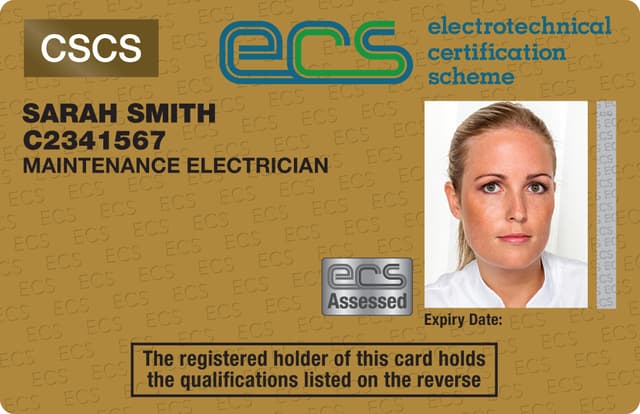
For electricians who specialise in electrical maintenance rather than new installation work. The qualification requirements differ from installation cards, reflecting the different competencies required for maintenance, repair, and fault-finding work.
Highway Electrical Card
A specialist card for electricians working on highway electrical systems, including street lighting, traffic signals, and motorway infrastructure. This requires specific highway electrical qualifications in addition to the standard electrical competencies.
Fire, Emergency and Security Systems (FESS) Cards
The ECS scheme includes a family of cards for technicians working in fire alarm, emergency lighting, intruder alarm, CCTV, and access control systems. These FESS cards recognise qualifications specific to each discipline and are managed through the same JIB framework. FESS cards are increasingly required on construction sites where fire and security system installation runs alongside the main electrical works.
- ✓Fire Detection and Alarm Systems Technician
- ✓Emergency Lighting Technician
- ✓Security Systems Technician (intruder alarms, CCTV, access control)
- ✓Each requires discipline-specific qualifications plus the HSEAP
- ✓Valid for three years, same renewal process as other ECS cards
Experienced Worker Cards (Brown Stripe / Gold Stripe)
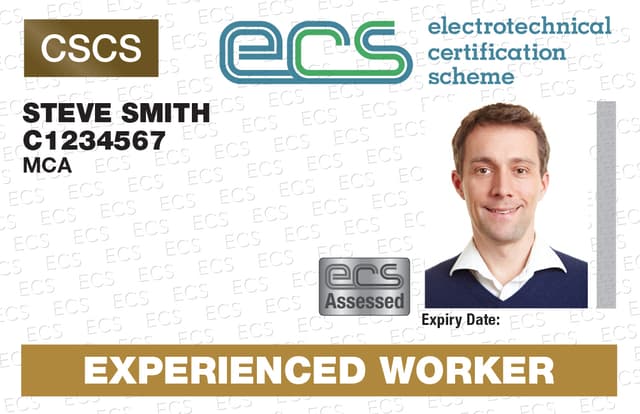
The ECS scheme provides a route for experienced electricians who have been working in the trade for three or more years but may not hold all the formal qualifications typically required. The Experienced Worker Assessment (EWA) allows these electricians to demonstrate their competence through on-site observation and portfolio evidence, leading to either a brown stripe (partial qualifications) or a gold stripe (full Gold Card) depending on the assessment outcome.
For full details on the experienced worker pathway, see our Experienced Worker Route guide.
EWA 2346 Withdrawal — Important Update
The City and Guilds 2346 Experienced Worker Assessment is being withdrawn post-2026. If you are planning to use the experienced worker route to obtain your Gold Card, you should begin the process as soon as possible. Once the 2346 is withdrawn, a replacement pathway will be introduced, but details and timelines have not yet been fully confirmed. Do not delay if this is your planned route to the Gold Card.
Temporary Card
Available in certain circumstances where an electrician can demonstrate they are working towards a specific qualification. Temporary cards have a shorter validity period and are designed to bridge a gap while qualifications are being updated or renewed.
ECS Card Fees — Full Breakdown
ECS card fees depend on whether your employer is a JIB member or not. JIB member employers pay an annual subscription that includes card benefits for their employees, resulting in significant savings. Here is a full breakdown of current 2025-2026 fees.
What Fees Are Involved?
There are three types of fee associated with ECS cards:
- ✓Initial card application fee — paid when you first apply for your card
- ✓HSEAP assessment fee — paid to sit the Health, Safety and Environmental Assessment
- ✓Renewal fee — paid every three years when your card is due for renewal
Fees vary depending on whether you apply directly through the JIB or through a training provider. If your employer is a JIB member, the initial card application may be free.
HSEAP Assessment
- ✓Valid for two years from the date of passing
- ✓Must be current at the time of both initial application and renewal
- ✓Can be booked through ecscard.org.uk, the Employer Assessment Portal, or through your training provider
Total Skills handles the process
Total Skills students can sit the HSEAP and apply for their ECS card through us. We handle the assessment booking, application sponsorship, and paperwork. Contact us for current pricing — fees are not included in your course fee.
Qualification Requirements Summary
The table below summarises the qualifications needed for the main ECS card types that installation electricians will hold during their career progression.
Trainee Electrician Card Requirements
- ✓Enrolment on a recognised electrotechnical training programme (e.g. City and Guilds 2365)
- ✓Training provider sponsorship of the application
- ✓Health, Safety and Environmental Assessment (HSEAP) pass
- ✓Proof of training provider and programme dates
Electrical Labourer Card Requirements
- ✓Relevant Level 1 or Level 2 qualification in Building Services Engineering or Electrotechnical
- ✓Health, Safety and Environmental Assessment (HSEAP) pass
- ✓No electrical installation, testing, or inspection work permitted
Registered Electrician (Blue Card) Requirements
- ✓Level 2 and Level 3 Diplomas in Electrical Installation (2365 or equivalent)
- ✓Current 18th Edition Wiring Regulations (2382)
- ✓Inspection and Testing qualification (2391)
- ✓Health, Safety and Environmental Assessment (HSEAP) pass
Installation Electrician Gold Card Requirements
- ✓All Registered Electrician qualifications (listed above)
- ✓NVQ Level 3 in Electrical Installation (2357 or equivalent)
- ✓Health, Safety and Environmental Assessment (HSEAP) pass
Domestic Electrician Card Requirements
- ✓Level 2 and Level 3 Diplomas in Electrical Installation (2365 or equivalent)
- ✓Current 18th Edition Wiring Regulations (2382)
- ✓Inspection and Testing qualification (2391)
- ✓Health, Safety and Environmental Assessment (HSEAP) pass
- ✓Card scope denotes domestic installation work
Important
All qualifications must be current at the time of application. The 18th Edition certificate does not expire, but the JIB requires it to be from the most recent edition of BS 7671. The HSEAP must have been passed within the last two years. Check the JIB website for the latest requirements before applying.
The Health, Safety and Environmental Assessment (HSEAP)
Every ECS card application requires a valid Health, Safety and Environmental Assessment (HSEAP). This is a multiple-choice assessment available online through the MyECS portal or the Employer Assessment Portal. The test covers general construction health and safety knowledge, including working at height, manual handling, fire safety, asbestos awareness, noise and vibration, COSHH, electrical safety, and site-specific hazards.
There are 50 multiple-choice questions to answer within a 30-minute time period. The pass mark is 43 out of 50 (86%) — one of the highest pass thresholds of any construction industry assessment.
The test is not specific to electrical work alone. It covers the broader health and safety knowledge expected of anyone working on a construction site. Questions are drawn from a bank of 327 across 11 topic areas. The high pass mark means thorough preparation is essential.
The HSEAP is valid for two years. When renewing your ECS card, you must ensure your HSEAP is still valid. If it has expired, you will need to retake the test before your card renewal can be processed.
- ✓Available online via MyECS portal or Employer Assessment Portal
- ✓50 multiple-choice questions in 30 minutes
- ✓Pass mark: 43 out of 50 (86%)
- ✓Covers general construction health and safety topics across 11 areas
- ✓Valid for two years from the date of passing
- ✓Must be current at the time of ECS card application and renewal
- ✓Study materials available through the ECS Revision Guide (ECS034)
- ✓The CITB Health, Safety and Environment test is NOT accepted as a substitute
Practise for free with our interactive ECS practice quiz containing all 327 official revision questions.
How to Apply for an ECS Card
The application process for an ECS card is straightforward and is handled entirely online through the JIB website. Here is a step-by-step guide to applying.
Step 1: Check Your Eligibility
Before starting your application, use the ECS card eligibility checker on the JIB website (ecscard.org.uk) to confirm which card type you qualify for. Enter your qualifications and the tool will tell you exactly which card you are entitled to. This is especially useful if you hold older or non-standard qualifications.
Step 2: Pass the HSEAP
If you do not already have a valid HSEAP result (passed within the last two years), book and pass this assessment before starting your ECS application. You can book through ecscard.org.uk, the Employer Assessment Portal, or through your training provider. Total Skills students can sit the HSEAP through us. Prepare with our free ECS Health and Safety practice quiz containing all 327 official revision questions.
Step 3: Create an Account on the JIB Website
Visit the JIB website and create an account if you do not already have one. You will use this account to submit your application and track its progress.
Step 4: Complete the Online Application
Fill in the online application form with your personal details, qualification information, and HSEAP details. You will need to upload copies of your qualification certificates or provide registration numbers that the JIB can verify directly with the awarding body (City and Guilds, EAL, etc.). You will also need a passport-style photo — head and shoulders, facing forward, on a plain white or light-coloured background, taken within the last six months. No hats, sunglasses, or filters.
Step 5: Pay the Application Fee
Online applications cost £40 + VAT (£48 including VAT) for a three-year card. If your employer is a JIB member, the initial card may be free. Paper applications cost more (£40 + VAT plus a £10 + VAT administration fee) — apply online where possible. Check ecscard.org.uk for current pricing. There is a separate fee for the HSEAP assessment. Total Skills students can apply through us — we handle the paperwork and sponsorship.
Step 6: Receive Your Card
Once your application has been verified and your qualifications confirmed with the awarding bodies, your ECS card will be produced and posted to you. The process typically takes two to four weeks. You can check the status of your application through your JIB online account.
Digital Card via ECS Card Check App
Once your physical card is issued, you can also access a digital version on your smartphone through the ECS Card Check app (free on iOS and Android). The digital card is useful as a backup if you forget your physical card, and site managers can scan your digital card for instant verification. The app also lets employers and site managers verify any cardholder by scanning the QR code on the physical card.
Renewing Your ECS Card
Most ECS graded cards are valid for three years. You can apply for renewal when your card has less than six months before expiry — start the process well before then to avoid any gap in your site access. The JIB will send you a reminder when your card is approaching its expiry date.
To renew, you need to demonstrate that your qualifications are still current and that you have a valid HSEAP pass from within the last two years. If any of your qualifications have been updated or superseded since your last card was issued, you will need to provide evidence of the current qualification.
- ✓Start the renewal process at least two months before your card expires
- ✓Ensure your HSEAP is current (passed within the last two years)
- ✓Provide evidence of any updated qualifications
- ✓If you have gained additional qualifications since your last card, you may be eligible for an upgrade
- ✓Renewal fees apply — check with the JIB or your training provider for current rates
- ✓Renewal is completed through the JIB online portal
If your card expires before you renew, you will not be able to access construction sites that require ECS verification. There is no grace period, so it is important to plan ahead and allow time for processing.
2025-2026 Changes to the ECS Scheme
The ECS scheme is undergoing several significant changes during 2025 and 2026. If you are planning to apply for or renew an ECS card, you should be aware of the following developments.
Electrician Plus Reforms
The JIB is phasing in Electrician Plus reforms during 2025-2026. This initiative aims to raise the competence bar for Installation Electricians by incorporating additional skills requirements around renewable energy, electric vehicle charging, and smart home technologies. The exact scope and timeline of the changes are being phased in gradually. Current cardholders will not be affected immediately, but future applications and renewals may include updated CPD (Continuing Professional Development) requirements.
EWA 2346 Withdrawal
The City and Guilds 2346 Experienced Worker Assessment — the primary route for experienced electricians without an NVQ to obtain their Gold Card — is being withdrawn post-2026. If you have been working in the trade for three or more years and plan to use this route, you should begin the process immediately. A replacement assessment pathway is expected but has not yet been fully confirmed.
For more on this route while it remains available, see our Experienced Worker Route guide.
Fee Updates
Card fees were updated in 2025 and may be subject to further review. Check the JIB website (ecscard.org.uk) for the latest fee schedule, or contact Total Skills for our current pricing if you are enrolling on one of our courses.
Digital Card Expansion
The ECS Card Check app is being expanded with additional features, including qualification expiry notifications, CPD tracking, and instant digital renewal processing. The JIB is moving towards a digital-first approach, though physical cards will continue to be issued. Site managers can already verify cardholders instantly by scanning the QR code on either the physical or digital card.
Stay Up to Date
ECS scheme changes are published on the JIB website (jib.org.uk) and the ECS card portal (ecscard.org.uk). Sign up for email alerts to be notified of any changes that affect your card type or renewal requirements.
Which Total Skills Courses Qualify for ECS Cards?
Total Skills offers a complete range of qualifications that map directly to ECS card requirements. Here is how our courses align with each card type.
Trainee Electrician Card
Enrolling on the Level 2 Diploma in Electrical Installation (2365) at Total Skills, once you have enrolled and attempted your first exam or assessment, you qualify for a Trainee Electrician ECS card. We sponsor your application.
ECS card fees are separate from course fees
The ECS card application and HSEAP assessment are not included in your course fee. Total Skills students can sit the HSEAP and apply for their card through us — we handle the assessment, sponsorship, and paperwork. Contact us for current pricing.
Related Course
Level 2 Diploma (2365)
Enrolling and attempting your first exam or assessment qualifies you for a Trainee Electrician ECS card.
Registered Electrician (Blue Card)
To qualify for the blue card, you need to complete four qualifications. Total Skills offers all of them:
- ✓Level 2 Diploma in Electrical Installation (City and Guilds 2365)
- ✓Level 3 Diploma in Electrical Installation (City and Guilds 2365)
- ✓18th Edition Wiring Regulations (City and Guilds 2382)
- ✓2391 Inspection and Testing (City and Guilds 2391)
Related Course
Level 2 & 3 Package
The combined Level 2 and 3 package covers both diplomas needed for ECS progression, saving time and money.
Related Course
18th Edition (2382)
The 18th Edition (BS 7671) is mandatory for every card type above Trainee. Available as a 2-day classroom course or exam-only option from home.

Related Course
Inspection & Testing (2391)
The 2391 Inspection and Testing qualification is required for both the blue card and Gold Card.
Installation Electrician Gold Card
In addition to all blue card qualifications (above), you need the NVQ Level 3 in Electrical Installation. Total Skills offers the 5357 Level 3 Electrotechnical (C&G 5357-95) as an on-site assessment programme. An assessor visits your workplace to observe your installations and review your evidence portfolio. The 5357 has replaced the withdrawn 2357 — bookings open 24 October 2026, with City & Guilds registration from 1 November 2026. If you are still working towards your diplomas, start with the Level 2 Diploma or the Level 2 & 3 Package.
Related Course
5357 Level 3 Electrotechnical
The NVQ Level 3 is the final qualification needed for your Gold Card.
ECS Health, Safety and Environmental Assessment
Total Skills arranges the HSEAP for students enrolled on our diploma and NVQ courses. You can also prepare using our free interactive practice quiz containing all 327 official revision questions.
Card Progression Path
Most electricians progress through the ECS card scheme in a logical sequence as they gain qualifications and experience. Understanding this progression helps you plan your career development effectively.
Adult Diploma Route — The Primary Path
The adult diploma route is the most common pathway for career changers and adult learners. It does not require an apprenticeship, making it ideal for people who want to retrain without spending three to four years as an apprentice. Total Skills specialises in this route. Here is the typical ECS card progression:
- ✓Step 1: Enrol on the Level 2 Diploma and attempt your first exam or assessment — apply for your Trainee Electrician card (Total Skills sponsors the application)
- ✓Step 2: Complete Level 2 and progress to the Level 3 Diploma
- ✓Step 3: Complete the 18th Edition (2382) and 2391 Inspection and Testing
- ✓Step 4: Apply for the Registered Electrician (blue) card with all four qualifications
- ✓Step 5: Gain on-site experience and complete the NVQ Level 3 (typically 6 to 12 months)
- ✓Step 6: Upgrade to the Installation Electrician Gold Card
The total timeline from enrolment to Gold Card is typically 18 to 24 months, depending on how quickly you complete each stage and how much on-site experience you gain between qualifications.
Apprenticeship Route
Apprentices follow a similar path but start with an Apprentice card rather than a Trainee Electrician card. The NVQ is typically built into the apprenticeship programme, which means apprentices may progress directly to the Gold Card upon completion of their apprenticeship. Note that Total Skills does not offer apprenticeships — we specialise in the adult diploma route, which achieves the same Gold Card outcome in a shorter timeframe.
Experienced Worker Route
If you are an experienced electrician who already holds the technical qualifications but lacks the NVQ, you can progress from a Registered Electrician card to the Gold Card via the Experienced Worker Assessment. This involves an assessor visiting you on-site to observe your work and review evidence of your competence. You need a minimum of three years of verifiable industry experience.
Act Now on Experienced Worker Route
The City and Guilds 2346 Experienced Worker Assessment is being withdrawn post-2026. If you have three or more years of experience and want to use this route, start the process now to avoid being caught by the withdrawal.
Why the ECS Card Matters for Your Career
Holding the right ECS card is not just an administrative requirement. It has a direct impact on your earning potential, the types of work available to you, and your professional reputation within the industry.
Site Access
The most immediate practical benefit is site access. All major construction companies, house builders, and principal contractors require a valid ECS card for entry to their sites. If you cannot get on site, you cannot work. This applies to everything from large commercial builds to new-build housing developments.
Employer and Agency Requirements
Recruitment agencies and electrical contractors routinely require a valid ECS card as a condition of employment. Job advertisements for site-based electrical work almost universally specify that a valid ECS or CSCS card is required — and for electricians, that means an ECS card. Without one, you are limiting yourself to a smaller pool of available work.
Higher Earning Potential
Electricians holding the Gold Card typically command higher day rates than those with lower card types. The Gold Card is seen as proof that you are fully qualified and site-ready, which gives employers confidence and justifies premium rates. See our Electrician Salary UK guide for current earning benchmarks by card level and region.
Professional Credibility
For self-employed electricians, the ECS card is a visible mark of professionalism. Showing customers and clients that you hold an industry-recognised card builds trust and helps differentiate you from unqualified competitors. The ECS Card Check app allows customers to verify your card instantly, adding another layer of credibility.
Insurance and Compliance
Some insurance providers ask about your ECS card status when quoting for professional indemnity or public liability insurance. Holding a valid card can demonstrate due diligence and may support your insurance application. Similarly, competent person scheme registration (such as NAPIT or NICEIC) may reference your ECS status as part of their assessment process. For a full breakdown of how to register with these bodies, see our How to Register as an Electrician guide.
Common Mistakes to Avoid
When applying for or maintaining your ECS card, there are several common pitfalls to be aware of:
- ✓Letting your HSEAP expire before renewing your card — it must be passed within the last two years
- ✓Not starting the renewal process early enough and facing a gap in site access
- ✓Applying for the wrong card type based on your qualifications — use the eligibility checker first
- ✓Not keeping copies of your qualification certificates in an accessible location
- ✓Forgetting that the 18th Edition must be from the current edition of BS 7671
- ✓Assuming you can work on construction sites while your application is being processed — you cannot
- ✓Not checking whether your qualifications are still on the JIB-approved list
- ✓Taking the CITB Health, Safety and Environment test instead of the ECS HSEAP — the CITB test is not accepted
- ✓Delaying the experienced worker route when the 2346 assessment is being withdrawn post-2026
Top Tip
Keep a digital folder with scanned copies of all your electrical qualifications, your HSEAP result, and your current ECS card. This makes renewal straightforward and ensures you always have proof of your qualifications if your physical card is lost or damaged. Set a calendar reminder for six months before your HSEAP expires and two months before your ECS card expires.
Related Guides
ECS Gold Card Requirements: Full Qualification Checklist (2026)
ECS Gold Card requires NVQ Level 3 (or Experienced Worker Assessment), current BS 7671 18th Edition, and ECS Health & Safety Assessment. Full checklist.
Read guideECS Health & Safety Test: Free Practice Questions & Revision
ECS HSE practice quiz with all 327 official revision questions. Free topic-by-topic study, instant feedback, timed mock exams, and progress tracking.
Read guideHow to Renew Your ECS Card: Steps, Costs & HSEAP Retake
ECS card expired or expiring? Step-by-step renewal guide — HSEAP retake, updated qualifications, costs (~£36), and timeline. Free practice quiz included.
Read guideFrequently Asked Questions
How long does an ECS card last?
Can I work on construction sites without an ECS card?
What is the difference between ECS and CSCS cards?
How much does an ECS card cost?
Do I need an ECS card for domestic work?
What Health and Safety assessment do I need for an ECS card?
How do I use the ECS eligibility checker?
Can I apply for an ECS card online?
Why is the ECS Gold Card important?
How hard is the HSEAP assessment?
Can I get an ECS card without doing an apprenticeship?
What happens when my ECS card expires?
Can I get an ECS card without qualifications?
How do I renew my ECS card?
What photo do I need for an ECS card?
Do I need an ECS card to work as an electrician?
Ready to Start Training?
Browse our City & Guilds accredited courses and take the next step in your electrical career.