
What Is the City & Guilds 2391 Qualification? (2391-52 Explained)
What the City & Guilds 2391-52 inspection and testing qualification covers, who needs it, entry requirements, and how it is assessed — plus where to book the course.
In this guide
What Is the City & Guilds 2391-52?
The 2391-52 at a glance
The City & Guilds 2391-52 is a 5-day intensive course that qualifies you to inspect, test, and certify electrical installations. It covers both initial verification (new installations) and periodic inspection (EICRs). Prerequisites: 18th Edition (2382) plus Level 3 qualification or equivalent experience. The exam includes written and practical assessments.
The full title is the Level 3 Award in Initial and Periodic Inspection and Testing of Electrical Installations (Ofqual qualification number 603/1275/0). You will see it written many ways — City & Guilds 2391-52, City and Guilds 2391, C&G 2391, or simply “the 2391” — they all refer to the same inspection and testing qualification. It is the UK's standard qualification for electricians who want to sign off their own work and carry out EICRs.
The 2391-52 carries 50 guided learning hours and a total qualification time of 67 hours, and City & Guilds currently lists it as available for certification until 31 August 2031. You can see upcoming dates and availability on our 2391 Inspection and Testing course page.
This qualification is essential for anyone who wants to sign off their own electrical work, carry out EICRs (Electrical Installation Condition Reports), or work as an independent electrician. Without the 2391, you cannot demonstrate the competence needed to inspect and test installations to the standard required by BS 7671 and competent person schemes.
The 2391-52 is the combined qualification covering both disciplines — City & Guilds also offers the narrower 2391-50 (initial verification only) and 2391-51 (periodic inspection only) for those who need just one. The 2391 suite superseded the older 2394/2395 qualifications that some electricians may still hold.
What Does the Course Cover?
The 2391-52 is a comprehensive course that covers both the theory and practice of electrical inspection and testing. You will learn the correct procedures for every test in the BS 7671 testing sequence, how to interpret results, and how to produce compliant certification.
Safe isolation procedures
Before any testing can begin, you must safely isolate the circuit or installation. The course covers the GS38 guidance on safe isolation, the correct use of voltage indicators and proving units, and the lock-off procedures that protect you and others.
Dead testing
- ✓Continuity of protective conductors — verifying earth paths using R1+R2 method
- ✓Continuity of ring final circuits — confirming ring mains are complete and unbroken
- ✓Insulation resistance testing — measuring at 500V DC to confirm minimum 1 megohm
- ✓Polarity checks — ensuring live, neutral, and earth are correctly connected throughout
Live testing
- ✓Earth fault loop impedance (Zs) — measuring the total impedance of the earth fault path
- ✓Prospective fault current (Ipf) — determining maximum fault current at each point
- ✓RCD testing — verifying trip times at rated current, 5x rated current, and ramp tests
- ✓Functional testing — confirming switchgear, controls, and interlocks operate correctly
Periodic inspection and EICR skills
- ✓Visual inspection of existing installations before any instrument testing
- ✓Sampling strategies for large installations — how much to inspect and why
- ✓Identifying defects and coding observations (C1, C2, C3, FI) correctly
- ✓Agreeing and recording the scope and limitations of the inspection
- ✓Producing a compliant Electrical Installation Condition Report (EICR)
Periodic inspection is where the 2391-52 goes beyond new-work verification. You will learn how to assess the condition of an existing installation, classify what you find using the C1, C2, C3 and FI observation codes, and recommend remedial action — the core skills behind every EICR.
Certification and reporting
You will learn how to complete the official certification documents: Electrical Installation Certificates (EICs) for new work, Minor Works Certificates for small jobs, and Electrical Installation Condition Reports (EICRs) for periodic inspections. Correct paperwork is as important as correct testing.
The testing sequence matters
How Is the 2391 Assessed?
The 2391-52 assessment has two components, both of which must be passed to achieve the qualification. The assessment is rigorous because the qualification certifies that you are competent to inspect and test real installations where safety is critical.
Online multiple-choice exam
City & Guilds assesses the theory through an online multiple-choice exam. It covers the testing sequence, acceptable values and limits, the requirements of BS 7671 for inspection and testing, and your ability to interpret test results. The exam is open-book — you can refer to BS 7671 and the IET Guidance Note 3 throughout.
Practical assessment
The practical assignment is carried out on a real or purpose-built electrical installation under exam conditions. You will be required to carry out a full sequence of tests, record results accurately, identify any defects, and complete the appropriate certification. Time management is critical — you must work methodically and efficiently.
Receiving your 2391 certificate
Once you pass both components, City & Guilds issues your 2391 certificate — officially the Level 3 Award in Initial and Periodic Inspection and Testing of Electrical Installations. The certificate is the document that competent person schemes (NICEIC, NAPIT), clients, and insurers ask to see as proof of your inspection and testing competence, so keep a copy with your qualification records.
Preparation is key
For structured preparation, practise with the free 2391-52 mock exams in the Total Skills Training app (iOS and Android), which includes timed practice questions written for the inspection and testing syllabus. Our electrical exam tips guide also has a dedicated 2391-52 section covering exam-day strategy for both the written and practical assessments.
Prerequisites and Entry Requirements
The 2391-52 is not an entry-level qualification. It builds on a foundation of electrical knowledge and practical experience. You need to understand how electrical installations work before you can inspect and test them competently.
Essential prerequisites
- ✓Current 18th Edition Wiring Regulations qualification (C&G 2382-26, Amendment 4 / Orange Book) — this is mandatory
- ✓Level 2 and/or Level 3 Diploma in Electrical Installation (C&G 2365 or equivalent)
- ✓Practical experience of electrical installation work
- ✓Familiarity with electrical test instruments (multifunction testers, insulation resistance testers)
- ✓Competent maths skills — you will work with Ohm's law, voltage drop, and fault current calculations
Recommended experience
While there is no formal experience requirement set by City & Guilds, you will find the course and assessment significantly easier if you have hands-on experience of electrical installation work. Understanding how circuits are wired, how consumer units are configured, and what common faults look like will help you enormously during both the theory and practical components.
Related Course
18th Edition (2382)
The 18th Edition is mandatory before taking the 2391
Course Duration and Structure
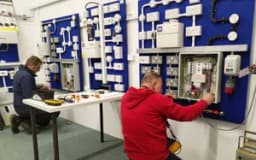
The 2391-52 course typically takes 5 days to complete. City & Guilds specifies 50 guided learning hours and a total qualification time of 67 hours for the combined award, which an intensive 5-day delivery covers with pre-course reading. At Total Skills, we deliver the course as an intensive week of classroom theory, practical workshops, and guided practice on real installations at our Nottingham training centre.
Typical course structure
- ✓Days 1–2: Theory — BS 7671 requirements, testing sequence, acceptable values, safe isolation
- ✓Days 3–4: Practical — hands-on testing on real installations, instrument familiarisation
- ✓Day 5: Assessment preparation, mock exams, written examination, and practical assessment
The exact schedule varies depending on the cohort and intake. Check the 2391 course page for current availability and dates.
How Much Does the 2391 Cost?
At Total Skills, the full 5-day 2391-52 course is £1,100 inc VAT — including all City & Guilds assessment and certification fees. Payment plans are available, with the course fee spread across instalments through Klarna.
How Total Skills compares
- ✓Total Skills: £1,100 inc VAT, 5-day intensive, Nottingham, max 9 students per cohort
- ✓GTEC (national provider): approximately £1,005 + VAT at their centres
- ✓Many providers charge £1,200 or more for equivalent 2391-52 delivery
The 2391 is among the best-value investments an electrician can make. A domestic EICR takes 2 to 4 hours and typically charges £150–£300 — so the course fee is recovered in as few as 4 to 7 jobs. Recurring landlord contracts pay for the qualification many times over in the first year.
Related Course
Inspection & Testing (2391)
View 2391 course dates, pricing, and payment plans
Why the 2391 Matters for Your Career
The 2391 is one of the most important qualifications an electrician can hold. It is the gateway to several key career capabilities and is effectively essential for anyone who wants to work independently or run their own electrical business.
What the 2391 enables you to do
- ✓Sign off your own electrical work by issuing Electrical Installation Certificates
- ✓Carry out EICRs (Electrical Installation Condition Reports) for landlords and homeowners
- ✓Join a competent person scheme (NICEIC, NAPIT) — most require the 2391 or equivalent
- ✓Self-certify notifiable work under Part P of the Building Regulations
- ✓Work independently as a self-employed electrician
- ✓Command higher day rates — inspection and testing is premium, skilled work
Without the 2391, you are limited in what you can do as an electrician. You cannot sign off your own work, you cannot carry out EICRs, and you will not be accepted by most competent person schemes. For anyone serious about a career in electrical work, the 2391 is not optional — it is essential.
Related Course
Inspection & Testing (2391)
View dates, pricing, and payment plans for our 2391 Inspection & Testing course
What Has Changed for 2026: EAS and Amendment 4
Two regulatory changes in 2026 make the 2391 more important — and more time-sensitive — than ever. If you carry out EICRs, or plan to, you need to understand both.
The EAS now requires a Level 3 inspection and testing qualification
The updated Electrotechnical Assessment Specification (EAS) — the standard that certification bodies such as NICEIC and NAPIT assess businesses against — now requires qualified supervisors and employed persons carrying out periodic inspection and testing to hold a Level 3 award in periodic inspection and testing, such as the City & Guilds 2391-52 or 2391-51. Assessors began recording non-conformances in late 2025, and the requirements become mandatory from 1 October 2026.
- ✓A Level 3 inspection and testing qualification (2391-52, 2391-51, or an accepted equivalent)
- ✓A minimum of two years’ evidence of relevant inspection and testing experience
- ✓Evidence of ongoing continuing professional development (CPD)
This shifts competence from firm level to individual level — a business can no longer rely on a single qualified supervisor to cover everyone doing EICR work. Electricians without a recognised Level 3 inspection and testing qualification risk losing the ability to carry out periodic inspection under scheme membership. If that affects you, our 5-day 2391-52 course is the most direct route to compliance — and course dates fill quickly ahead of the October deadline.
Amendment 4 to BS 7671 is now in force
Amendment 4 to BS 7671 (BS 7671:2018+A4:2026, the Orange Book) was published in April 2026 and becomes the current version of the Wiring Regulations on 15 October 2026. City & Guilds is aligning its inspection and testing assessments with Amendment 4 in the qualification documentation. If you already hold the 2382-22, your 18th Edition qualification remains valid — a one-day Amendment 4 update course leading to the 2382-26 exam is the usual route to bring it current before taking the 2391.
What to Do After Qualifying
Once you have passed the 2391, there are several steps you should take to make the most of your new qualification and start building your inspection and testing career.
Immediate next steps
- ✓Join a competent person scheme (NICEIC, NAPIT, or equivalent) to self-certify your work
- ✓Invest in calibrated test equipment — a multifunction tester is essential
- ✓Start offering EICR services to landlords, letting agents, and estate agents
- ✓Practise the full testing sequence on every job to build speed and confidence
- ✓Consider the NVQ Level 3 to complete your pathway to the JIB Gold Card
The 2391 also positions you well for specialist qualifications such as the C&G 2921 EV Charging Equipment Installation, where inspection and testing competence is essential for commissioning chargepoints.
Related Course
Inspection & Testing (2391)
Ready to get started? View our 2391 course details
Frequently Asked Questions
What is the 2391-52 qualification?
What is the difference between 2391-50, 2391-51 and 2391-52?
What are the prerequisites for the 2391?
How long does the 2391 course take?
How is the 2391 assessed?
Do I need the 2391 to carry out EICRs from October 2026?
Is the 2391 hard to pass?
Can I do EICRs without the 2391?
Can I do the 2391 online?
Does the 2391 expire? Do I need to renew it?
What happens if I fail the 2391 assessment?
Ready to Start Training?
Browse our City & Guilds accredited courses and take the next step in your electrical career.
Related Guides
EICR Explained: Electrical Installation Condition Reports
Everything about EICRs — what they are, when they are required, who can carry them out, costs, and observation codes.
Read guideEICR Codes Explained: C1, C2, C3 and FI
What the observation codes on an EICR mean, how they are classified, and what action is required for each.
Read guideElectrical Testing Sequence: Dead & Live Tests in Order
The BS 7671 testing sequence in order: dead tests (continuity, ring circuit, insulation resistance, polarity), then live tests (Zs, PFC, RCD trip times).
Read guideEIC vs EICR: What's the Difference?
A clear explanation of the difference between an Electrical Installation Certificate and an Electrical Installation Condition Report.
Read guide