The Qualification That Pays for Itself
The City & Guilds 2391-52 is the industry-standard inspection and testing qualification for electricians in the UK. It combines Initial Verification (2391-50) and Periodic Inspection and Testing (2391-51) into a single 5-day intensive course, qualifying you to inspect, test, and certify electrical installations — both new and existing.
Electricians with the 2391 can sign off Electrical Installation Condition Reports (EICRs), Initial Verification certificates, and Periodic Inspection reports. These are legally required for landlord safety compliance, property sales, insurance, and change of use — creating a consistent stream of well-paid work that doesn’t depend on new installation projects.
Who Is This Course For?
Qualified electricians adding testing to their services — If you hold the Level 3 Diploma (2365) and 18th Edition (2382), the 2391 is your next step. It opens up EICR work, which many electricians find is their most reliable income source.
Electricians pursuing their Gold Card — While not a formal Gold Card requirement, the 2391 is expected by most employers and is essential for NICEIC or NAPIT registration.
Domestic installers expanding their scope — Part P registered electricians who want to offer periodic inspection and condition reporting alongside their installation work.
Experienced electricians without formal testing qualifications — If you’ve been testing informally but need the certificate to sign off reports and satisfy compliance requirements.
What You’ll Learn
Initial Verification — How to inspect and test a new electrical installation before it’s energised, verifying compliance with BS 7671
Periodic Inspection and Testing — How to assess an existing installation’s condition, identify deterioration, and determine safety
EICR Completion — How to complete an Electrical Installation Condition Report with correct observation codes (C1, C2, C3, FI)
Testing Procedures — Continuity, insulation resistance, polarity, earth fault loop impedance, RCD testing, and prospective fault current measurement
Safe Isolation — Procedures for safely de-energising circuits before testing
Certification and Documentation — Electrical Installation Certificates, Minor Works Certificates, and Condition Reports
How the Course Works
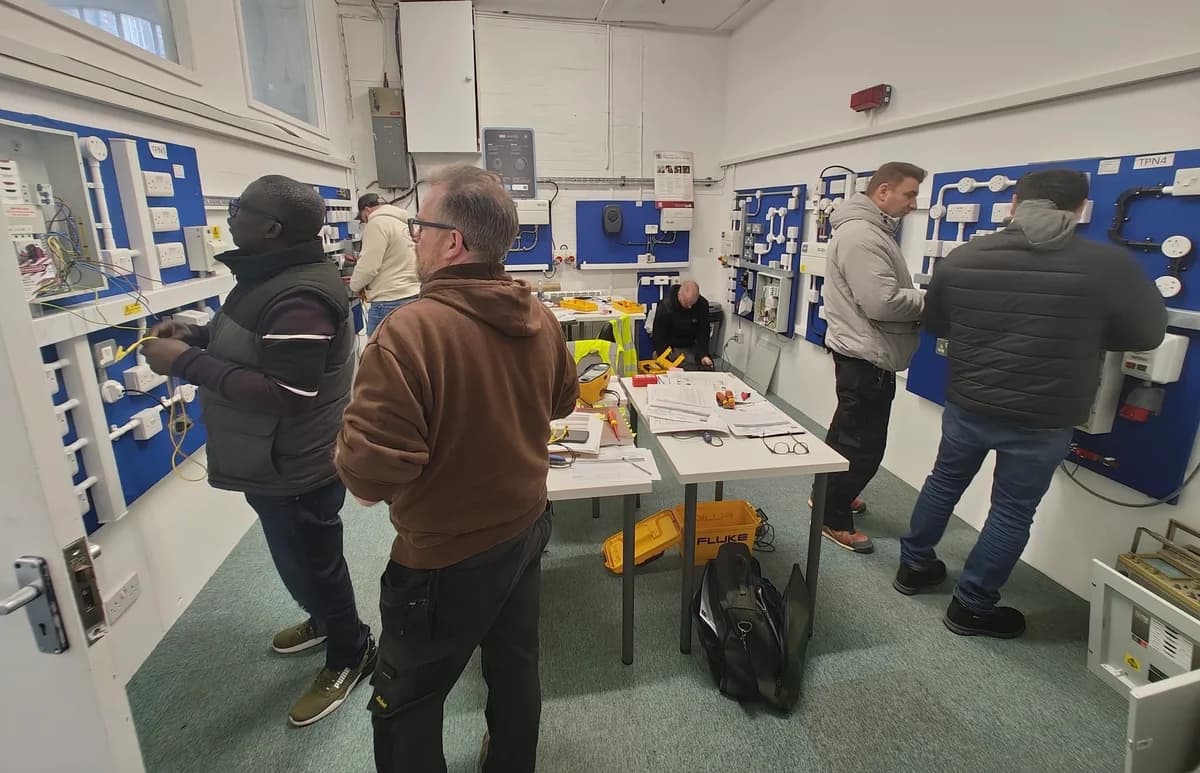
This is a 5-day intensive classroom course at our Nottingham training centre, combining theory with hands-on practical training on industry-standard Fluke testing equipment. Class sizes are capped at 9 learners — 1 trainer for groups of up to 6, and 2 trainers for groups of 7–9, ensuring you get personalised attention and plenty of time with the test equipment.
The course is structured to build your confidence progressively — starting with the theory of testing procedures, moving to hands-on practice on our training rigs, and finishing with realistic assessment scenarios. Our trainers are practising electricians with real-world experience in both domestic and commercial inspection work.
Assessment
Assessment includes both written and practical components. The practical assessment involves completing a full inspection and test on our training installations, recording results accurately, and completing the correct certification. Our 95%+ pass rate reflects the quality of training and the personalised support you receive throughout.
Earning Potential
The 2391 is one of the most commercially valuable electrical qualifications. Typical EICR rates:
Domestic EICR: £150–£300 per inspection (2–4 hours work)
HMO/Landlord EICR: £200–£400 per property
Commercial EICR: £400–£1,500+ depending on installation size
Landlords are legally required to have an EICR every 5 years for rented properties, creating consistent repeat demand. Many 2391-qualified electricians find that testing work provides their most reliable income stream.
Convenient Central Location
Our training centre in Arnold, Nottingham (NG5 7ER) is ideally positioned for electricians across the East Midlands and surrounding regions. We regularly welcome students from Derby (25 mins), Leicester (40 mins), Sheffield (50 mins), Lincoln (50 mins), Birmingham (90 mins), Mansfield (15 mins), and Chesterfield (30 mins). Free parking and easy access via the M1, A52, and A46.
ELCAS Funding
This course is eligible for ELCAS (Enhanced Learning Credits) funding for serving and former Armed Forces personnel. Total Skills is an approved ELCAS provider (Provider Number: 12999), offering up to 80% financial support.
Testing to BS 7671 Amendment 4 (the "Orange Book")
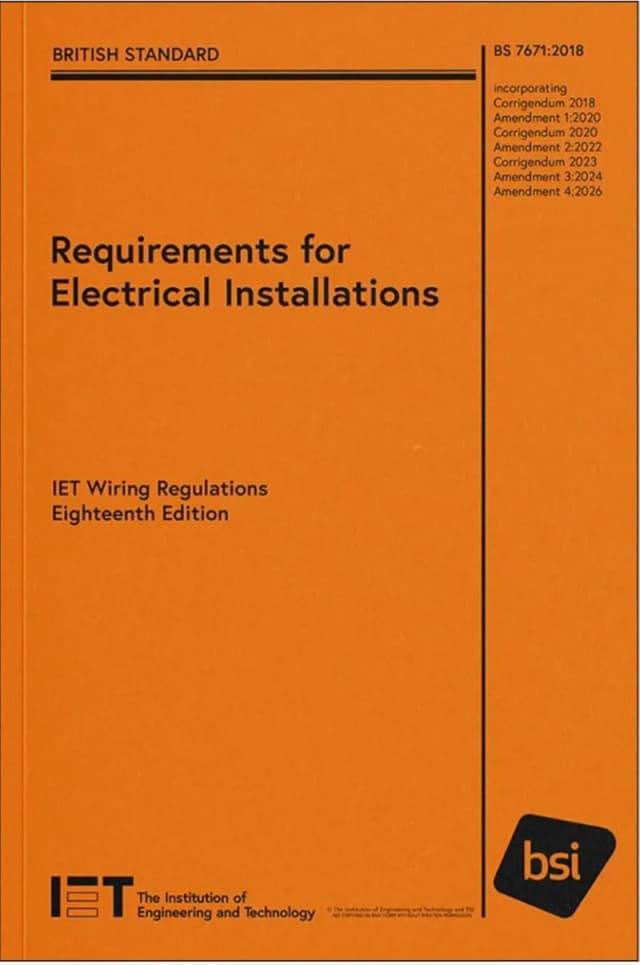
All inspection and testing now assesses compliance with the current BS 7671:2018+A4:2026 standard — the "Orange Book", Amendment 4, effective from April 2026. The 2391-52 course covers the additional test scope introduced by A4, including battery storage systems (Chapter 82), Power over Ethernet (PoE) installations, ICT equipment earthing, low-voltage generators, and the revised medical location inspection requirements. If your existing 18th Edition certificate is older (2382-18 / 2382-22), you will need to update to the current 2382-26 Orange Book standard to inspect and certify A4-compliant installations — we recommend pairing this course with our 18th Edition 2382-26 course or exam if your BS 7671 certification is not current.
EICR Demand: The Landlord Mandate
Electrical Installation Condition Reports (EICRs) have been legally required for all privately rented homes in England since 1 June 2020 under the Electrical Safety Standards in the Private Rented Sector (England) Regulations 2020. Every tenancy must have an EICR at least every 5 years, creating consistent recurring demand for 2391-qualified inspectors. Commercial premises require EICRs every 3 to 5 years depending on use; homeowners typically commission one every 10 years or at change of ownership. A typical domestic EICR takes 2 to 4 hours and commands £150 to £300, so the course fee is recovered in as few as 4 to 7 jobs.
The City & Guilds 2391-52 Level 3 Award in Initial and Periodic Inspection and Testing of Electrical Installations is regulated by Ofqual (number 603/1275/0) and supersedes the older 2395 and 2391-10/20 qualifications. Older inspection and testing certificates remain valid as evidence of competence, but employers and competent person schemes increasingly expect the current combined 2391-52 — this course covers the full 2391-52 scope, including the Amendment 4 test scope.
Certification Authority: 2391 Alone vs with NVQ / Gold Card
The 2391-52 gives you the technical competence to carry out inspections and testing. To issue EICRs independently in your own name, most schemes and customers expect you to be registered with a competent person scheme (NICEIC or NAPIT), which requires the NVQ Level 3 (2357 or the new 5357) and ECS Gold Card. Without Gold Card/scheme membership you can still carry out the inspection and testing work, but the certificate needs to be signed off by a supervising scheme-registered electrician (which is how most trainees gain on-site experience). For landlord EICRs specifically, letting agents and insurers will almost always require a scheme-registered inspector, so the full pathway (2365 + 18th Ed + 2391 + NVQ + Gold Card) is the standard — the 2391 is one critical component of that pathway.
Part of our home study electrician course pathway — while the practical element requires Nottingham attendance, much of the theoretical preparation can be done online before you arrive. For typical pricing benchmarks, see our EICR cost guide and what is an EICR guide.
Who Is the 2391 Course For?
The 2391 course is for practising electricians who already hold the 18th Edition and a Level 2/3 electrical qualification and want to inspect, test, and certify electrical installations in their own name — including issuing EICRs. Our 2391-52 inspection and testing course runs over 5 days at our Nottingham centre and costs £1,100 inc VAT, with payment plans available.
2391 Course Pass Rate and Assessment
Our 2391 inspection and testing course pass rate consistently exceeds 95%, well above the reported national first-time average for this qualification. Assessment has two parts: an online multiple-choice exam and a practical assignment carried out on a real or purpose-built installation. From 1 October 2026, the updated Electrotechnical Assessment Specification (EAS) makes a Level 3 inspection and testing qualification — such as the 2391-52 — mandatory for anyone carrying out periodic inspection and testing under a competent person scheme (NICEIC, NAPIT). See our 2391 qualification guide for the full syllabus, entry requirements, and exam format.

 JIB Preferred Provider