
EICR Cost UK 2026: £100–£300 (Prices by Property Size)
EICRs cost £100–£300 for UK homes (average £200). Prices for flats, houses, HMOs and commercial properties, what affects the cost, and how to qualify.
In this guide
How Much Does an EICR Cost?
An Electrical Installation Condition Report (EICR) is a formal inspection and test of the fixed electrical wiring in a property. The cost of an EICR depends on the size of the property, the number of circuits, and your location. For a standard domestic property, you can expect to pay between 100 and 350 pounds.
Since June 2020, landlords in England are legally required to have an EICR carried out on their rental properties at least every 5 years under the Electrical Safety Standards in the Private Rented Sector Regulations 2020. Failure to comply can result in fines of up to 30,000 pounds. Understanding the costs involved helps landlords budget for this obligation and homeowners make informed decisions about their electrical safety.
Typical EICR Costs by Property Type
The following price ranges are typical for domestic EICRs across England in 2026. Prices in London and the South East tend to be at the higher end, while the Midlands and North are generally lower.
Domestic properties
- ✓1-bed flat: 100 to 150 pounds
- ✓2-bed house: 150 to 200 pounds
- ✓3-bed house: 180 to 250 pounds
- ✓4+ bed house: 250 to 350 pounds
- ✓HMO (House in Multiple Occupation): 300 to 500 pounds
Commercial properties
Commercial EICR costs vary widely depending on the size and complexity of the installation. A small retail unit might cost 300 to 500 pounds, while a large office building or industrial unit could cost several thousand pounds. Commercial inspections often require out-of-hours access, which adds to the cost.
HMO pricing
Factors That Affect EICR Cost
Several factors influence how much an electrician will charge for an EICR. Understanding these helps you assess whether a quote is fair.
Number of circuits
The single biggest factor in EICR pricing is the number of circuits. Each circuit must be individually tested — continuity, insulation resistance, earth fault loop impedance, and RCD operation. A one-bedroom flat might have 6 to 8 circuits, while a 4-bedroom house could have 15 or more.
Age of the installation
Older installations take longer to inspect because they are more likely to have defects, non-standard wiring, and outdated consumer units. An installation that has not been inspected for 20 or 30 years will require more thorough investigation than one last tested 5 years ago.
Size and layout of the property
Larger properties have more socket outlets, light fittings, and fixed equipment to inspect. Properties with loft conversions, extensions, or outbuildings may have additional consumer units and sub-circuits that add to the inspection time.
Location
EICR prices are higher in London and the South East, reflecting higher business costs and electrician day rates. Prices in the Midlands, North, and rural areas tend to be lower.
Access issues
If the electrician cannot easily access the consumer unit, loft wiring, or certain circuits, the inspection will take longer. Painted-over consumer units, furniture blocking sockets, and inaccessible loft spaces all increase the time and cost.
Common Remedial Work Costs
If the EICR identifies C1 (danger present) or C2 (potentially dangerous) defects, remedial work is required. For landlords, this must be completed within 28 days of the inspection. The cost of remedial work is separate from the EICR fee. For a full explanation of observation codes, see our EICR codes guide.
Typical remedial costs
- ✓Consumer unit upgrade: 500 to 800 pounds
- ✓Earthing improvements: 200 to 400 pounds
- ✓Bonding upgrades: 150 to 300 pounds
- ✓Rewiring individual circuits: 300 to 600 pounds per circuit
- ✓Adding RCD protection to existing circuits: 100 to 200 pounds per circuit
- ✓Replacing damaged socket outlets or switches: 40 to 80 pounds per point
- ✓Full domestic rewire (if needed): 3,000 to 5,000 pounds for a 3-bed house
Consumer unit upgrades
Who Can Carry Out an EICR?
An EICR must be carried out by a person who is both qualified and competent. The standard qualification for inspection and testing work is the City & Guilds 2391-52 Inspection and Testing qualification. This is the industry-recognised qualification that demonstrates an electrician can inspect existing installations, identify defects, and produce compliant reports.
Qualification requirements
- ✓City & Guilds 2391-52 Inspection and Testing (or the older 2391-50/51 or 2394/2395)
- ✓Current 18th Edition qualification (C&G 2382-26)
- ✓Registration with a competent person scheme (NICEIC, NAPIT, etc.)
- ✓Calibrated test equipment (within the last 12 months)
For electricians looking to add EICR services to their business, the 2391-52 is an excellent investment. Landlord inspections provide steady, predictable income, and an unsatisfactory report often leads to follow-on remedial work.
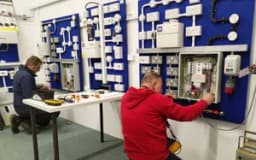
Related Course
Inspection & Testing (2391)
Get qualified to carry out EICRs with the City & Guilds 2391-52 Inspection and Testing course.
How Long Does an EICR Take?
The duration of an EICR depends on the size and complexity of the installation. The electrician needs time for both the visual inspection and the electrical testing of every circuit.
- ✓1-bed flat: approximately 2 hours
- ✓2-3 bed house: 2 to 3 hours
- ✓4+ bed house: 3 to 4 hours
- ✓HMO: 3 to 5 hours depending on size
- ✓Commercial premises: half a day to several days
The power will need to be switched off to individual circuits during testing. The electrician will work through circuits systematically, so the disruption at any one time is limited. For a full overview of the testing process, see our guide to electrical testing procedures.
Beware of very fast inspections
EICR Requirements for Landlords
Since the Electrical Safety Standards in the Private Rented Sector (England) Regulations 2020, an EICR is a legal requirement for landlords renting out residential properties in England. The key obligations are:
- ✓An EICR must be obtained before a new tenancy begins and at least every 5 years
- ✓A copy must be given to the tenant within 28 days of the inspection
- ✓A copy must be provided to the local authority within 7 days if requested
- ✓Any C1 or C2 defects must be remediated within 28 days
- ✓Fines of up to 30,000 pounds can be imposed for non-compliance
The EICR cost is a legitimate business expense for landlords and can be offset against rental income for tax purposes. For a full breakdown of landlord obligations, see our electrical safety for landlords guide and our guide to electrical certificates explained.
How to Get a Fair Price on Your EICR
While you should never choose an electrician solely on price, there are sensible ways to ensure you are paying a fair rate for your EICR.
- ✓Get at least three quotes from qualified, competent person scheme registered electricians
- ✓Ask whether the quote includes the report and any minor remedial work, or just the inspection
- ✓Check the electrician holds the 2391-52 qualification and is registered with NICEIC or NAPIT
- ✓For portfolio landlords, negotiate a bulk rate for multiple properties
- ✓Ensure the property is prepared — clear access to the consumer unit and all circuits
- ✓Combine the EICR with any planned electrical work to reduce call-out charges
Cheapest is not always best
Frequently Asked Questions
How much does an EICR cost for a 3-bed house?
Is an EICR cheaper for a flat than a house?
Does the EICR price include remedial work?
Can I claim the EICR cost against tax as a landlord?
Why do EICR prices vary so much between electricians?
How long does an EICR take?
Ready to Start Training?
Browse our City & Guilds accredited courses and take the next step in your electrical career.
Related Guides
EICR Explained: Electrical Installation Condition Reports
Everything about EICRs — what they are, when they are required, who can carry them out, costs, and observation codes.
Read guideWhat Is the City & Guilds 2391 Qualification? (2391-52 Explained)
What the City & Guilds 2391-52 inspection and testing qualification covers, who needs it, entry requirements, and how it is assessed — plus where to book the course.
Read guideEICR Codes Explained: C1, C2, C3 and FI
What the observation codes on an EICR mean, how they are classified, and what action is required for each.
Read guideElectrical Testing Sequence: Dead & Live Tests in Order
The BS 7671 testing sequence in order: dead tests (continuity, ring circuit, insulation resistance, polarity), then live tests (Zs, PFC, RCD trip times).
Read guide