
Electrician Qualifications Explained: Full UK Guide
Every UK electrical qualification explained — from entry-level diplomas to the 18th Edition, inspection and testing, and specialist certifications.
In this guide
Understanding the Qualification Landscape
To become a fully qualified electrician in the UK you need five core qualifications: the Level 2 Diploma (2365), Level 3 Diploma (2365), 18th Edition Wiring Regulations (2382), NVQ Level 3 (2357), and the AM2 practical assessment. All are awarded by City & Guilds and lead to the JIB ECS Gold Card.
The UK electrical qualification system can seem confusing at first — there are numerous course codes, acronyms, and awarding bodies. But once you understand how the qualifications fit together, the pathway becomes clear. This guide explains every qualification you are likely to encounter on your journey to becoming a fully qualified electrician.
All of the core qualifications are awarded by City & Guilds, the UK's leading vocational awarding body. They are nationally recognised and accepted by the JIB (Joint Industry Board), NICEIC, NAPIT, and all major employers in the electrical industry.
Level 2 Diploma in Electrical Installations (2365)
The Level 2 Diploma in Electrical Installations (2365) is the entry-level qualification for the electrical trade. It provides the foundation knowledge and skills that everything else builds upon.
What It Covers
- ✓Electrical science — voltage, current, resistance, power, Ohm's law
- ✓Health and safety legislation — Part P, CDM regulations, safe working practices
- ✓Wiring systems — cables, conduit, trunking, containment methods
- ✓Installation techniques — connecting accessories, installing circuits, terminations
- ✓Earthing and bonding — protective systems and their importance
- ✓Basic inspection and testing — continuity, insulation resistance, polarity
Key Details
- ✓Awarding body: City & Guilds
- ✓Course code: 2365 (Level 2)
- ✓Duration: 14-16 weeks (full-time/hybrid) or up to 6 months (part-time)
- ✓Entry requirements: none (basic maths and English literacy needed)
- ✓Assessment: written exams, practical assessments, and coursework
- ✓Equivalent to: the knowledge component of a Level 2 apprenticeship

Related Course
Level 2 Diploma (2365)
The foundation qualification — your starting point in the electrical trade.
Level 3 Diploma in Electrical Installations (2365)
The Level 3 Diploma is the advanced qualification that builds on Level 2. It covers more complex theory and practical skills, preparing you for the full range of electrical work you will encounter in your career.
What It Covers
- ✓Complex installation design and calculations — cable sizing, voltage drop, fault current
- ✓Fault diagnosis and rectification — systematic approaches to finding faults
- ✓Three-phase systems and distribution — industrial and commercial power systems
- ✓Advanced inspection and testing procedures — initial verification and periodic testing
- ✓Environmental technology systems — renewable energy principles
- ✓Electrical design — applying BS 7671 to real-world installations
Key Details
- ✓Awarding body: City & Guilds
- ✓Course code: 2365 (Level 3)
- ✓Duration: 16-20 weeks (full-time/hybrid) or up to 8 months (part-time)
- ✓Prerequisites: Level 2 Diploma (2365) or equivalent
- ✓Assessment: written exams, practical assessments, and design projects
- ✓This is significantly more challenging than Level 2 — expect to study hard

Related Course
Level 3 Diploma (2365)
The advanced diploma — complex installations, design, and fault diagnosis.
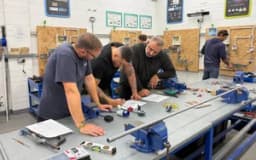
Level 2 & 3 Package
18th Edition Wiring Regulations (2382)
The 18th Edition qualification covers BS 7671: Requirements for Electrical Installations — the UK national standard that governs all electrical installation work. Every practising electrician in the UK needs this qualification. It is required for the JIB Gold Card, for NICEIC and NAPIT membership, and by virtually all employers.
What It Covers
- ✓The scope, object, and fundamental principles of BS 7671
- ✓Protection for safety — against electric shock, thermal effects, overcurrent, voltage disturbances
- ✓Selection and erection of equipment — wiring systems, protective devices, earthing arrangements
- ✓Inspection and testing requirements — initial verification and periodic inspection
- ✓Special installations — bathrooms, swimming pools, agricultural premises, construction sites
- ✓Amendment 4 (2026, the Orange Book) changes — the latest updates to the regulations
Key Details
- ✓Awarding body: City & Guilds
- ✓Course code: 2382-26
- ✓Duration: 2 days (intensive course) or up to 6 weeks (online)
- ✓Prerequisites: recommended to have Level 2 or 3 diploma, but not mandatory
- ✓Assessment: 2-hour online exam, 60 questions (open-book — you can use the BS 7671 book)
- ✓Pass mark: 60% (36 out of 60)
- ✓Must be renewed when a new edition or major amendment is published
Related Course
18th Edition (2382)
The UK wiring standard — essential for every practising electrician.
Inspection & Testing (2391-52)
The 2391 qualification proves you can carry out initial verification (testing new installations) and periodic inspection and testing (testing existing installations). This is one of the most important qualifications for practising electricians, particularly if you plan to work self-employed or carry out EICRs.
What It Covers
- ✓Safe isolation procedures — GS38 requirements, lock-off, proving dead
- ✓Continuity testing — R1+R2, protective bonding conductors
- ✓Insulation resistance testing — between live conductors and between live and earth
- ✓Earth fault loop impedance testing — Zs and Ze measurements
- ✓RCD testing — trip times, test currents, and compliance requirements
- ✓Polarity checking — correct connection of line, neutral, and earth
- ✓Completing electrical certificates — EIC, EICR, Minor Works certificates
- ✓Observation codes — C1, C2, C3, and FI classifications on EICRs
Key Details
- ✓Awarding body: City & Guilds
- ✓Course code: 2391-52 (combined initial verification and periodic inspection)
- ✓Duration: 5 days
- ✓Prerequisites: 18th Edition (2382) strongly recommended; Level 2/3 diploma
- ✓Assessment: written exam + two practical assessments (initial verification and periodic inspection)
- ✓This is widely considered the most challenging of the short courses
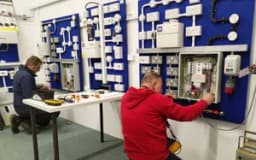
Related Course
Inspection & Testing (2391)
Essential for signing off work, self-employment, and EICR testing.
NVQ Level 3 in Electrical Installation (2357)
The NVQ is fundamentally different from the other qualifications listed above. It is not a taught course with lessons and exams — it is an on-site competence assessment based on evidence of real work. An assessor visits your workplace to observe you working, reviews your evidence portfolio (photos, test results, certificates), and conducts professional discussions about your knowledge and decision-making.
What It Assesses
- ✓Your ability to install wiring systems and equipment safely and competently
- ✓Correct application of BS 7671 on real installations
- ✓Safe isolation and testing procedures
- ✓Risk assessment and safe working practices
- ✓Quality of workmanship and attention to detail
- ✓Your understanding of why you do things, not just how
Key Details
- ✓Awarding body: City & Guilds
- ✓Course code: 2357
- ✓Duration: 6-12 months (sometimes longer)
- ✓Prerequisites: must be working on real electrical installations
- ✓Assessment: assessor visits, evidence portfolio, professional discussions
- ✓You need access to a variety of work — domestic, commercial, or industrial
- ✓This is the final qualification required for the JIB ECS Gold Card
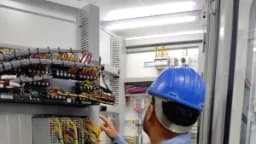
Related Course
5357 Level 3 Electrotechnical
On-site competence assessment — the final step before your Gold Card.
The AM2 Assessment
The AM2 (Achievement Measurement 2) is a practical assessment administered by NET (National Electrotechnical Training) at approved assessment centres. It is the final hurdle before you can apply for your Gold Card.
What It Involves
The AM2 is a full-day assessment where you must:
- ✓Wire a complete electrical installation from a given specification
- ✓Carry out safe isolation procedures
- ✓Complete initial verification testing
- ✓Produce an Electrical Installation Certificate (EIC)
- ✓Demonstrate competent use of tools and materials
- ✓Work to BS 7671 standards throughout
Key Details
- ✓Administered by: NET (National Electrotechnical Training)
- ✓Cost: approximately £1,200
- ✓Duration: 1 full day
- ✓Prerequisites: NVQ Level 3, 18th Edition, and Level 3 Diploma (or equivalent)
- ✓Location: NET (National Electrotechnical Training) assessment centres across the UK
- ✓Pass rate: historically around 70-75% on first attempt
AM2 Preparation
ECS Cards: The Industry Standard
ECS (Electrotechnical Certification Scheme) cards are the industry-standard identification cards for the electrical sector. They prove your qualifications and competence level. Different card types correspond to different grades:
- ✓ECS Trainee Card (white) — for those in training with no completed qualifications
- ✓ECS Provisional Card (blue) — for those with some qualifications but not yet fully qualified
- ✓ECS Electrician Card (blue) — Level 3 Diploma + 18th Edition (no NVQ yet)
- ✓ECS Installation Electrician Gold Card (gold) — NVQ Level 3 + 18th Edition + AM2 (the target)
- ✓ECS Approved Electrician Gold Card (gold) — additional competence requirements above standard Gold
- ✓ECS Inspection and Testing Card — for those specialising in testing work
The Gold Card is the one most electricians aim for. It is required on virtually every construction site in the UK and is the card that employers and clients expect to see.
Specialist Qualifications
Once you have your core qualifications (or alongside them), you can add specialist skills that open up higher-paying work:
EV Charging Installation (City & Guilds 2921)
Covers the installation of electric vehicle charging points — one of the fastest-growing specialisms. Available as 2921-34 (domestic) or 2921-32/33 (including commercial/large-scale).
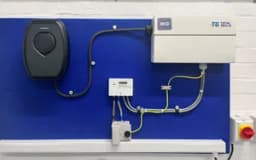
Related Course
EV Charging (2921)
Electric vehicle charger installation — a rapidly growing specialism.
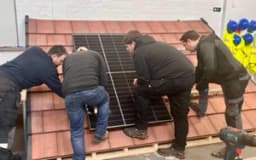
Solar PV & Battery Storage
Covers the installation and commissioning of solar photovoltaic panels and battery storage systems. Increasingly in demand as the UK pursues net zero targets.
Related Course
Solar PV & Battery Storage
Renewable energy installation — solar panels and battery storage systems.
Other Specialist Areas
- ✓Fire alarm systems (BS 5839) — design, installation, and commissioning
- ✓Emergency lighting (BS 5266) — compliance testing and certification
- ✓Data and structured cabling — network infrastructure for commercial buildings
- ✓PAT testing (City & Guilds 2377) — portable appliance testing
- ✓Electrical vehicle large-scale infrastructure (2921-32/33) — commercial charging networks
How Qualifications Fit Together
Here is the recommended order for completing your qualifications (see our Level 2 vs Level 3 comparison for more detail):
- ✓1. Level 2 Diploma (2365) — the foundation
- ✓2. Level 3 Diploma (2365) — advanced knowledge
- ✓3. 18th Edition (2382) — the wiring regulations
- ✓4. Inspection & Testing (2391) — testing competence
- ✓5. NVQ Level 3 (2357) — on-site competence (while working)
- ✓6. AM2 Assessment — practical assessment
- ✓7. ECS Gold Card application — your proof of qualification
- ✓8. Specialist qualifications (EV, solar, etc.) — add these as your career develops
Steps 3 and 4 can be completed in either order, or even concurrently with Level 3. Step 5 overlaps with paid work — you should start the NVQ as soon as you begin working on real installations. Steps 6 and 7 come at the end, after all other qualifications are complete.
Frequently Asked Questions
What qualifications do I need to be a qualified electrician?
What is the difference between the 2365 and the 2357?
Do I need the 18th Edition to work as an electrician?
Is the 2391 mandatory?
What is the AM2 assessment?
Do qualifications expire?
What are ECS cards?
Ready to Start Training?
Browse our City & Guilds accredited courses and take the next step in your electrical career.
Related Guides
How to Become an Electrician in the UK: 4 Routes Compared (2026)
Four routes to becoming a qualified electrician: apprenticeship, fast-track diploma, FE college, or experienced worker assessment. Costs from £0–£11k.
Read guideHow Much Does It Cost to Become an Electrician? (2026)
Training costs ~£8,050 (£7,750 via the L2 & L3 package, saving £300). Overall budget £9,700–£11,200 including the AM2 assessment, ECS card, and tools.
Read guideHow Much Does an Electrician Make? UK Salary Guide 2026
UK electricians make £39,039 on average (ONS 2025) — £18.38–£22.70/hr on JIB 2026 rates, £45k–£70k self-employed. Hourly, monthly, annual and London pay.
Read guideCareer Change to Electrician at 30, 40 or 50: A Realistic Guide
Honest advice for adults retraining as an electrician — no experience needed. Train part-time around your job, qualify in 18–24 months, earn £35k–45k.
Read guide