
How to Become an Electrician in the UK: 4 Routes Compared (2026)
Four routes to becoming a qualified electrician: apprenticeship, fast-track diploma, FE college, or experienced worker assessment. Costs from £0–£11k.
In this guide
Overview: The 4 Routes to Becoming an Electrician in 2026
You can become a qualified electrician in the UK through four routes: apprenticeship (3–4 years), fast-track adult diploma (18–24 months), FE college (3.5–4.5 years), or experienced worker assessment (3–6 months). No prior experience is needed for the diploma route, and all four lead to the same endpoint: the City & Guilds 2365 Level 2 and Level 3 Diplomas, an on-site competence qualification (the 2357 NVQ until it closes to new registrations on 31 October 2026, then the new 5357), the AM2 practical assessment, and your ECS Gold Card from the JIB.
How long it takes to become an electrician in the UK depends entirely on which route you choose. The fastest option for adults who want to qualify without an apprenticeship is the fast-track diploma route: 18–24 months of training centre courses followed by the on-site competence stage — until 31 October 2026 that means 6–12 months on the 2357 NVQ while working as an ECS Trainee (around 2–3 years in total); from the 2026 reform, the new 5357 portfolio requires a minimum of two years. An apprenticeship takes 3–4 years, FE college takes 3.5–4.5 years, and experienced workers with 5+ years in the trade can be assessed in as little as 3–6 months.
With strong demand, excellent earning potential, and genuine job security, the electrical trade offers a stable and well-paid career path at a manageable training cost. Here are the four TESP-endorsed routes in detail:
There are four TESP-endorsed routes (The Electrotechnical Skills Partnership) to becoming a qualified electrician in the UK. The right one depends on your age, circumstances, and how quickly you want to qualify:
- ✓Route 1: Apprenticeship — 3-4 years, employer-funded, earn while you learn
- ✓Route 2: Fast-Track Diploma Route — 18-24 months, self-funded, intensive training centre-based (this is the route Total Skills offers)
- ✓Route 3: FE College Route — 42-54 months, free or subsidised tuition, part-time study
- ✓Route 4: Experienced Worker Assessment — 3-6 months, for those already working in the trade with 5+ years of hands-on experience
Regardless of which route you take, you end up with the same nationally recognised qualifications awarded by City & Guilds. The destination is the same — only the journey differs. This guide walks you through every step in detail so you can decide whether the electrical trade is right for you.
Route 1: Apprenticeship (3-4 Years, Employer-Funded)
The apprenticeship is the traditional route into the electrical trade and remains the most common way for school leavers to become electricians. You work for an employer while studying for your qualifications, typically attending a college or training centre one day per week (or in block release).
How Apprenticeships Work
An electrical apprenticeship in England typically lasts 3 to 4 years and follows either the Installation Electrician or Maintenance Electrician pathway. The apprenticeship standard covers the Level 3 Diploma in Electrotechnical Services, the 18th Edition Wiring Regulations (BS 7671), and an End-Point Assessment (EPA) that includes the AM2 practical assessment.
During your apprenticeship, you will earn a wage. The national minimum apprentice wage applies in your first year (currently £8.00 per hour from April 2026), but many employers pay more. From year two, you must be paid at least the national minimum wage for your age group (£10.85 for 18-20 year olds, £12.71 for those 21 and over, from April 2026). The JIB (Joint Industry Board) sets recommended apprentice pay rates that are typically higher than the statutory minimum. Read our full guide to electrical apprenticeships for more detail on pay, entry requirements, and how to find one.
Entry Requirements
- ✓Minimum age: 16 (no upper age limit, though most apprentices are 16-24)
- ✓GCSEs at grade 4 or above in English and maths are typically required
- ✓No prior electrical experience necessary
- ✓You must find an employer willing to take you on as an apprentice
- ✓A genuine interest in practical, hands-on work
Pros and Cons
The biggest advantage of an apprenticeship is that you earn while you learn and your training costs are covered by the employer (often through the Apprenticeship Levy). You also gain real-world experience from day one. The downside is the time commitment — 3-4 years is a long time, and finding an employer willing to take on an apprentice can be competitive, particularly outside major cities.
Finding an Apprenticeship
How to Become an Electrician Without an Apprenticeship
You do not need an apprenticeship to become a qualified electrician in the UK. TESP recognises several routes for adult learners, and all of them lead to the same City & Guilds qualifications, the same AM2 assessment, and the same ECS Gold Card. If you are over 25, changing careers, or simply cannot find an employer willing to take on an apprentice, these are your realistic options.
Option 1: Fast-Track Diploma Route (18-24 Months)
The most popular option. You complete the Level 2 Diploma (2365) and Level 3 Diploma (2365) through intensive courses at a training centre — full-time weekdays, part-time weekends, or hybrid — then add the 18th Edition (2382) and Inspection & Testing (2391). Once you are working on site, you complete the NVQ Level 3 (the 2357 until 31 October 2026, then the new 5357) and the AM2. Budget £7,000–£11,000 in total and around 2–3 years from complete beginner to Gold Card holder.
Option 2: FE College as an Adult (3.5-4.5 Years)
Adults aged 19 and over can study the same diplomas part-time at a further education college, often funded by an Advanced Learner Loan (repayable only once you earn above £25,000 a year). It is the most affordable route but the slowest — each diploma takes a full academic year, and you still need the additional qualifications and NVQ afterwards.
Option 3: Experienced Worker Assessment (3-6 Months)
If you are already working in the trade with five or more years of hands-on experience, the Experienced Worker Assessment lets you convert that experience into formal qualifications without repeating classroom training you already know.
Why Adults Choose the Diploma Route
- ✓No need to find an employer first — you start training immediately
- ✓No formal entry requirements — no GCSEs needed for the diploma route
- ✓Faster than an apprenticeship — courses complete in 18-24 months rather than 3-4 years
- ✓Study around your current job with weekend and part-time options
- ✓Interest-free payment plans spread the cost over 12-24 months
- ✓You end up with exactly the same qualifications and Gold Card as an apprentice
You Still Need Site Experience

Related Course
Level 2 & 3 Package
The most popular route without an apprenticeship — Level 2 and Level 3 Diplomas together at a package price.
Route 2: Fast-Track Diploma Route (18-24 Months, Self-Funded)
The adult diploma route is the most popular pathway for career changers, mature learners, and anyone who wants to qualify faster than a traditional apprenticeship allows. Our diploma route guide covers this pathway in full detail. Instead of working for an employer over 3-4 years, you complete your qualifications through intensive courses at a training centre, typically within 1 to 2 years.
This route uses the same City & Guilds qualifications as the apprenticeship. You follow a structured pathway starting with the Level 2 Diploma, progressing to Level 3, then adding the 18th Edition and Inspection & Testing qualifications. Once you have workplace experience, you complete the NVQ Level 3 to qualify for your Gold Card.
Step 1: Level 2 Diploma in Electrical Installations (2365)
The Level 2 Diploma is your entry point — read our full 2365 course guide for a detailed breakdown. It covers the fundamentals of electrical science, health and safety legislation, wiring systems, installation techniques, and basic inspection and testing. This course typically takes 14 to 16 weeks with a hybrid delivery model combining online theory and practical workshop sessions. Typical 2026 cost: £1,800–£2,500 depending on the provider.
There are no formal entry requirements — you do not need GCSEs or prior experience. You should be comfortable with basic maths (fractions, percentages, simple algebra) and have a reasonable level of English.

Related Course
Level 2 Diploma (2365)
Your starting point — covers electrical science, wiring systems, and installation fundamentals.
Step 2: Level 3 Diploma in Electrical Installations (2365)
The Level 3 Diploma builds on Level 2 with more complex installation techniques, fault diagnosis and rectification, electrical design and calculations, three-phase systems, and advanced inspection and testing. This typically takes 16 to 20 weeks and costs £2,200–£3,200 in 2026 — or £3,500–£5,000 for the Level 2 and Level 3 combined package, which saves £500–£800 over booking separately. See our Level 2 vs Level 3 comparison if you are unsure which level to start at.
Level 3 is where you develop the deeper technical knowledge that separates a competent installer from someone who truly understands electrical systems. It is a challenging qualification that requires genuine study and commitment.

Related Course
Level 3 Diploma (2365)
Advanced knowledge — fault diagnosis, design calculations, and three-phase systems.
Step 3: 18th Edition Wiring Regulations (2382)
The 18th Edition (officially BS 7671: Requirements for Electrical Installations) is the UK standard that every practising electrician must understand and follow. The City & Guilds 2382 qualification proves you can interpret and apply the current wiring regulations. This is a short, intensive course typically completed in just 2 days and costing £400–£500 in 2026.
Related Course
18th Edition (2382)
The UK wiring standard — required by every practising electrician.
Step 4: Inspection & Testing (2391)
The City & Guilds 2391-52 qualification proves you can carry out initial verification of new installations and periodic inspection and testing of existing ones. This is essential for self-employment (you need it to sign off your own work) and for joining a competent person scheme like NICEIC or NAPIT. The course typically takes 5 days and costs £900–£1,300.
Related Course
Inspection & Testing (2391)
Prove you can inspect and test electrical installations to the required standard.
Step 5: NVQ Level 3 in Electrical Installation (2357)
The NVQ (National Vocational Qualification) Level 3 is an on-site competence assessment based on evidence of real electrical work. It is not a taught course — instead, an assessor visits your workplace to observe your work, review photographic evidence, and conduct professional discussions. Until 31 October 2026, this typically takes 6 to 12 months alongside paid employment via the current 2357 route. From the 2026 reform, this becomes the 5357 on-site competence portfolio — a minimum of two years, completed after your diplomas and before your AM2, working as an ECS Trainee throughout. Budget £1,400–£2,200 for the NVQ itself, plus the AM2 assessment at approximately £885 (NET recommended price from April 2026).
The NVQ is the final qualification you need before applying for your JIB ECS Gold Card. You must be working on real electrical installations to gather the required evidence, so you need to be in employment (either as an employee or self-employed) before starting.

Related Course
5357 Level 3 Electrotechnical
The final step — on-site competence assessment leading to your Gold Card.
Save with a Package Course
Related Course
Level 2 & 3 Package
Level 2 and Level 3 together at a discounted package price.
Route 3: FE College Route (42-54 Months, Free Tuition)
The further education (FE) college route is the traditional academic pathway. You study part-time at a local college — typically two to three days per week — while working or looking for employment. Colleges deliver the same City & Guilds qualifications as private training centres but spread the learning over a longer period.
How the FE College Route Works
You enrol on a Level 2 Diploma in Electrical Installations (2365) at your nearest college, which takes around one academic year (September to June). You then progress to the Level 3 Diploma, which takes another academic year. After that, you still need the 18th Edition, Inspection & Testing, and the NVQ — bringing the total to around 3.5 to 4.5 years from start to Gold Card. If that timeline feels too long, the adult diploma route compresses the same qualifications into 18-24 months.
Costs
For learners aged 16-18, FE college tuition is fully government-funded. Adults aged 19 and over may qualify for an Advanced Learner Loan, which covers the full course fee and only becomes repayable once you earn above the student loan threshold (currently £25,000 per year). Some colleges also receive Adult Education Budget funding for learners over 24.
Pros and Cons
The main advantage is cost — college tuition can be free or loan-funded, making it the most affordable route. The downside is time. At 3.5 to 4.5 years, it is significantly slower than the fast-track diploma route. You are also studying part-time alongside other students, rather than in small intensive groups, which some learners find less engaging. College availability is limited to the academic calendar, so you may wait several months for the next intake.
FE vs Fast-Track
Route 4: Experienced Worker Assessment (3-6 Months, Experience Required)
The Experienced Worker Assessment is a fast-track route for people who are already working in the electrical trade but lack formal qualifications. If you have been doing electrical work for five or more years — wiring, installing, testing, or working alongside a qualified electrician — the EWA allows you to gain your qualifications without sitting through weeks of classroom training on material you already know.
How the EWA Works
Rather than starting from scratch, the EWA recognises your existing skills and experience. Read our dedicated experienced worker route guide for full details. Assessment is through a combination of practical observation, professional discussion, and evidence of your previous work. Your assessor identifies any gaps in your knowledge and provides targeted support, rather than requiring you to study everything from the beginning.
The EWA can be completed in as little as 3 to 6 months, depending on your existing competence, and the assessment programme typically costs £1,500–£2,500. You receive exactly the same City & Guilds 2365 Level 2 Diploma — there is no difference on the certificate.
Who Is It For?
- ✓Electricians who have been working without formal qualifications for 5+ years
- ✓People who learned on the job rather than through formal training
- ✓Those who need formal recognition for Part P, insurance, or career progression
- ✓Workers who want to progress to Level 3 and beyond but need the Level 2 foundation first
Important
What Does a Training Day Look Like?
If you are considering the fast-track diploma route, you are probably wondering what the actual training experience involves. For a broader look at life in the trade, see our day in the life of an electrician guide. Here is a realistic picture of a typical day at a training centre like Total Skills.
Morning: Theory and Electrical Science (9:00am – 12:30pm)
The morning session focuses on the technical knowledge that underpins everything you will do as an electrician. Your trainer — a qualified electrician with years of industry experience — works through the theory in a classroom setting with a small group of learners, typically 8 to 16 people.
Topics vary depending on where you are in the course. In Level 2, you cover electrical science fundamentals (Ohm's law, resistivity, power calculations), health and safety legislation, wiring systems and enclosures, and the principles of inspection and testing. In Level 3, the theory becomes more advanced — fault diagnosis, three-phase systems, electrical design, and complex calculations.
The teaching style is practical and example-driven. Your trainer draws on real installations and genuine scenarios rather than abstract textbook exercises. Questions are encouraged throughout — this is not a lecture hall.
Afternoon: Practical Workshop (1:30pm – 5:00pm)
The afternoon is where theory becomes practice. You work in a purpose-built electrical workshop fitted with real consumer units, distribution boards, lighting circuits, power circuits, and testing equipment. Each learner has their own workstation and a full set of tools and materials.
Practical exercises follow the morning's theory. If you studied ring final circuits in the morning, you wire one in the afternoon. If you learned about RCD protection, you install and test RCDs. By the end of each day, you have both the theoretical understanding and the hands-on skill.
Your trainer circulates the workshop, checking your work, demonstrating techniques, and offering one-to-one guidance. The small class sizes mean you get genuine individual attention — a significant advantage over larger FE college classes.
Assessment and Progression
Throughout the course, you complete a combination of online assessments (multiple choice and short answer) and practical assignments. These are marked by your assessor and contribute to your City & Guilds portfolio. The final exam for each unit is an invigilated City & Guilds assessment — either online or paper-based depending on the qualification.
Flexible Delivery Options
- ✓Full-time weekday courses (Monday to Friday, fastest completion)
- ✓Part-time weekend courses (ideal if you are still working in your current job)
- ✓Hybrid delivery — online theory study combined with intensive practical blocks
Most career changers opt for the weekend or part-time route so they can continue earning while they train. This extends the timeline slightly but means you do not need to give up your income during training.
What to Bring
The JIB Gold Card: Your End Goal
Regardless of which route you take, your ultimate goal is the JIB ECS Gold Card — the Electrotechnical Certification Scheme card issued by the Joint Industry Board. This is the industry-standard proof that you are a fully qualified electrician. It is required on virtually every construction site in the UK and is the benchmark that employers, clients, and competent person schemes look for.
Requirements for the Gold Card
To apply for the JIB ECS Installation Electrician Gold Card, you need:
- ✓NVQ Level 3 in Electrical Installation (City & Guilds 2357, or the new 5357 from the 2026 reform)
- ✓Current 18th Edition qualification (City & Guilds 2382)
- ✓AM2 assessment — a practical assessment of your installation skills (approximately £885 + VAT, NET recommended price from April 2026)
- ✓Valid first aid certificate (Emergency First Aid at Work)
- ✓Health and Safety Assessment (CSCS touch-screen test)
The Gold Card is typically valid for three years and must be renewed. Renewal requires a current 18th Edition certificate, so when the wiring regulations are updated, you will need to complete the new edition to maintain your card.
What Qualifications Do You Need?
Here is a summary of every qualification on the pathway to becoming a fully qualified electrician, in the order you should complete them:
Core Qualifications
- ✓Level 2 Diploma in Electrical Installations (City & Guilds 2365) — foundation knowledge and skills
- ✓Level 3 Diploma in Electrical Installations (City & Guilds 2365) — advanced theory and practice
- ✓18th Edition Wiring Regulations (City & Guilds 2382) — the current BS 7671 standard
- ✓Inspection & Testing (City & Guilds 2391-52) — proving you can inspect and test installations
- ✓NVQ Level 3 in Electrical Installation (City & Guilds 2357 — closing to new registrations on 31 October 2026, replaced by the new 5357) — on-site competence assessment
- ✓AM2 Assessment — practical installation skills test for JIB Gold Card
Optional Specialist Qualifications
Once you are qualified, you can add specialist skills to increase your earning potential:
- ✓EV Charging Installation (City & Guilds 2921) — electric vehicle charger installation
- ✓Solar PV & Battery Storage — renewable energy installation
- ✓Fire Alarm Systems — BS 5839 design, installation, and commissioning
- ✓Data and Structured Cabling — network infrastructure installation
- ✓Emergency Lighting — BS 5266 compliance and testing
Costs: What to Budget For in 2026
The cost of becoming an electrician varies significantly depending on your route. Here is a realistic breakdown for 2026:
Route Comparison at a Glance
| Route | Training Cost | Duration | Earn While Training? |
|---|---|---|---|
| Apprenticeship | £0 (employer-funded) | 3-4 years | Yes — £8.00+/hr |
| Fast-Track Diploma | £7,000-£11,000 | 2-3 years total | No (during courses) |
| FE College | £0-£5,000 | 3.5-4.5 years | Part-time possible |
| Experienced Worker | £1,500-£7,500 | 3-18 months | Yes (already working) |
Source: Training costs based on 2026 published prices from City & Guilds approved centres. Apprentice wage from GOV.UK National Minimum Wage rates effective April 2026.
Apprenticeship Costs (Route 1)
£0 for training. Your employer covers all course fees, usually through the Apprenticeship Levy. You will need basic tools and PPE (around £300-£500), though many employers provide these. You also earn a wage throughout — starting at £8.00/hr from April 2026.
Fast-Track Diploma Costs (Route 2)
The fast-track diploma route requires you to fund your own training. Typical 2026 costs are:
- ✓Level 2 Diploma (2365): £1,800 - £2,500
- ✓Level 3 Diploma (2365): £2,200 - £3,200
- ✓Level 2 & 3 Package (saves £500-£800): £3,500 - £5,000
- ✓18th Edition (2382): £400 - £500
- ✓Inspection & Testing (2391): £900 - £1,300
- ✓NVQ Level 3 (2357): £1,400 - £2,200
- ✓AM2 Assessment: approximately £885 + VAT (NET recommended price from April 2026)
- ✓ECS Gold Card application: £47.50 + VAT initial / £38.50 + VAT renewal (free on completion of a JIB-registered apprenticeship)
- ✓Tools and test equipment: £500 - £1,500
In total, you should budget approximately £7,000 to £11,000 for the complete pathway from beginner to Gold Card holder. Enrolling on the Level 2 & 3 Package is the most cost-effective option, and most training providers offer interest-free payment plans spreading the cost over 12-24 months. See our guide to funding electrician training for all available options.
FE College Costs (Route 3)
Free for 16-18 year olds. Adults aged 19+ may qualify for an Advanced Learner Loan (repayable only above £25,000 earnings). You still need to fund the 18th Edition, 2391, NVQ, and AM2 privately — budget around £3,500-£5,000 for those additional qualifications on top of the free college tuition.
Experienced Worker Assessment Costs (Route 4)
The EWA itself typically costs £1,500 - £2,500 for the assessment programme. You will still need the remaining qualifications (18th Edition, 2391, NVQ, AM2) if you do not already hold them — budget an additional £3,500-£5,000.
Funding Options
Related Course
Level 2 & 3 Package
Save with the Level 2 & 3 Package — the most popular and cost-effective option for career changers.
Timelines: How Long Does Each Route Take?
Realistic timelines for each route from complete beginner to fully qualified electrician — see our detailed how long to become an electrician guide for more — with a JIB Gold Card:
Route 1: Apprenticeship
3 to 4 years from start to finish, including your End-Point Assessment. This is the longest route but you are earning and gaining experience throughout.
Route 2: Fast-Track Diploma
18 to 24 months for all courses (Level 2, Level 3, 18th Edition, 2391), plus — until 31 October 2026 — 6 to 12 months for the NVQ and AM2 while working, for a total of approximately 2 to 3 years from complete beginner to Gold Card holder. From the 2026 reform, the on-site competence stage (the new 5357) needs a minimum of two years before your AM2, working as an ECS Trainee throughout. This is the fastest route for career changers.
Diploma Route: Month-by-Month Breakdown
Here is a realistic month-by-month timeline if you follow the fast-track diploma route full-time:
Foundation electrical science, wiring systems, health & safety. 14–16 weeks of theory and practical.
Advanced fault diagnosis, three-phase systems, design calculations. 16–20 weeks intensive.
2-day intensive course on BS 7671 wiring regulations. Online exam.
5-day course plus revision and exam. You can now inspect and certify installations.
Find employment as a qualified installer. Your NVQ assessor visits your workplace to observe and review evidence.
Finish your NVQ portfolio, pass the AM2 practical assessment (~£885), and apply for your JIB ECS Gold Card.
Part-time or weekend study extends this timeline to approximately 24–30 months for the course work, plus — until 31 October 2026 — the same 6–12 months for the NVQ. From the 2026 reform, the on-site competence stage requires a minimum of two years instead.
Route 3: FE College
42 to 54 months (3.5 to 4.5 years) from start to Gold Card. The Level 2 and Level 3 Diplomas each take a full academic year, and you still need the additional qualifications and NVQ afterwards. Similar in length to an apprenticeship but without the guaranteed employment.
Route 4: Experienced Worker Assessment
3 to 6 months for the initial assessment if you already have the practical experience. You can then progress through the remaining qualifications at a similar pace to the diploma route — until 31 October 2026, expect 12 to 18 months total to reach Gold Card level. From the 2026 reform, the on-site competence portfolio becomes a minimum of two years, so this route takes longer too.
After Qualifying: Industry Registration
Once you hold your Gold Card, the next step for most electricians — especially those planning to work domestically or go self-employed — is joining a competent person scheme. These schemes allow you to self-certify your electrical work under Part P of the Building Regulations without involving your local council's building control department.
Part P Building Regulations
Part P requires that most electrical work in domestic properties is either carried out by a registered competent person or notified to building control. Without scheme membership, you or your customer must pay for a building control inspection on every notifiable job — adding cost, delay, and inconvenience. Joining a scheme removes this requirement.
NICEIC (National Inspection Council for Electrical Installation Contracting)
NICEIC is the largest and most widely recognised scheme in the UK, with over 40,000 registered contractors. Membership costs approximately £500–£600 per year (Domestic Installer scheme). To join, you need a qualifying supervisor who holds the 18th Edition, 2391, and NVQ Level 3. NICEIC conducts an initial assessment of your premises and a sample of your work, then annual inspections thereafter.
NAPIT (National Association of Professional Inspectors and Testers)
NAPIT is the second-largest scheme and is generally considered slightly more affordable than NICEIC. Annual membership costs approximately £400–£500. The qualification requirements are the same. NAPIT also offers multi-discipline registration covering gas, plumbing, and ventilation alongside electrical work — useful if you plan to diversify.
What About ELECSA?
ELECSA was a third scheme operated by Certsure (which also runs NICEIC), but the brand was retired — from 2021 all ELECSA members were transferred to NICEIC. You may still see the ELECSA name on older certificates and vans, but it no longer accepts registrations. In practice the choice today is between NICEIC and NAPIT.
Which Scheme Should You Choose?
Both schemes carry equal legal weight — there is no practical difference in what you can self-certify. Read our NICEIC vs NAPIT comparison for a detailed breakdown. The choice often comes down to cost, brand recognition in your area, and personal preference. NICEIC has the strongest consumer brand (customers sometimes specifically ask for “NICEIC-approved” electricians), but NAPIT is a perfectly valid alternative.
- ✓NICEIC — strongest brand recognition, slightly higher fees, largest network
- ✓NAPIT — competitive pricing, multi-discipline options, growing reputation
When to Register
Career Prospects and Earning Potential
The UK has a well-documented shortage of qualified electricians. An estimated 15,000 electricians retire each year, while only around 5,000 new ones qualify (source: Electrical Contractors' Association industry report, 2024). This supply gap means job security is excellent and wages remain strong.
Typical Earnings
- ✓Apprentice: £14,000 - £18,000 per year (rising each year)
- ✓Newly qualified: £28,000 - £33,000 per year
- ✓Experienced (5+ years): £35,000 - £45,000 per year
- ✓Senior/specialist: £45,000 - £55,000+ per year
- ✓Self-employed day rates: £250 - £400 per day
Location matters significantly. Electricians in London and the South East typically earn 20-30% more than the national average. Specialist skills like EV charging, solar PV, and data centre work command premium rates. For a full breakdown, see our electrician salary guide.
Source: Salary data from ONS Annual Survey of Hours and Earnings 2024/25 and JIB National Working Rules 2025.
Career Paths
Once qualified, you have numerous career options:
- ✓Domestic electrician — rewires, consumer units, extensions, new builds
- ✓Commercial electrician — offices, retail, hospitals, schools
- ✓Industrial electrician — factories, power stations, heavy industry
- ✓Self-employed contractor — set your own rates and choose your work
- ✓Specialist installer — EV charging, solar PV, fire alarms, data cabling
- ✓Testing and inspection — EICRs and periodic testing (lucrative day rates)
- ✓Site supervisor or project manager — leading teams on larger projects
- ✓Training and assessment — teaching the next generation of electricians
What Skills Do You Need?
You do not need to be a genius or have a background in science to become an electrician, but certain skills and attributes will serve you well:
- ✓Basic maths — you will need to work with fractions, percentages, and simple algebra for electrical calculations
- ✓Problem-solving ability — fault finding and diagnosis require logical thinking
- ✓Good hand-eye coordination — practical installation work demands dexterity
- ✓Attention to detail — electrical work must be precise and safe
- ✓Physical fitness — the job involves working in confined spaces, lifting, and standing for extended periods
- ✓Customer service skills — especially if you plan to work domestically or go self-employed
- ✓Willingness to keep learning — regulations change and technology evolves
Getting Started: Your Next Steps
If you have read this far and you are seriously considering a career as an electrician, here is what to do next:
If You Are a School Leaver (16-18)
Look into apprenticeships or the FE college route. Search the GOV.UK Find an Apprenticeship service, contact local electrical contractors, and speak to your school careers advisor. An apprenticeship gives you the best start with no debt and real experience from day one.
If You Are an Adult Career Changer (25-55)
The fast-track diploma route is almost certainly your best option. Start with the Level 2 Diploma (or the Level 2 & 3 Package if you are committed). Look into payment plans and ELCAS funding if applicable. Worried about your age? Read our guide on becoming an electrician at 40 — it is never too late.
If You Already Have Electrical Experience
Consider the Experienced Worker Assessment. If you have been doing electrical work for five or more years, there is no point sitting through months of classroom training on material you already know. The EWA gets you qualified faster so you can progress through the rest of the pathway.
Related Course
Level 2 & 3 Package
The most popular option for career changers — Level 2 and Level 3 together at a package price with interest-free payment plans available.
See the Training Centre
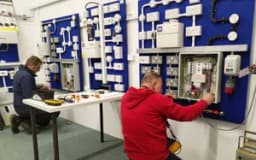
Curious what the workshop actually looks like? Here's a look inside our Nottingham training centre, where every stage of this pathway is taught hands-on.
Related Guides
Career Change to Electrician at 30, 40 or 50: A Realistic Guide
Honest advice for adults retraining as an electrician — no experience needed. Train part-time around your job, qualify in 18–24 months, earn £35k–45k.
Read guideFast-Track Electrician Course: Qualified in 18–24 Months
Fast-track electrical courses explained: the same City & Guilds qualifications as a 4-year apprenticeship in 18–24 months. Online theory, intensive practicals.
Read guidePart-Time Electrician Course: How to Train Around Your Job (2026)
Become an electrician part-time — study theory online in evenings, attend practical workshops on weekdays or weekends. Same City & Guilds qualification.
Read guideElectrician Course Online: What You Can Study From Home
Online electrician courses let you study theory from home, but practical skills need hands-on training. Our online-plus-workshop model gets you qualified.
Read guideFrequently Asked Questions
How do I become an electrician in the UK?
Can I become an electrician without an apprenticeship?
Can I become an electrician at 30, 40, or 50?
How long does it take to become an electrician without an apprenticeship?
How much does it cost to become a fully qualified electrician in 2026?
How long does it take to become a qualified electrician?
Do I need GCSEs to become an electrician?
Can I train to be an electrician online?
What is the difference between the diploma route and an apprenticeship?
What is a JIB Gold Card and do I need one?
What are the 4 routes to becoming an electrician?
Can women become electricians?
Ready to Start Training?
Browse our City & Guilds accredited courses and take the next step in your electrical career.