
Competent Person Schemes for Electricians: Full Guide
What competent person schemes are, why you need one, the main providers, and the qualification requirements.
In this guide
What Is a Competent Person Scheme?
A competent person scheme (CPS) is a government-approved registration scheme that allows members to self-certify that their work complies with building regulations. For electricians, this means being able to sign off notifiable electrical work under Part P of the Building Regulations without needing to involve the local authority building control department.
Quick Answer: What Is a Competent Person Scheme Electrical Certificate?
A competent person scheme electrical certificate is the proof that notifiable electrical work in a home complies with Part P of the Building Regulations. When a registered electrician completes a notifiable job, they issue an Electrical Installation Certificate and their scheme issues a Building Regulations Compliance Certificate to the homeowner — no separate building control visit is needed.
The concept was introduced as part of the Building Regulations framework to provide a practical route for competent tradespeople to certify their own notifiable electrical work. Without scheme membership, any notifiable work requires a separate building control application, inspection, and fee, which adds cost and delay for both the electrician and the customer. To understand how this relates to Part P Building Regulations, see our dedicated guide.
For self-employed electricians and small electrical businesses, joining a competent person scheme is one of the most important business steps after gaining your qualifications. See our guide to registering as an electrician for the full business setup process. It allows you to operate professionally, compete effectively for domestic work, and provide customers with the certification they need.
How a Competent Person Scheme Works
The competent person scheme process works as follows. When you complete a notifiable electrical installation, you test and inspect the work in accordance with BS 7671, issue the appropriate electrical certificate (EIC or Minor Works), and then notify the local authority through your scheme. The scheme issues a Building Regulations Compliance Certificate on your behalf. The homeowner and the local authority each receive a copy.
This notification process is typically done electronically through the scheme's online portal. You log into your account, enter the job details, upload or record the certificate information, and the notification is processed automatically. There is no need for building control to visit the property.
Benefits of Scheme Membership
- ✓Self-certify notifiable Part P work without building control involvement
- ✓Faster completion of jobs with no building control waiting times
- ✓Lower cost for customers (no building control fee of 250 to 500 pounds)
- ✓Professional credibility and listing on the scheme directory
- ✓Annual assessment keeps your work to a high standard
- ✓Marketing benefits from using the scheme logo and Find a Contractor directories
Main Competent Person Scheme Providers
There are several government-approved competent person schemes for electrical work in England and Wales. The main names you will encounter are:
NICEIC
The National Inspection Council for Electrical Installation Contracting is the oldest and largest scheme, established in 1956. For a detailed comparison, see our NICEIC vs NAPIT guide. Managed by Certsure, NICEIC has strong brand recognition among both the trade and the general public. It offers Domestic Installer and Approved Contractor registration levels. Annual fees for Domestic Installer registration are typically 500 to 700 pounds.
NAPIT
The National Association of Professional Inspectors and Testers is a growing scheme that has attracted many members with competitive pricing and good customer service. NAPIT offers domestic and full-scope registration. Annual fees for domestic registration are typically 400 to 600 pounds, making it one of the more affordable options.
ELECSA (retired brand)
ELECSA was a government-approved scheme also operated by Certsure, but the brand was retired — from April 2021 ELECSA members were transferred to NICEIC, with the transition completed by late 2022. If you held an ELECSA registration, you are now registered with NICEIC. You may still see the ELECSA name on older certificates and vans.
Certsure
Certsure is the organisation that manages the NICEIC scheme. It is a joint venture between the Electrical Contractors Association (ECA) and the Institution of Engineering and Technology (IET). While the brand name NICEIC is more commonly used, Certsure is the parent organisation.
Competent Person Scheme Comparison at a Glance
The table below compares the main competent person schemes for domestic electrical work. All schemes assess applicants against the same EAS requirements, so the practical differences come down to cost, brand recognition, and customer service.
| Scheme | Operator | Registration Levels | Typical Annual Fee (Domestic) |
|---|---|---|---|
| NICEIC | Certsure | Domestic Installer, Approved Contractor | £500 to £700 |
| NAPIT | NAPIT Registration | Domestic Installer, full-scope | £400 to £600 |
| ELECSA | Certsure | Brand retired — members moved to NICEIC | N/A |
| Other operators | APHC, BESCA and others | Domestic and full-scope | Varies |
Fees shown are approximate annual figures for domestic registration and typically exclude VAT and initial assessment fees. Check each scheme's website for current pricing.
For a detailed head-to-head on the two most popular schemes — including assessment style, pricing tiers, and which suits different types of business — see our NICEIC vs NAPIT comparison.
Competent Person Scheme Qualification Requirements
All competent person schemes follow the Electrotechnical Assessment Specification (EAS), published by the IET and managed by TESP. The EAS defines the minimum competence requirements for individuals and enterprises to self-certify electrical work. There are no shortcuts — since September 2021, short courses and certificates of competence are no longer accepted by any scheme.
Required Qualifications (Standard Adult Learner Route)
- ✓Level 2 Diploma in Electrical Installations (City & Guilds 2365) — foundational electrical theory
- ✓Level 3 Diploma in Electrical Installations (City & Guilds 2365) — advanced electrical theory
- ✓NVQ Level 3 in Electrical Installation (City & Guilds 2357) plus the AM2 practical assessment — proves on-site competence
- ✓Current 18th Edition Wiring Regulations certificate (City & Guilds 2382)
- ✓Inspection and Testing qualification (City & Guilds 2391)
The only alternative for people already working in the trade is the Experienced Worker Assessment (EWA) route, which requires a minimum of 3 to 5 years of documented electrical industry experience, a Level 2 qualification, plus 18th Edition, 2391, and the AM2E practical assessment. All work must comply with the current 18th Edition wiring regulations. The EWA is not a shortcut — it assesses experienced workers to the same industry standard.

Related Course
Level 2 Diploma (2365)
The Level 2 Diploma is the essential first step — you cannot progress without it.
Related Course
18th Edition (2382)
The 18th Edition is a mandatory requirement for all competent person schemes.
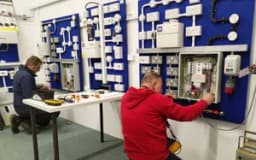
Related Course
Inspection & Testing (2391)
You cannot join a scheme without the 2391 Inspection and Testing qualification.
Other Requirements
- ✓Public liability insurance (minimum 2 million pounds, some schemes require 5 million)
- ✓Calibrated test equipment within its calibration date
- ✓A business address (even if working from home)
- ✓Evidence of recent electrical work and certification
Keeping Qualifications Current
Your qualifications must remain current throughout your scheme membership. If the Wiring Regulations are updated and a new edition is published, you will need to obtain the updated qualification within the timeframe specified by your scheme to maintain your registration.
How to Join a Competent Person Scheme
The joining process is broadly similar across all schemes. Here is what to expect when applying.
Application Steps
- ✓Choose your scheme based on cost, reputation, and your business needs
- ✓Complete the online application form with your personal and business details
- ✓Provide copies of your qualifications and insurance documents
- ✓Pay the initial assessment fee and first year membership fee
- ✓An assessor is assigned and contacts you to arrange a visit
- ✓The assessor visits your premises and assesses your competence
- ✓If successful, your registration is confirmed and you receive your certificate
- ✓You can immediately begin self-certifying notifiable work
The Initial Assessment
The initial assessment is the most important step in the joining process. A qualified assessor will visit you to evaluate your competence. They will typically check your qualifications, review your test instruments, examine certificates you have issued, and may ask you technical questions about installation practices and BS 7671 requirements. Some schemes may also require you to demonstrate practical skills or inspect a recent installation.
The assessment is thorough but not unreasonably difficult for a competent electrician. The assessor is looking for evidence that you understand the regulations, test properly, certify correctly, and work to a professional standard.
Your Ongoing Competent Person Scheme Obligations
Scheme membership comes with ongoing obligations that you must maintain throughout your registration.
- ✓Annual assessment visit: a scheme assessor reviews your work each year
- ✓Maintain current qualifications: update when regulations change
- ✓Keep test equipment calibrated: instruments must be within their calibration date
- ✓Maintain public liability insurance: provide proof at each annual assessment
- ✓Notify all Part P work through the scheme portal: every notifiable job must be recorded
- ✓Issue proper certificates: EICs and Minor Works certificates as appropriate
- ✓Pay annual registration fees on time
Common Reasons for Losing Registration
The most common reasons for losing your scheme registration are: failing to attend or pass an annual assessment, letting your qualifications or insurance lapse, persistent poor quality work identified during assessments, or failing to notify jobs through the scheme. All of these are easily avoidable with proper planning.
Is Joining a Competent Person Scheme Worth the Cost?
The annual cost of scheme membership — typically 400 to 700 pounds — may seem like a significant expense, especially for a new business. However, the financial case for membership is strong when you consider the alternative.
Without scheme membership, every notifiable job requires a building control application at a cost of 250 to 500 pounds to the homeowner. This either comes out of the customer's pocket (making your quote less competitive) or out of your own margin. After just one or two notifiable jobs per year, the scheme membership has paid for itself.
Beyond the direct cost comparison, scheme membership provides marketing benefits through the contractor directory, professional credibility through the scheme logo, and the discipline of annual assessments that keeps your work to a high standard. Most successful self-employed electricians consider scheme membership an essential business expense.
Frequently Asked Questions
Do I legally need to join a competent person scheme?
What qualifications do I need to join a competent person scheme?
How long does the application process take?
Can I self-certify commercial work through a competent person scheme?
What happens if I fail the initial assessment?
Ready to Start Training?
Browse our City & Guilds accredited courses and take the next step in your electrical career.
Related Guides
JIB Preferred Provider: What It Means & Why It Matters (2026)
JIB Preferred Provider is a recognised upgrade over JIB Approved Centre. What the status means and why it matters for your ECS Gold Card application.
Read guideECS Card Types, Costs & How to Apply (2026 Guide)
Every ECS card type explained — Trainee, Registered, Gold, Labourer and more. Requirements, costs (~£36), colours, and how to apply for each card in 2026.
Read guideECS Gold Card Requirements: Full Qualification Checklist (2026)
ECS Gold Card requires NVQ Level 3 (or Experienced Worker Assessment), current BS 7671 18th Edition, and ECS Health & Safety Assessment. Full checklist.
Read guideECS Health & Safety Test: Free Practice Questions & Revision
ECS HSE practice quiz with all 327 official revision questions. Free topic-by-topic study, instant feedback, timed mock exams, and progress tracking.
Read guide