
Becoming an Electrician at 40: A Realistic Guide (2026)
Can you become an electrician at 40? Absolutely. The realistic timeline, costs, and steps — while juggling a mortgage, family, and career change.
In this guide
Yes, You Can Become an Electrician at 40
If you are reading this at 40 (or 38, or 45) and wondering whether it is realistic to retrain as an electrician, the short answer is yes, and you are in good company. The average age of career changers entering the electrical trade at training centres like Total Skills is between 36 and 41. You are not the exception — you are the typical student.
The UK Trade Skills Index estimates 104,000 additional electricians are needed by 2032 — the largest gap of any trade. The Electrotechnical Skills Partnership (TESP) has set out plans for around 12,000 new electrical apprentices a year to begin closing that gap. The trade does not just welcome career changers — it depends on them.
This guide is not about reassurance for the sake of it. It is a practical, honest walkthrough of what it actually takes to become an electrician at 40 — the real costs when you have a mortgage, the realistic timeline while you are still working, and how to manage the financial transition without burning through your savings.
Why 40 Is Actually a Great Time to Retrain
At 40, you are not starting from scratch — you are starting from a position of strength. Here is why your age is an advantage, not a barrier:
- ✓You have likely built savings or equity that allow you to self-fund training without relying on government grants (which do not cover these courses anyway)
- ✓Maturity and reliability make you more attractive to employers than an 18-year-old with no work history
- ✓Your transferable skills — project management, customer service, problem solving, time management — give you a genuine head start in the trade
- ✓You have 25 to 27 years of working life ahead — longer than many people spend in their first career
- ✓Electrician demand is growing faster than supply, driven by EV charging, solar PV, smart homes, and data centres
- ✓Green skills like EV charging and solar installation are brand new — everyone starts at the same level, regardless of age
The people who struggle in career changes are not those who start at 40. They are those who spend years thinking about it without acting. Every month you delay is a month of higher earnings you are giving up.
The Honest Costs (When You Have Got a Mortgage)
Let us talk about money, because at 40 you cannot pretend it does not matter. You likely have a mortgage, bills, possibly a family depending on your income. Here is what the full training pathway actually costs:
Training Costs
- ✓Level 2 & 3 Diploma Package: the most cost-effective starting point — bundling both levels saves compared to booking separately
- ✓NVQ Level 3 (2357): required for Gold Card — completed while working, so you are earning at the same time
- ✓18th Edition (2382): typically included or a short add-on course
- ✓2391 Inspection & Testing: adds a valuable specialism
- ✓AM2 Assessment: approximately £885 + VAT — the final practical assessment
- ✓Tools and PPE: approximately £500-£1,000 for a starter kit (drill, multimeter, hand tools, PPE)
Funding reality
These courses cannot be government funded. There is no adult learner loan or Skills Bootcamp for City & Guilds electrical diplomas. However, Total Skills offers payment plans to spread the cost, and ELCAS funding is available for military veterans (up to £2,000 per claim). For everyone else, this is a self-funded investment — and one that pays for itself within your first year of qualified work.

Related Course
Level 2 & 3 Package
The Level 2 & 3 Package is the most popular choice for career changers — bundling saves money.
The real total
Budget approximately £6,000 to £10,000 for the complete pathway from beginner to Gold Card, including all courses, assessments, tools, and exam fees. That sounds significant — but compare it to a university degree at £27,000+ in tuition alone, or the cost of staying in a career that underpays you for the next 25 years.
The Realistic Timeline (While Still Working)
You do not need to quit your job on day one. Here is how the timeline typically works for a 40-year-old career changer:
Months 1-8: Level 2 & 3 Diploma (2365)
The taught qualification phase. Level 2 covers electrical science, wiring, and installation basics over 6 to 8 weeks full-time. Level 3 covers advanced skills including fault diagnosis, design, and three-phase systems over 10 to 12 weeks. If studying around a current job, this phase stretches but remains manageable.
Month 9: 18th Edition Wiring Regulations (2382)
A short, intensive course on the current BS 7671 wiring regulations. Typically 2 to 3 days of study plus an exam. Can be slotted into a weekend or a few days off work.
Months 10-11: Inspection & Testing (2391)
Five days of practical and theory covering how to inspect and test electrical installations. This is a valuable qualification that opens up testing work as an additional income stream.
Months 12-24: NVQ Level 3 (2357)
Workplace-based competence assessment. An assessor visits you on site, reviews your evidence portfolio, and conducts professional discussions. This phase runs while you are working and earning — you are not sitting in a classroom, you are building a career.
Month 24+: AM2 Assessment and Gold Card
A 2-day practical assessment, then apply for your ECS Gold Card. You are now a fully qualified electrician with the same credentials as someone who spent 4 years on an apprenticeship.
Key takeaway
If you start at 40, you could realistically be fully qualified and earning as an electrician by 42. That gives you 25 years of skilled trade earnings — potentially £1 million or more over your remaining career.

Related Course
5357 Level 3 Electrotechnical
The 5357 follows your diplomas — you earn while completing this final on-site stage.
How to Manage the Career Transition Financially
This is the section most guides skip, but at 40 it is the most important. You cannot just quit your job and hope for the best. Here are four realistic approaches:
Option 1: Save up and go full-time (fastest route)
Build a runway of 4 to 6 months of living expenses, then commit to full-time training. This is the fastest route to qualification and the quickest path to earning as an electrician. If your partner works or you have savings, this may be feasible.
Option 2: Train around your current job
Study theory in evenings and weekends, attend practical workshops on scheduled days, and use annual leave for intensive blocks. Slower, but you keep your income throughout. Many career changers at 40 take this approach. See our guide on part-time electrician courses for more detail.
Option 3: Start with shorter courses while you decide
Not fully committed yet? Start with the 18th Edition (2 to 3 days) or the 2391 Inspection & Testing (5 days). These are standalone qualifications you can complete in a week off work. They give you a feel for electrical training without the full commitment, and they count towards your eventual pathway.
Option 4: Negotiate a career break or redundancy
If your current employer offers career breaks, sabbaticals, or voluntary redundancy, these can fund your transition. A redundancy payment can cover your entire training cost and several months of living expenses.
What to expect salary-wise during the transition
- ✓During training: your current salary (if training around work) or £0 (if full-time study)
- ✓Trainee / electrical mate (after Level 2): £20,000-£25,000 per year
- ✓Newly qualified electrician: £30,000-£35,000
- ✓Experienced electrician (2-3 years qualified): £40,000-£50,000+
- ✓Self-employed electrician: £50,000-£80,000+
Break-even analysis
If you invest £8,000 in training and earn £35,000 in your first qualified year (versus £28,000 in your previous role), the additional £7,000 per year means you recover the training cost in just over a year. Every year after that is pure upside. Over 20 years, even a modest £10,000/year salary increase adds up to £200,000.
Your Advantages Over 18-Year-Old Apprentices
Stop comparing yourself to school leavers. At 40, you have advantages they cannot match:
- ✓Financial stability to self-fund — no waiting months or years for an apprenticeship placement that may never come
- ✓Customer-facing skills — homeowners and businesses prefer dealing with a mature, articulate professional. This matters enormously in domestic work.
- ✓Project management and time management — you already know how to plan, organise, and deliver. These skills transfer directly to running electrical jobs.
- ✓A driving licence and your own transport — essential for the job and something many 18-year-olds lack
- ✓Business acumen if going self-employed — you understand invoicing, quoting, marketing, and customer relationships
- ✓Motivation and focus — career changers have higher completion rates than school leavers because you are investing your own time and money
- ✓A professional network — your existing contacts (colleagues, friends, neighbours) are all potential customers when you go self-employed
Employers consistently report that mature career changers are more reliable, communicate better, and require less supervision. Your age is a selling point, not a handicap.
The Fast-Track Route (Skip the 4-Year Apprenticeship)
Traditional apprenticeships are designed for school leavers. They take 3 to 4 years, pay £7 to £15 per hour, and require you to find an employer willing to take you on before you can even start. At 40, with a mortgage and bills, this is rarely viable.
The fast-track diploma route gets you to the same endpoint — identical qualifications, same ECS Gold Card, same industry recognition — in 18 to 24 months. You train at a centre, qualify faster, and control your own timeline. The JIB and employers recognise both routes equally. Your Gold Card does not show which route you took.
The pathway is straightforward: Level 2 Diploma, Level 3 Diploma, 18th Edition, 2391, NVQ Level 3, AM2 Assessment, Gold Card. Each step builds on the last. You can start working in the trade after Level 2 while completing the remaining qualifications.
Related Course
Level 2 & 3 Package
Start with the Level 2 & 3 Package — the fastest route to qualification for career changers.
Common Concerns Addressed
Am I too old for the physical work?
Electrical work is skilled technical work, not heavy manual labour. You are not carrying hods of bricks up scaffolding. The work involves wiring, connecting, testing, and problem-solving. Yes, you will be on your feet, working in loft spaces and under floors, and climbing ladders. But it is comparable to a day of DIY, not a day on a building site. Many electricians work comfortably well into their 60s. Specialist areas like inspection and testing are even less physically demanding.
Will employers hire a 40-year-old trainee?
Yes — and many actively prefer it. Electrical contractors value reliability, punctuality, and professionalism, all of which mature workers typically bring. The industry has a severe skills shortage, so qualified (or nearly qualified) workers of any age are in demand. Additionally, a large proportion of domestic electrical work is self-employed, so you are your own boss from the start.
Can I earn while I learn?
Once you complete Level 2, you can work as a trainee or mate alongside a qualified electrician. This pays £20,000 to £25,000 and provides the on-site experience you need for your NVQ. Many career changers transition into paid electrical work within 4 to 6 months of starting their training.
What about the maths and science?
You need basic maths — Ohm's law (V = I x R), power calculations, percentages, and cable sizing formulas. It is formulaic and learnable, not A-level physics. The courses teach all the maths you need in context, not in the abstract. If you can calculate a mortgage payment or work out a discount, you can handle electrical maths. No degree or GCSEs are required.
What if my partner or family are sceptical?
Show them the numbers. A qualified electrician earns £35,000 to £50,000+ employed, or £50,000 to £80,000+ self-employed. Compare that to your current salary. Show them the timeline — 18 to 24 months, not 4 years. Explain that the training investment pays for itself within a year of qualifying. Career changes are easier when your family understands the financial logic.
Real Earning Potential at 40+
Here is what electricians actually earn at different stages, based on current UK electrician salary data:
- ✓Employed electrician (general): £35,000-£45,000
- ✓Self-employed domestic electrician: £50,000-£70,000
- ✓Specialist (EV charging, solar PV, inspection & testing): £60,000-£80,000+
- ✓JIB Approved Electrician minimum rate (2026): £20.08/hour (£39,156/year at standard hours)
- ✓Average UK salary for comparison: £34,000
At 40, you have roughly 25 working years ahead. Even at the conservative employed rate of £40,000, that is £1 million in career earnings. Go self-employed and specialise, and the figure rises significantly. The question is not whether you can afford to retrain — it is whether you can afford not to.
Specialist upsell opportunities
Once qualified, you can add specialist skills that command premium rates. EV charger installation and solar PV are particularly lucrative and growing rapidly. These specialisms are new enough that experience counts for less — a newly qualified electrician with an EV or solar certification is on equal footing with someone who has been in the trade for 20 years.
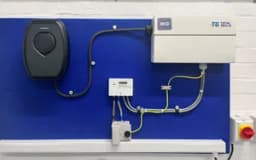
Related Course
EV Charging (2921)
Add EV charging installation to your skill set — one of the fastest-growing specialisms in the trade.
Frequently Asked Questions
Can I become an electrician at 40 with no experience?
Is 40 too old to start an apprenticeship?
How much will I earn as a trainee electrician?
Do I need GCSEs to train as an electrician?
Can I train part-time while keeping my current job?
What if I do not pass the exams?
How physically fit do I need to be?
What is the first step to becoming an electrician at 40?
Ready to Start Training?
Browse our City & Guilds accredited courses and take the next step in your electrical career.
Related Guides
How to Become an Electrician in the UK: 4 Routes Compared (2026)
Four routes to becoming a qualified electrician: apprenticeship, fast-track diploma, FE college, or experienced worker assessment. Costs from £0–£11k.
Read guideHow Much Does It Cost to Become an Electrician? (2026)
Training costs ~£8,050 (£7,750 via the L2 & L3 package, saving £300). Overall budget £9,700–£11,200 including the AM2 assessment, ECS card, and tools.
Read guideHow Much Does an Electrician Make? UK Salary Guide 2026
UK electricians make £39,039 on average (ONS 2025) — £18.38–£22.70/hr on JIB 2026 rates, £45k–£70k self-employed. Hourly, monthly, annual and London pay.
Read guideCareer Change to Electrician at 30, 40 or 50: A Realistic Guide
Honest advice for adults retraining as an electrician — no experience needed. Train part-time around your job, qualify in 18–24 months, earn £35k–45k.
Read guide