
How Long Does It Take to Become an Electrician?
Realistic timelines for every route — diploma, apprenticeship, experienced worker, and package courses.
In this guide
Quick Answer: Timelines at a Glance
It takes 18 months to 4 years to become a fully qualified electrician in the UK, depending on your route. The fast-track adult diploma route takes 18–24 months. An apprenticeship takes 3–4 years. The experienced worker route typically takes 6–12 months if you already have 5+ years of hands-on experience. All routes lead to the same JIB Gold Card.
- ✓Apprenticeship: 3 to 4 years (earning a wage throughout)
- ✓Adult Diploma Route: 6-10 months diplomas, then either the current 2357 NVQ route (evidence builds alongside Level 3 once on-site, available until 31 October 2026) for 18 to 24 months total, or a minimum two-year on-site competence stage under the 2026 reform (new 5357 qualification) if starting after that date
- ✓Experienced Worker Assessment (C&G 2346-03): assessment-only route to a full Level 3 qualification for those with 5+ years of experience — typically 6 to 12 months to Gold Card eligibility
- ✓Package courses: combining Level 2 and Level 3 saves weeks compared to separate enrolments
These timelines cover the full journey from starting training to holding your JIB ECS Gold Card — the industry-standard proof that you are a fully qualified electrician. Each route leads to the same qualifications; the difference is how long the journey takes.
Route 1: Apprenticeship (3-4 Years)
The apprenticeship is the longest route but the most structured. You work for an employer full-time while attending college or a training centre one day per week (or in block release). The total duration is 3 to 4 years.
Year-by-Year Breakdown
- ✓Year 1: Foundation skills — basic electrical science, health and safety, introduction to wiring systems. One day per week at college, four days on site.
- ✓Year 2: Intermediate skills — more complex installations, testing basics, building on Year 1 knowledge. You start to work more independently on site.
- ✓Year 3: Advanced skills — electrical design, fault diagnosis, three-phase systems. You are now a competent worker handling most tasks independently.
- ✓Year 4: End-Point Assessment preparation, AM2 practical assessment, and final qualification. Some apprenticeships complete in 3 years if you progress quickly.
The apprenticeship standard in England includes the Level 3 Diploma in Electrotechnical Services, the 18th Edition Wiring Regulations, and the End-Point Assessment (including the AM2). By the end, you qualify for your JIB ECS Gold Card.
Apprenticeship Advantage
Route 2: Adult Diploma Route (18 Months - 3 Years)
The adult diploma route is the most popular choice for career changers because it is significantly faster than an apprenticeship. Our fast-track electrician course guide explains how you complete your qualifications through intensive courses at a training centre, then gain work experience alongside your NVQ.
Qualification-by-Qualification Timeline
Level 2 Diploma (2365): 14-16 weeks
Your starting point. Covers electrical science, health and safety, wiring systems, and basic installation techniques. With hybrid delivery (online theory plus practical workshops), most learners complete this in around 4 months. Part-time study can extend this to 6 months.

Related Course
Level 2 Diploma (2365)
Your first qualification — typically completed in 14-16 weeks.
Level 3 Diploma (2365): 16-20 weeks
Builds on Level 2 with advanced installation, fault diagnosis, electrical design, and three-phase systems. You can start Level 3 immediately after completing Level 2 — there is no waiting period.

Related Course
Level 3 Diploma (2365)
Advanced diploma — typically 16-20 weeks after completing Level 2.
18th Edition (2382): 2 days
A short, intensive 2-day course on the current BS 7671 wiring regulations. Can be completed alongside or immediately after Level 3. The exam is open-book (you can use the BS 7671 regulation book), but you need to know where to find information quickly.
Inspection & Testing (2391): 5 days
A 5-day intensive course that proves you can inspect and test electrical installations. Includes practical assessments. Can be taken after the 18th Edition. This qualification is essential for self-employment and joining a competent person scheme.
5357 Level 3 Electrotechnical: minimum 24 months
The 5357 is an on-site competence assessment, not a taught course, and it comes after your diplomas — you need to be working on real electrical installations to gather evidence. An assessor visits your workplace periodically to observe your work and conduct professional discussions. This is the step that typically takes the longest.

Related Course
5357 Level 3 Electrotechnical
On-site assessment — minimum 24 months after your diplomas, while you are working.
AM2 Assessment: 1 day
A one-day practical assessment at a NET (National Electrotechnical Training) centre — see our AM2 assessment guide for full details on what to expect. You book this after completing your NVQ. Waiting times vary but are typically 2-6 weeks.
Total Diploma Route Timeline
Route 3: Experienced Worker Assessment (Typically 6-12 Months)
The Experienced Worker Assessment (EWA, City & Guilds 2346-03) is the fastest route, but it is only available to people who already have 5 or more years of practical electrical experience. If you have been working in the trade without formal qualifications, the EWA recognises your existing skills and takes you straight to a full Level 3 qualification without repeating training you do not need.
The EWA typically takes 6 to 12 months and involves practical assessment, professional discussion, and evidence review rather than classroom learning. You receive a full Ofqual-regulated Level 3 credential — the same level as an apprenticed electrician's qualification.
To enrol you need a Level 2 qualification (or the 2346-04 Experienced Worker Entrance Test), a current 18th Edition, and 2391 Inspection & Testing. With those in place, the EWA takes you directly to Gold Card eligibility — see our full EWA guide for details.
Saving Time: Package Courses
One of the most effective ways to reduce your total training time is to enrol on a package course that combines Level 2 and Level 3. This eliminates the gap between courses (waiting for the next start date, re-enrolment administration) and guarantees your progression.
A Level 2 & 3 Package typically takes 30-36 weeks from start to finish, compared to 30-36 weeks if you book them separately (with potential gaps between courses). The package also saves money — typically £500-£1,000 less than booking separately.
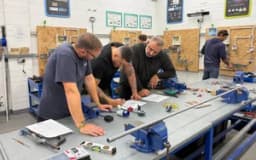
Related Course
Level 2 & 3 Package
Combine Level 2 and Level 3 for a faster, more cost-effective pathway.
What Affects How Long It Takes?
Several factors can speed up or slow down your journey to becoming a fully qualified electrician:
Factors That Speed Things Up
- ✓Choosing intensive, full-time courses over part-time study
- ✓Enrolling on a Level 2 & 3 package to eliminate gaps between courses
- ✓Taking the 18th Edition and 2391 concurrently with Level 3 or immediately after
- ✓Starting the NVQ as soon as you begin paid electrical work
- ✓Studying consistently and passing exams on the first attempt
- ✓Having prior experience (even non-electrical technical experience helps with learning speed)
Factors That Slow Things Down
- ✓Part-time study around a full-time job (adds months to each course)
- ✓Gaps between courses (waiting for start dates, taking breaks)
- ✓Exam resits (typically adds 4-8 weeks per resit)
- ✓Difficulty finding electrical employment for the NVQ
- ✓NVQ evidence gathering (some types of work produce evidence faster than others)
- ✓The AM2 assessment booking queue (can be 2-6 weeks in busy periods)
When Can You Start Working?
You do not need to wait until you are fully qualified to start working in the electrical trade. Here is when you can start earning at each stage:
- ✓After Level 2 (4 months): work as an electrical mate or trainee installer under supervision (£22,000-£28,000)
- ✓After Level 3 + 18th Edition (9-10 months): work as an electrician under supervision on most sites (£28,000-£33,000)
- ✓After 2391 (9-11 months): can carry out inspection and testing work, sign off certain certificates
- ✓After NVQ + AM2 + Gold Card (18-30 months): fully qualified, can work independently, join competent person schemes, go self-employed
Start Earning Early
Realistic Example Timelines
Full-Time Career Changer (Fastest)
Leaves current job, studies full-time, and takes fast-track courses back-to-back: Level 2 (4 months) then Level 3 (5 months) then 18th Edition (2 days) then 2391 (5 days) then NVQ while working (6 months) then AM2. Total: approximately 16-18 months.
Part-Time Career Changer (Typical)
Studies around current job, then transitions to electrical work: Level 2 part-time (6 months) then Level 3 (6 months) then 18th Edition + 2391 (about 2 weeks) then NVQ while working (9 months). Total: approximately 2 years.
Experienced Worker (Fastest Overall)
Has 5+ years of electrical experience plus a Level 2 qualification: updates the 18th Edition + 2391 (about 2 weeks), then completes the 2346-03 EWA while continuing to work (evidence gathering is faster due to an existing portfolio). Total: approximately 6-12 months.
School Leaver Apprenticeship
Starts at 16-18, works for an employer while studying: combined study and work over 3-4 years, End-Point Assessment including AM2 in final year. Total: 3 to 4 years.
Frequently Asked Questions
What is the fastest way to become a qualified electrician?
Can I become an electrician in 6 months?
How long does an electrical apprenticeship take?
How long does the Level 2 Diploma take?
Can I speed up the qualification process?
How long after qualifying can I go self-employed?
Ready to Start Training?
Browse our City & Guilds accredited courses and take the next step in your electrical career.
Related Guides
How to Become an Electrician in the UK: 4 Routes Compared (2026)
Four routes to becoming a qualified electrician: apprenticeship, fast-track diploma, FE college, or experienced worker assessment. Costs from £0–£11k.
Read guideHow Much Does It Cost to Become an Electrician? (2026)
Training costs ~£8,050 (£7,750 via the L2 & L3 package, saving £300). Overall budget £9,700–£11,200 including the AM2 assessment, ECS card, and tools.
Read guideHow Much Does an Electrician Make? UK Salary Guide 2026
UK electricians make £39,039 on average (ONS 2025) — £18.38–£22.70/hr on JIB 2026 rates, £45k–£70k self-employed. Hourly, monthly, annual and London pay.
Read guideCareer Change to Electrician at 30, 40 or 50: A Realistic Guide
Honest advice for adults retraining as an electrician — no experience needed. Train part-time around your job, qualify in 18–24 months, earn £35k–45k.
Read guide