
AM2 Assessment: What to Expect & How to Prepare (2026 Guide)
Everything you need to know about the AM2 practical assessment — format, tasks, pass rates, costs, and how to prepare with the right training.
In this guide
What Is the AM2 Assessment?
The AM2 (Achievement Measurement 2) is the final practical assessment you must pass to become a fully qualified electrician in the UK. It is a hands-on test of your installation, inspection, testing, and fault-finding competence — proving you can do the job safely and to the required standard.
The AM2 is run by NET (National Electrotechnical Training) in conjunction with the JIB (Joint Industry Board). It takes place at licensed NET assessment centres across the UK — not at your training provider. The closest centres to Nottingham are typically in the Derby, Newark, and Leicester area.
The assessment spans approximately 3 days (16-17 hours of assessed time) and is carried out in purpose-built assessment booths containing typical electrical installation wiring systems. All major tools, calibrated test instruments, and materials are provided by the assessment centre.
Total Skills does not offer the AM2 directly
Why You Need the AM2
The AM2 is not optional if you want to work as a fully qualified electrician. It is the gateway to the ECS Gold Card (Installation Electrician) — the industry-standard proof of competence that is required on virtually every construction site in the UK.
Without the AM2 and Gold Card, you cannot:
- ✓Register as a fully qualified electrician with industry bodies
- ✓Join a Competent Person Scheme (NICEIC, NAPIT) to self-certify Part P work
- ✓Work on most commercial and industrial construction sites
- ✓Demonstrate full occupational competence to employers and clients
The AM2 has been the industry standard since it was introduced by the JIB to ensure that every qualified electrician can demonstrate practical skills under controlled conditions — not just classroom knowledge.
AM2 vs AM2E vs AM2ED — What's the Difference?
There are three variants of the AM2, each designed for a different qualification route. The one you take depends on how you got your qualifications:
AM2 (Standard)
The standard AM2 is for candidates who have completed the Installation Electrician route — typically through the Level 2 and Level 3 Diplomas (City & Guilds 2365) plus the NVQ Level 3 (2357). This is the most common route for adult career changers and apprenticeship completers.
AM2E (Experienced Worker Assessment)
The AM2E is for candidates taking the Experienced Worker Assessment route (City & Guilds 2346-03). This is for electricians who already have at least two years of practical experience but lack formal qualifications. The scope of assessment reflects the standard EWA pathway.
AM2ED (Domestic Experienced Worker)
The AM2ED is for the Domestic Experienced Worker Assessment route (City & Guilds 2347-03). This covers a narrower scope focused on domestic electrical work only.
Which one do you need?
What Does the AM2 Test?
The AM2 is a two-to-three day practical assessment carried out in a purpose-built assessment booth. It covers six sections testing every aspect of your practical competence:
Day 1: Installation Work
The majority of the first day (and part of the second) is spent on the composite installation — building a complete electrical system in an assessment booth. This includes:
- ✓Wiring a consumer unit (typically a split-load board with RCBOs)
- ✓Installing a ring final circuit for socket outlets
- ✓Installing a radial circuit
- ✓Installing lighting circuits (one-way and two-way switching)
- ✓Working with containment systems — steel conduit, trunking, and cable tray
- ✓Connecting a three-phase distribution board
This is the longest section at approximately 8.5 to 10 hours and is where time management is most critical.
Day 2: Inspection, Testing, and Fault Finding
The second day focuses on verifying and documenting your installation, then diagnosing faults in a separate pre-wired rig:
- ✓Completing initial verification of your installation (Electrical Installation Certificate documentation)
- ✓Safe isolation procedures (tested twice — any error is an automatic fail)
- ✓Testing: continuity, insulation resistance, earth fault loop impedance, RCD testing
- ✓Recording all test results accurately on official documentation
- ✓Fault diagnosis and rectification in a pre-wired installation
- ✓Identifying the fault, explaining the cause, and correcting it safely
Knowledge Assessment
There is also an online open-book knowledge assessment — 30 multiple-choice questions covering BS 7671 wiring regulations, safe working practices, and electrical principles. You have one hour, and you can refer to your copy of the regulations.
Throughout the entire assessment, you are also judged on safe working practices, compliance with BS 7671 (18th Edition), and correct use of test instruments.
AM2 Pass Rates and Common Failures
The overall AM2 pass rate is approximately 70-75%. That means roughly one in four candidates fails on their first attempt. The most common reasons for failure are:
- ✓Incomplete or incorrect documentation — missing test results, unsigned forms, wrong values
- ✓Incorrect test readings — recording Zs values wrongly, not understanding what the results mean
- ✓Not following the safe isolation procedure correctly — this is an automatic fail
- ✓Poor time management — running out of time on the composite installation
- ✓Wiring errors in the consumer unit — incorrect connections, wrong protective devices
- ✓Not following a systematic approach to fault finding
How to Improve Your Chances
- ✓Practise under timed conditions — simulate the time pressure of each section
- ✓Know your Zs values and what they mean without having to look them up
- ✓Get comfortable with split-load consumer units and RCBO boards
- ✓Practise safe isolation until it is completely automatic — no hesitation, no missed steps
- ✓Complete mock EICR documentation until you can fill it in without errors
- ✓If possible, book a practice session at a NET centre before the real assessment
Safe isolation is non-negotiable
How Much Does the AM2 Cost?
The AM2 assessment fee is paid directly to the NET centre when you book. As of 2026, typical costs are:
- ✓Standard AM2: approximately £885 + VAT (NET recommended price from April 2026)
- ✓AM2E v1 (Experienced Worker): approximately £1,235 + VAT
- ✓AM2S v1 (Apprentice route): approximately £1,340 + VAT (from April 2026)
If you fail individual sections, you can re-sit just those sections rather than retaking the whole assessment. Re-sit fees typically range from around £235 to £320 + VAT per section, capped so resits never cost more than the full assessment.
Prices are set by NET and may vary slightly between centres. Always check the NET website (netservices.org.uk) for the most current pricing.
This is separate from your training costs
How to Book the AM2
You book the AM2 directly through a NET assessment centre — not through your training provider. Here is the process:
- ✓Complete all prerequisite qualifications (Level 2, Level 3, 18th Edition, NVQ Level 3)
- ✓Get your NVQ assessor to sign your NET Readiness for Assessment Checklist
- ✓Visit the NET website (netservices.org.uk) and choose your nearest assessment centre
- ✓Contact the centre directly to check availability and book your assessment dates
- ✓Pay the assessment fee to the centre when booking
- ✓Attend on the booked dates with your photo ID and signed checklist
Typical waiting times are 2 to 8 weeks depending on centre availability, though popular centres in the Midlands can have longer waits. Book as early as possible once your NVQ is signed off.
You must complete your qualifications first
How to Prepare for the AM2
The best preparation for the AM2 is completing the right training courses and getting plenty of practical experience. Here is what you should focus on:
1. Complete the Level 2 Diploma (2365)
The Level 2 Diploma (2365) — online + practical gives you the foundation installation skills you need — wiring techniques, circuit types, containment systems, and basic testing. The practical workshop sessions directly prepare you for the installation tasks in the AM2.
2. Complete the Level 3 Diploma (2365)
The Level 3 Diploma takes you deeper into fault diagnosis, electrical design, three-phase systems, and advanced inspection and testing. These are all heavily tested in the AM2.
3. Know BS 7671 (18th Edition) Inside Out
The 18th Edition wiring regulations underpin everything in the AM2. You need to know where to find key information quickly, understand the requirements for different circuit types, and apply the regulations to your installation work. Tab and annotate your copy of BS 7671 before the assessment.
4. Complete the NVQ Level 3 (2357)
The NVQ Level 3 ensures you have real workplace experience. The practical competence you develop during your NVQ — working on real installations, real testing, real fault finding — is exactly what the AM2 assesses.
5. Practise Under Timed Conditions
Time management is one of the biggest challenges in the AM2. Practise wiring consumer units, installing circuits, and completing test documentation under realistic time constraints. The composite installation alone is 8.5 to 10 hours — you need to work efficiently without rushing.
6. Drill Your Testing Procedures
Inspection and testing is one of the most common fail areas. Practise every test (continuity, insulation resistance, earth fault loop impedance, RCD testing) until the procedures are second nature. Know the correct sequence and what each reading should be.
Related Course
Level 2 & 3 Package
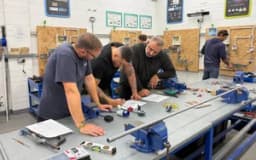
The most popular option — Level 2 and Level 3 Diplomas together at a discounted package price. Covers the core skills tested in the AM2.
Related Course
5357 Level 3 Electrotechnical
The final qualification step before the AM2 — on-site competence assessment leading to your Gold Card eligibility.
The Full Qualification Journey
Here is the complete pathway from beginner to fully qualified electrician, showing where the AM2 fits in. For a visual overview, see our qualification pathway diagram:
Step 1: Level 2 Diploma in Electrical Installations (2365)
Foundation knowledge and skills — electrical science, wiring systems, installation techniques. Typically 14-16 weeks.
Step 2: Level 3 Diploma in Electrical Installations (2365)
Advanced theory and practice — fault diagnosis, design calculations, three-phase systems, advanced testing. Typically 16-20 weeks.
Step 3: 18th Edition Wiring Regulations (2382)
The current BS 7671 standard — every practising electrician must hold this. Typically 2 days.
Step 4: Inspection and Testing (2391)
Proves you can inspect and test electrical installations. Essential for self-employment and joining competent person schemes. Typically 5 days.
Step 5: NVQ Level 3 in Electrical Installation (2357)
On-site competence assessment — your assessor visits your workplace to observe and verify your practical skills. Typically 6-12 months alongside employment.
Step 6: AM2 Assessment
The practical end-point assessment at a NET centre. 3 days of hands-on testing. This is where you prove everything comes together.
Step 7: ECS Gold Card
Apply for your JIB ECS Gold Card (Installation Electrician). You are now a fully qualified electrician.
The typical total time from beginner to Gold Card via the diploma route is 18 to 24 months, depending on how quickly you progress through the courses and gain workplace experience for the NVQ.
Related Course
Level 2 & 3 Package
Start the journey — Level 2 and Level 3 together at a package price. The first two steps towards your AM2 and Gold Card.
After the AM2 — What Happens Next?
Once you pass the AM2, you receive NET's Certificate of Occupational Competence. This is the final piece you need to apply for your ECS Gold Card.
Apply for Your ECS Gold Card
With your AM2 pass, NVQ Level 3, and 18th Edition, you can apply for the ECS Gold Card (Installation Electrician). The Gold Card is the industry-standard proof that you are a fully qualified electrician. It is required on virtually every construction site and is the benchmark employers and clients look for.
Register with a Competent Person Scheme
With your Gold Card, you can register with a Competent Person Scheme such as NICEIC or NAPIT. This allows you to self-certify your electrical work under Part P of the Building Regulations — essential if you plan to work as a self-employed electrician.
Add Specialist Skills
Once you are qualified, consider adding specialist qualifications to increase your earning potential and open up new work areas:
- ✓EV Charging Installation (2921) — electric vehicle charger installation, a rapidly growing market
- ✓Solar PV and Battery Storage — renewable energy installation for domestic and commercial properties
- ✓Inspection and Testing (2391) — EICRs and periodic testing, commanding premium day rates
Related Course
EV Charging (2921)
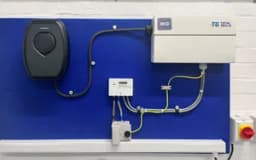
A popular next step after qualifying — EV charger installation is one of the fastest-growing specialisms in the trade.
Frequently Asked Questions
Can I do the AM2 without qualifications?
How many times can I retake the AM2?
What tools do I need to bring to the AM2?
How long are AM2 results valid?
Is the AM2 the same as the AM2E?
Can I practise for the AM2?
What if I fail the AM2?
Do I need the 18th Edition before the AM2?
Where is the nearest AM2 centre to Nottingham?
How long does the AM2 take?
Ready to Start Training?
Browse our City & Guilds accredited courses and take the next step in your electrical career.
Related Guides
Become an Electrician Without an Apprenticeship: Diploma Route
Yes — become an electrician without an apprenticeship via the C&G 2365 diploma route. Full-time training, no employer needed, qualified in 8–12 months.
Read guideNVQ Level 3 Electrical: Everything You Need to Know
A complete guide to the City & Guilds 2357 NVQ Level 3 — who it is for, how it works, evidence requirements, and how it leads to your gold card.
Read guideCity & Guilds 5357: New Level 3 Electrotechnical Qualification
What City & Guilds 5357 (5357-95 and 5393-43) means — the qualification replacing the 2357 NVQ from 31 October 2026, and the new ECS Gold Card route.
Read guideNVQ Level 2 Electrical: Why It Doesn’t Exist & What You Need
There is no NVQ Level 2 in Electrical Installation. The qualification you need is the C&G 2365-02 Level 2 Diploma — we explain the difference.
Read guide