
How to Go Self-Employed as an Electrician UK (2026 Step-by-Step)
Step-by-step guide to going self-employed as an electrician — HMRC registration, insurance, Part P scheme, pricing, VAT (£90,000), and finding customers.
In this guide
Why Go Self-Employed?
Setup checklist
1. Register as sole trader with HMRC (free). 2. Get public liability insurance (£2M–£5M cover). 3. Join a competent person scheme (NICEIC or NAPIT) for Part P compliance. 4. Set up a business bank account. 5. Register on Checkatrade/MyBuilder for initial leads. 6. Register for VAT when turnover exceeds £90,000. Total setup cost: £2,000–£5,000 (excluding tools and van).
Going self-employed is one of the biggest advantages of a career in the electrical trade. Unlike many professions, electricians have genuine freedom to choose between employed work and running their own business. The majority of experienced domestic electricians eventually go self-employed because the earning potential is significantly higher and the flexibility is hard to beat.
As a self-employed electrician, you control your own schedule, choose which jobs to take, set your own rates, and build a business that can grow over time. Many self-employed electricians earn 40,000 to 65,000 pounds or more per year — see our electrician salary guide for detailed earnings data. Some specialists in EV charging or solar installation exceed that considerably.
However, going self-employed also means taking on responsibilities that an employer would normally handle — tax, insurance, marketing, quoting, invoicing, and dealing with customers. This guide covers every step you need to take to set up properly and give yourself the best chance of success.
Choosing Your Business Structure
The first decision you need to make is how to structure your business. The two main options for electricians are sole trader and limited company. Each has different implications for tax, liability, and administration.
Sole Trader
The simplest way to start. You register with HMRC as self-employed, and you and your business are treated as the same legal entity. Most electricians start here because it is quick, free to set up, and involves less paperwork.
- ✓Free to register — notify HMRC by 5 October after the end of your first tax year of trading
- ✓Simple bookkeeping and one annual self-assessment tax return
- ✓You keep all profits after tax
- ✓Personally liable for any business debts
- ✓Less tax-efficient once earning above roughly 40,000 to 50,000 pounds
Limited Company
A limited company is a separate legal entity from you personally. You become a director and shareholder of the company. This structure becomes more tax-efficient at higher earnings because you can pay yourself a combination of salary and dividends.
- ✓Registration fee of 50 pounds for online incorporation at Companies House
- ✓Limited personal liability — your personal assets are protected
- ✓More tax-efficient at higher earnings through salary and dividend split
- ✓Annual accounts must be filed with Companies House
- ✓You will likely need an accountant (500 to 1,500 pounds per year)
- ✓IR35 rules may apply if you work for a single client
Start simple
Most electricians start as a sole trader and switch to a limited company once their earnings justify the additional complexity. You can convert at any time, so there is no rush to decide immediately.
Essential Registrations
Before you start trading, there are several registrations you need to complete. Some are legal requirements, while others are strongly recommended for credibility and to comply with industry standards.
HMRC Self-Assessment
You must register with HMRC for self-assessment by 5 October following the end of the tax year in which you became self-employed — though it is sensible to register as soon as you start trading. You can do this online at the HMRC website. Once registered, you will need to submit a tax return each year by 31 January and pay income tax and National Insurance contributions on your profits.
Construction Industry Scheme (CIS)
If you do any subcontracting work for builders or other contractors, you need to register for CIS. Under this scheme, the contractor deducts 20 percent from your payments and passes it to HMRC as an advance payment of your tax. Without CIS registration, the deduction increases to 30 percent.
Business Bank Account
While not a legal requirement for sole traders, having a separate business bank account makes bookkeeping dramatically easier and looks more professional when invoicing customers. Many banks offer free business accounts for the first year.
Competent Person Scheme
To self-certify notifiable electrical work under Part P of the Building Regulations, you must join a competent person scheme such as NICEIC or NAPIT. Our competent person scheme guide explains the options in detail. This costs between 400 and 800 pounds per year and is essential for domestic installers. Without it, your customers would need to pay for separate building control approval on notifiable work.
ECS Card
If you plan to do any work on construction sites, you will need a valid ECS card. See our guide to registering as an electrician for the full process. This proves your qualifications and competence. Most commercial clients and principal contractors require it as a condition of site access.

Related Course
Level 2 Diploma (2365)
The Level 2 Diploma is the first step towards the qualifications you need to go self-employed.
Getting the Right Insurance
Insurance is not optional for self-employed electricians — see our electrician insurance guide for the full breakdown. It protects you, your customers, and your business. Most competent person schemes require proof of insurance before they will accept your application.
Public Liability Insurance
This covers claims from third parties for injury or property damage caused by your work. The industry standard is 2 to 5 million pounds of cover, costing roughly 200 to 400 pounds per year. This is the single most important policy for any self-employed electrician.
Professional Indemnity Insurance
Covers claims arising from professional advice or design errors — for example, if you design a circuit that later proves inadequate. Typically costs 100 to 200 pounds per year and is increasingly required by competent person schemes.
- ✓Public liability: 200 to 400 pounds per year (2 to 5 million cover)
- ✓Professional indemnity: 100 to 200 pounds per year
- ✓Employers liability: legally required if you hire staff (5 million legal minimum — most policies provide 10 million)
- ✓Tool insurance: 100 to 300 pounds per year (covers theft and accidental damage)
- ✓Van insurance: 1,000 to 2,500 pounds per year (commercial use policy)
Bundle and save
Many specialist trade insurers offer bundled policies that combine public liability, professional indemnity, and tool cover at a discount compared to buying each separately. Companies like Hiscox, Simply Business, and Tradesman Saver cater specifically to electricians.
Pricing Your Work
Getting your pricing right is one of the most important skills for a self-employed electrician. Charge too little and you will struggle to cover your costs. Charge too much and you will lose work to competitors. Most electricians use a mix of day rates and fixed prices depending on the type of job.
Day Rates
Day rates work well for larger jobs where the scope may change, such as rewires or new-build installations. For a full breakdown, see our electrician day rates guide. Typical self-employed day rates in 2026 are:
- ✓Domestic work: 200 to 350 pounds per day
- ✓Commercial work: 250 to 400 pounds per day
- ✓Specialist work (EV, solar, data centres): 300 to 500 pounds per day
- ✓London and South East: add 15 to 25 percent premium
Fixed Prices
Fixed pricing works best for well-defined, repeatable jobs. Customers prefer knowing the total cost upfront. Our quoting electrical jobs guide covers pricing strategies in detail. Common fixed-price jobs include socket installations, light fittings, consumer unit replacements, and EICRs.
Calculate your minimum rate
Add up all your annual costs (insurance, scheme fees, van, tools, fuel, phone, accounting) and divide by the number of chargeable days you expect to work (typically 220 to 230 per year). This gives you your break-even daily cost. Your day rate should be at least double this figure to account for non-chargeable time, materials, and profit.
Related Course
18th Edition (2382)
A current 18th Edition certificate is essential for joining a competent person scheme.
Finding Work and Building a Reputation
When you first go self-employed, finding a steady stream of work is the biggest challenge. Over time, word of mouth becomes your most powerful marketing channel, but you need strategies to build momentum in the early months.
Online Platforms
- ✓Checkatrade: the most established trade platform, costs roughly 50 to 100 pounds per month
- ✓MyBuilder: lead-based model, you pay per lead rather than a monthly fee
- ✓Bark: similar to MyBuilder, sends you customer enquiries to quote on
- ✓Google Business Profile: free and essential — helps you appear in local searches
Newer platforms are also appearing. One example is Energy North, a trades marketplace that launched in 2026 with no fees for homeowners and no per-lead charges for trades during its launch period. We have not used it and cannot vouch for how much work it generates, so check the current job volumes and pricing on any new platform before you rely on it.
Social Media and Local Marketing
A simple Facebook business page and presence in local community groups can generate significant domestic work. Post photos of completed jobs (with customer permission), share useful electrical safety tips, and respond promptly to enquiries. A professional appearance, tidy van signage, and branded workwear all contribute to a trustworthy image.
Word of Mouth
This remains the single most effective source of work for established electricians. Do excellent work, leave every job site clean and tidy, communicate clearly with customers, and ask satisfied clients for reviews and referrals. Building relationships with other tradespeople (plumbers, builders, kitchen fitters) who can recommend you is also extremely valuable. If you are still deciding whether to go self-employed, our is electrician a good career guide covers the pros and cons in detail.
Tax, National Insurance & VAT
Understanding your tax obligations is essential for self-employed electricians. Getting this wrong can result in unexpected bills and penalties.
Income Tax and National Insurance
As a sole trader, you pay income tax on your profits (revenue minus allowable expenses). You also pay Class 2 and Class 4 National Insurance contributions. All of this is calculated through your annual self-assessment tax return, which is due by 31 January each year for the previous tax year.
Allowable Business Expenses
- ✓Tools, equipment, and test instruments
- ✓Van costs: fuel, insurance, maintenance, road tax
- ✓Insurance premiums (public liability, professional indemnity)
- ✓Competent person scheme fees
- ✓Accountancy fees and software subscriptions
- ✓Materials purchased for jobs (if not recharged separately)
- ✓Training courses and CPD
- ✓Mobile phone (business use proportion)
VAT Registration
You must register for VAT if your taxable turnover exceeds 90,000 pounds in any rolling 12-month period. Once registered, you charge VAT on your invoices and can reclaim VAT on your business purchases. Many electricians use the Flat Rate Scheme, which simplifies VAT accounting by applying a fixed percentage to your gross turnover.
Get an accountant
A good accountant who specialises in trades will save you far more in tax than they cost. Expect to pay 500 to 1,200 pounds per year for a sole trader, or 800 to 1,500 pounds for a limited company. They will ensure you claim all allowable expenses and stay compliant with HMRC.
Related Course
Inspection & Testing (2391)
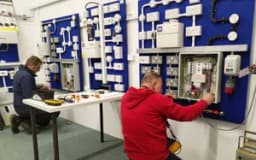
The 2391 qualification allows you to carry out inspection and testing — a high-value self-employed service.
Frequently Asked Questions
How much does it cost to set up as a self-employed electrician?
Do I need to register as a sole trader or limited company?
What insurance do I need as a self-employed electrician?
How do I find work as a self-employed electrician?
When do I need to register for VAT?
Can I go self-employed straight after qualifying?
Ready to Start Training?
Browse our City & Guilds accredited courses and take the next step in your electrical career.
Related Guides
Electrician Day Rates UK 2026: JIB Rates & Hourly Rates
UK electricians charge £250–£500 a day in 2026. JIB rates: £18.38/hr Electrician, £20.08/hr Approved Electrician. Day, hourly and fixed prices compared.
Read guideEssential Electrician Tools: Complete Kit List
Every tool an electrician needs — from basic hand tools to specialist test equipment, with buying guidance.
Read guideElectrician Starter Kit: What to Buy and What to Wait On
What learners need to buy before starting a Level 2 electrical course, what to add in your first year on the job, and what to leave until later.
Read guideGifts for Electricians: Ideas They Will Actually Use
Practical gift ideas for electricians and apprentices, what to avoid, and how to buy for someone starting out in the trade.
Read guide