
Electrician Course Online: What You Can Study From Home
Online electrician courses let you study theory from home, but practical skills need hands-on training. Our online-plus-workshop model gets you qualified.
In this guide
Can You Become an Electrician Online?
The short answer is: partially, but not entirely. If you have been searching for an electrician course online, you have probably seen adverts promising you can qualify from your sofa. Some of those claims are misleading. Here is the honest truth about what online training can and cannot do for you.
Certain theory elements of electrical training can genuinely be studied online. The 18th Edition wiring regulations, electrical science principles, and health and safety modules lend themselves well to self-paced online learning. The 18th Edition exam can even be sat remotely via a proctored online session.
But here is what no online course can teach you: how to wire a consumer unit. How to terminate cables safely. How a ring circuit feels when you are pulling cables through conduit. How to use a multifunction tester on a real installation. How to identify a fault by touch, sight, and instrument readings. These are hands-on, physical skills that require practice in a real workshop with real equipment — and they are exactly what employers, City & Guilds assessors, and the AM2 practical exam will test you on.
Electrical work is safety-critical. Mistakes do not just mean a failed assessment — they can cause fires, injuries, and fatalities. That is why the qualifications that matter most require you to prove practical competence in person. Be wary of any provider claiming you can become a fully qualified electrician without ever picking up a pair of strippers.
What CAN Be Done Online
There are genuine parts of the electrician training pathway that work well online. If you want to get a head start or fit study around existing commitments, these are the elements you can tackle from home:
18th Edition Theory and Exam
The 18th Edition (BS 7671) is the UK wiring standard that every electrician must understand. The qualification is theory-based — you study the regulations and sit a multiple-choice exam. The study material can be covered entirely at your own pace using the BS 7671 book and online resources. City & Guilds also offers a remote proctored exam option, meaning you can sit the 2382 exam from your own computer with a webcam and microphone.
Theory Modules and Pre-Course Preparation
Many of the theory elements within the Level 2 and Level 3 Diplomas can be studied at home before you attend practical sessions. This includes:
- ✓Electrical science fundamentals — Ohm's law, power calculations, circuit theory
- ✓BS 7671 regulation study and interpretation
- ✓Health and safety legislation and safe working practices
- ✓Electrical installation theory — cable selection, protection devices, earthing
- ✓Pre-course revision materials and practice questions
Studying theory online before your practical course means you arrive prepared and get significantly more from your workshop time. Many of our most successful learners spend weeks reading the BS 7671 book and working through theory before they set foot in the training centre.
Related Course
18th Edition (2382)
Theory-based qualification — study at home and sit the exam via remote proctoring.
What CANNOT Be Done Online
Practical Skills Require Hands-On Training
The practical skills that make up the core of your competence as an electrician must be learned and assessed in person:
- ✓Level 2 and Level 3 Diploma practical assessments — you must wire real circuits in a workshop
- ✓Wiring installations — ring circuits, radial circuits, lighting circuits, and spur connections
- ✓Consumer unit installation — working with live and dead connections safely
- ✓Inspection and testing with real instruments — multifunction testers, insulation resistance, earth fault loop impedance
- ✓Safe isolation procedures — proving dead before working on circuits
- ✓Fault diagnosis and rectification — finding and fixing real faults in real installations
- ✓NVQ workplace evidence gathering — an assessor must observe you working on actual jobs
- ✓AM2 practical assessment — a timed, hands-on test where you wire a complete installation
The City & Guilds 2365 Diploma explicitly requires practical assessment in a controlled workshop environment. There is no online alternative for these assessments, and any course that omits them is not delivering the full qualification.
The Bottom Line
The Blended Approach: Best of Both Worlds
The most effective way to train as an electrician combines online theory study with intensive practical sessions at a training centre. This blended approach gives you the flexibility of studying from home while ensuring you develop the hands-on skills that actually matter.
How It Works
- ✓Study theory at home in your own time — electrical science, BS 7671 regulations, health and safety
- ✓Attend practical sessions at a training centre — wiring, installation, testing, fault diagnosis
- ✓Maximise your workshop time by arriving with strong theoretical knowledge
- ✓Complete assessments under proper supervision with real equipment and instruments
This approach means you are not sitting in a classroom being talked through PowerPoint slides about Ohm's law — you already know that from your home study. Instead, your time at the training centre is spent doing the work: wiring circuits, connecting consumer units, testing installations, and building the muscle memory that makes you a competent electrician.
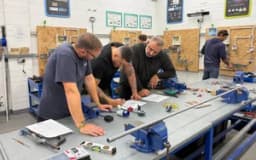
At Total Skills, our courses are structured to include both theory and practical elements delivered in purpose-built workshops at our training centre. Our workshop bays replicate real domestic and commercial installations, so you are practising on the same types of systems you will encounter on the job.
Beware of "Fully Online" Electrician Courses
Red Flags to Watch For
Here is what typically happens with online-only electrician courses:
- ✓They only cover theory — you still need separate practical training to get a real qualification
- ✓They issue their own certificates rather than City & Guilds qualifications recognised by employers
- ✓They do not include practical assessment, so you cannot progress to the NVQ or AM2
- ✓The total cost ends up higher when you add the practical training you still need
- ✓Employers and competent person schemes (NICEIC, NAPIT) do not recognise online-only certificates
What to Check Before Enrolling
Before you pay for any electrician course — online or otherwise — ask these questions:
- ✓Is the course accredited by City & Guilds? (Not just "endorsed" or "CPD certified")
- ✓Does it include practical workshop training and assessment?
- ✓Will I receive a City & Guilds 2365 Diploma on completion?
- ✓Where and when do the practical sessions take place?
- ✓Can I progress directly to the NVQ and AM2 after completing this course?
If the answer to any of those questions is no or unclear, think very carefully before handing over your money. A legitimate electrician qualification always includes practical assessment. There are no shortcuts to competence in a safety-critical trade.
A Simple Rule
The Realistic Path: Start Online, Finish In Person
If you want to make the most of online learning while still ending up with genuine, employer-recognised qualifications, here is the realistic pathway:
Step 1: Start with the 18th Edition (Online)
The 18th Edition (2382) is the ideal starting point for online study. It builds your foundational knowledge of BS 7671 wiring regulations, and you can study and sit the exam entirely from home via remote proctoring. This gives you a genuine City & Guilds qualification and a solid base of knowledge before you commit to the full diploma pathway.
Related Course
18th Edition (2382)
Start here — study at home, sit the exam online. Your first City & Guilds qualification.
Step 2: Level 2 Diploma at a Training Centre (In Person)
The Level 2 Diploma (2365) — hybrid online + practical course is where the hands-on work begins. You learn to wire real circuits, install accessories, test installations, and work safely. This must be done at a training centre with proper workshop facilities. Having already completed the 18th Edition, you arrive with a strong understanding of the regulations that govern everything you do.
Step 3: Level 3 Diploma (In Person)
The Level 3 Diploma takes you deeper into fault diagnosis, electrical design, three-phase systems, and advanced testing. Again, this is practical, hands-on training that requires workshop attendance.
Step 4: Inspection and Testing, NVQ, and AM2
After your diplomas, you continue with the 2391 Inspection and Testing qualification (practical, in person), then the NVQ Level 3 (workplace-based assessment), and finally the AM2 practical assessment at a NET centre. Each of these requires you to demonstrate real, hands-on competence.
Related Course
Level 2 & 3 Package
The practical pathway — Level 2 and Level 3 together at a package price.
Why Hands-On Training Matters
There is a reason the electrical trade has not gone fully online, and it is not because the industry is behind the times. It is because electrical work is one of the most safety-critical trades in existence. Poorly done electrical work kills people.
Employer Expectations
When an employer hires a newly qualified electrician, they expect you to be able to perform basic installation tasks from day one. That means wiring circuits, connecting protective devices, testing your work, and documenting it correctly. These are not skills you can learn from a screen — they require repetition, feedback, and muscle memory built through hours of practical work.
The AM2 Is a Practical Assessment
The AM2 assessment — the final gateway to your ECS Gold Card — is a timed practical exam. You wire a complete installation from a specification, including a consumer unit, lighting circuits, power circuits, and an outside supply. You then inspect and test the entire installation. If you have only studied theory online, you will not pass. It is that straightforward.
Safety Cannot Be Learned Remotely
Safe isolation, live working procedures, and fault diagnosis involve real risk. Learning these in a controlled workshop environment with qualified instructors means you make your mistakes where they cannot hurt anyone. Learning on the job without proper training puts you, your colleagues, and the public at risk.
Our Workshop Environment
At Total Skills, our training centre has purpose-built workshop bays that replicate real domestic and commercial installations. You work with the same consumer units, cable types, test instruments, and accessories that you will use on the job. Our instructors are experienced electricians who provide individual feedback on your technique and working practices.

Related Course
Level 2 Diploma (2365)
Start your hands-on training — study online from anywhere in the UK, attend practicals at our centre.
Related Guides
How to Become an Electrician in the UK: 4 Routes Compared (2026)
Four routes to becoming a qualified electrician: apprenticeship, fast-track diploma, FE college, or experienced worker assessment. Costs from £0–£11k.
Read guideCareer Change to Electrician at 30, 40 or 50: A Realistic Guide
Honest advice for adults retraining as an electrician — no experience needed. Train part-time around your job, qualify in 18–24 months, earn £35k–45k.
Read guideFast-Track Electrician Course: Qualified in 18–24 Months
Fast-track electrical courses explained: the same City & Guilds qualifications as a 4-year apprenticeship in 18–24 months. Online theory, intensive practicals.
Read guidePart-Time Electrician Course: How to Train Around Your Job (2026)
Become an electrician part-time — study theory online in evenings, attend practical workshops on weekdays or weekends. Same City & Guilds qualification.
Read guideFrequently Asked Questions
Can I get a City & Guilds qualification online?
Is the 18th Edition exam available online?
How much of the training is online vs in-person?
Are online electrician courses cheaper?
Can I study theory at home before attending a course?
Will an online-only course get me a job as an electrician?
What equipment do I need for online study?
Is Total Skills' training online or in-person?
Ready to Start Training?
Browse our City & Guilds accredited courses and take the next step in your electrical career.