
Emergency Lighting: BS 5266, Testing & Career Opportunities
Emergency lighting explained — BS 5266 requirements, testing schedules, system types, and why it is a valuable specialism for electricians.
In this guide
What Is Emergency Lighting?
Emergency lighting is lighting that activates when the normal mains supply fails, providing illumination to allow safe evacuation of a building. It is a legal requirement in virtually all non-domestic premises in the UK, including offices, shops, factories, warehouses, schools, hospitals, hotels, restaurants, and public buildings.
The primary standard governing emergency lighting in the UK (alongside the 18th Edition wiring regulations for the electrical installation) is BS 5266-1, the British Standard code of practice for emergency lighting. This standard specifies the design, installation, wiring, testing, and maintenance requirements for emergency lighting systems. Compliance with BS 5266-1 is the accepted way of satisfying the legal requirements of the Regulatory Reform (Fire Safety) Order 2005.
Legal Requirement
The Regulatory Reform (Fire Safety) Order 2005 places a legal duty on the responsible person for a premises to ensure that emergency routes and exits requiring illumination are provided with emergency lighting of adequate intensity. Failure to comply is a criminal offence and can result in prosecution, fines, and — in cases where people are put at risk — imprisonment.
Types of Emergency Lighting
Emergency lighting systems are classified by their mode of operation and their power source. Understanding these classifications is essential for specifying the correct system for any given premises.
Maintained Emergency Lighting
Maintained luminaires are illuminated at all times during normal occupation. They operate from the mains supply under normal conditions and automatically switch to battery power when the mains fails. Maintained fittings are required in premises where the normal lighting may be dimmed or extinguished during occupation, such as cinemas, theatres, and entertainment venues.
Non-Maintained Emergency Lighting
Non-maintained luminaires are off during normal conditions and only activate when the mains supply fails. They contain a battery that is kept charged by the mains supply. When the mains is interrupted, the luminaire automatically illuminates. This is the most common type of emergency lighting in offices, shops, and other general commercial premises.
Sustained Emergency Lighting
Sustained luminaires contain two lamps — one for normal lighting and one for emergency use. The normal lamp operates from the mains supply, while the emergency lamp only activates on mains failure. This differs from maintained fittings where the same lamp operates in both modes.
Self-Contained vs Central Battery Systems
- ✓Self-contained systems — Each luminaire has its own integral battery. The most common arrangement for small to medium premises. Simpler to install and maintain, but each battery must be individually tested and eventually replaced.
- ✓Central battery systems — A single central battery unit supplies power to all emergency luminaires via dedicated wiring. Used in larger buildings where centralised monitoring and maintenance is preferred. Higher initial cost but easier to monitor battery condition and provides consistent performance across all luminaires.
BS 5266-1 Testing Requirements
Regular testing of emergency lighting is not optional — standard electrical testing procedures apply alongside the specific BS 5266-1 requirements. It is a requirement of BS 5266-1 and is essential to ensure the system will operate correctly in a genuine emergency. The responsible person for the premises has a legal duty to ensure testing is carried out and properly documented.
Monthly Functional Test
A brief functional test must be carried out every month. The mains supply to the emergency lighting is interrupted (typically by operating a dedicated test switch or fish key) and each luminaire is checked to confirm it illuminates. The mains is restored after a few seconds — the test is not intended to discharge the batteries significantly. Any luminaire that fails to operate must be recorded and repaired promptly.
Annual Full Duration Test
Once per year, the emergency lighting system must be tested for its full rated duration — 3 hours for most premises. The mains supply is disconnected and the system runs on battery power for the full period. At the end of the test, every luminaire is checked to confirm it is still illuminated at an acceptable level. This test verifies that the batteries can sustain the required duration. After the test, the mains supply is restored and the batteries are allowed to recharge fully (typically 24 hours).
Record Keeping
BS 5266-1 requires that a log book is maintained for the emergency lighting installation. The log book must record every test, its date, the results, and any remedial action taken. This documentation is essential — fire safety inspectors will ask to see the log book, and failure to produce adequate records can result in enforcement action.
- ✓Monthly test results — date, pass or fail for each luminaire, any faults found
- ✓Annual full duration test results — date, duration achieved, luminaire condition at end of test
- ✓Details of any repairs or replacements carried out
- ✓Name of the person or company carrying out each test
Testing Tip
Schedule the annual full duration test carefully. The emergency lighting will be unavailable for up to 24 hours after the test while batteries recharge. Avoid testing immediately before a busy period. Many building managers schedule the annual test over a weekend.
3-Year Certification
In addition to the monthly and annual testing regime, BS 5266-1 recommends a more thorough periodic inspection and test. This is commonly referred to as the 3-yearly verification and is the most comprehensive assessment of the emergency lighting system.
The 3-yearly verification includes a full system inspection, checking that the installation still complies with BS 5266-1, that luminaire positions are still appropriate (taking into account any changes to the building layout), and that the system design is still adequate for the building's current use. A full duration test is carried out as part of this verification, along with measurement of illumination levels at key points.
A certificate is issued confirming the condition of the installation. This certificate is important evidence that the responsible person is meeting their legal obligations under the Fire Safety Order. Many insurers also require evidence of current emergency lighting certification.
Related Course
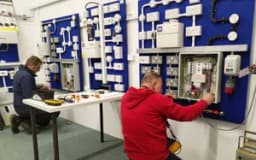
Inspection & Testing (2391)
The 2391 Inspection and Testing qualification equips you with the testing and certification skills needed for emergency lighting verification.
Career Opportunities
Emergency lighting represents a valuable and reliable specialism for electricians. Every commercial premises in the UK requires emergency lighting, and every system needs regular testing and periodic replacement. This creates a consistent stream of work that is largely unaffected by economic cycles.
Why Emergency Lighting Is a Strong Specialism
- ✓Legal requirement in all non-domestic premises — the work cannot be deferred or ignored
- ✓Monthly and annual testing creates reliable, recurring maintenance contracts
- ✓Batteries have a finite lifespan (typically 3 to 4 years) — replacement work is ongoing
- ✓Building alterations frequently require emergency lighting modifications or additions
- ✓New commercial developments always require emergency lighting from day one
Combined with Fire Alarm Work
Emergency lighting and fire alarm systems are the two most commonly paired life safety specialisms. Many maintenance companies offer both services under a single contract, and building managers prefer a single contractor for all life safety maintenance. Developing competence in both areas significantly increases your value to employers and clients.
Revenue from Testing Contracts
For self-employed electricians, emergency lighting testing contracts provide predictable recurring revenue. A single commercial premises may require 12 monthly tests plus an annual full duration test. Building a portfolio of testing contracts across multiple premises creates a stable income foundation alongside project-based installation work.
Related Course
Level 3 Diploma (2365)
A Level 3 electrical qualification provides the core knowledge and skills for emergency lighting installation work.
Frequently Asked Questions
How often must emergency lighting be tested?
What is the difference between maintained and non-maintained emergency lighting?
How long must emergency lighting stay on?
Do I need a qualification to test emergency lighting?
Is emergency lighting required in all commercial premises?
Ready to Start Training?
Browse our City & Guilds accredited courses and take the next step in your electrical career.
Related Guides
Electrician vs Plumber UK: Which Pays More? (2026 Comparison)
Electricians earn £33,500 vs plumbers at £31,900 on average. 2026 comparison of training costs, salaries, demand, daily work, and career growth.
Read guideWhy Electricians Will Always Be in Demand
The economic, technological, and regulatory factors that make electrical work one of the most secure trade careers.
Read guideElectrician vs Gas Engineer: Which Career Is Better?
A comparison of electrician and gas engineer careers — training, earnings, the gas boiler ban, and future demand.
Read guideData Centre Electrician: A Growing Career Path
How the UK data centre boom is creating high-paying opportunities for qualified electricians.
Read guide