
Bathroom Electrical Regulations: Zones, IP Ratings & Requirements
BS 7671 Section 701 explained — bathroom zones 0 to 2, IP rating requirements, RCD protection, and what can be installed where.
In this guide
Why Bathrooms Are Special Locations
Water and electricity are a dangerous combination. The human body has significantly lower resistance when wet, which means the risk of fatal electric shock is much greater in bathrooms than in other rooms. A fault current that might cause only a mild tingle in a dry environment can be lethal when a person is in contact with water or standing on a wet floor.
For this reason, BS 7671 Section 701 (part of the 18th Edition wiring regulations) sets specific requirements for electrical installations in locations containing a bath or shower. These requirements are more stringent than the general rules and override them where they differ. Section 701 defines zones within the bathroom, restricts the types of equipment that may be installed in each zone, specifies minimum IP ratings for protection against water ingress, and mandates RCD protection for all circuits serving the location.
Every electrician working in domestic properties will encounter bathroom installations regularly. Whether installing a new shower circuit, replacing a bathroom light fitting, or carrying out a periodic inspection, a thorough understanding of Section 701 is essential for safe and compliant work.
Bathroom Zones Explained
BS 7671 divides bathrooms into zones based on proximity to the bath or shower. Each zone has different requirements for the types of equipment permitted and the level of protection against water ingress. Understanding these zones is fundamental to any bathroom electrical installation.
Zone 0 — Inside the Bath or Shower Tray
Zone 0 is the interior of the bath tub or shower tray itself. This is the area where water is present during normal use and the risk is greatest. Only SELV (Separated Extra-Low Voltage) equipment rated at a maximum of 12V AC (or 30V DC) is permitted in Zone 0. The SELV safety source must be installed outside Zones 0, 1, and 2. Any equipment in Zone 0 must have a minimum IP rating of IPX7 (protection against temporary immersion).
Zone 0: Maximum Restriction
Only SELV equipment at a maximum of 12V AC is permitted in Zone 0. No mains-voltage equipment of any kind may be installed inside the bath or shower tray. The safety source for the SELV supply must be located outside all bathroom zones.
Zone 1 — Above the Bath or Shower to 2.25m
Zone 1 extends from the finished floor level (or the top of the bath/shower tray, whichever is lower) up to a height of 2.25m from the finished floor level, directly above the bath or shower tray. Only fixed, permanently connected equipment suitable for use in this zone is permitted. This includes electric shower units, shower pumps, water heating appliances, ventilation equipment, towel rails, whirlpool units, and luminaires suitable for the zone (Regulation 701.55). All equipment in Zone 1 must have a minimum IP rating of IPX4 (protection against splashing from all directions).
- ✓Electric showers, shower pumps, and water heating appliances (fixed, permanently connected)
- ✓Ventilation equipment, towel rails, and luminaires suitable for Zone 1 (minimum IPX4)
- ✓SELV or PELV equipment up to 25V AC / 60V DC (safety source outside the zones)
- ✓Whirlpool bath equipment (provided it complies with relevant standards)
- ✓No socket outlets permitted
- ✓No switches permitted (except SELV switches at max 12V)
- ✓Minimum IP rating: IPX4 (IPX5 if water jets used for cleaning)
Zone 2 — 0.6m Beyond Zone 1
Zone 2 extends 0.6m horizontally from the boundary of Zone 1, and also covers the area above Zone 1 up to 2.25m from the finished floor level. A wider range of equipment is permitted in Zone 2, including luminaires, extractor fans, and shaver supply units complying with BS EN 61558-2-5. All equipment must have a minimum IP rating of IPX4.
- ✓Luminaires (minimum IPX4)
- ✓Extractor fans (minimum IPX4)
- ✓Shaver supply units to BS EN 61558-2-5
- ✓SELV equipment
- ✓No standard socket outlets permitted
- ✓Minimum IP rating: IPX4 (IPX5 if water jets used for cleaning)
Outside Zones — Beyond Zone 2
The area beyond Zone 2 is not classified as a numbered zone, but additional requirements still apply because it is within a room containing a bath or shower. Switches, fused spurs, and other accessories are permitted here. Standard socket outlets, however, are prohibited within 2.5m horizontally of the boundary of Zone 1 (Regulation 701.512.3) — which excludes them from most domestic bathrooms entirely. Equipment should still be suitable for the conditions — bathrooms are humid environments, so moisture-resistant fittings are good practice even outside the defined zones.
Where There Is No Shower Tray
For showers without a tray (such as a wet room or walk-in shower), Zone 1 is measured as a 1.2m radius from the fixed water outlet on the wall or ceiling, extending from the floor to 2.25m. Zone 2 then extends a further 0.6m from the Zone 1 boundary. This is a common question in both the 18th Edition exam and real-world inspections.
IP Ratings for Bathrooms
The IP (Ingress Protection) code is a two-digit rating that indicates the degree of protection an enclosure provides against solid objects (first digit) and water (second digit). In bathroom installations, the second digit is the critical one. Equipment must meet the minimum IP rating specified for the zone in which it is installed.
Understanding the IP Code
The IP code follows the format IP XY, where X is protection against solids and Y is protection against water. When one digit is not relevant, it is replaced with X. For bathroom zones, the water protection digit (Y) is the one specified by BS 7671.
- ✓IPX4 — Protection against water splashing from all directions. Required in Zones 1 and 2.
- ✓IPX5 — Protection against low-pressure water jets from all directions. Required where water jets may be used for cleaning (e.g., commercial or communal facilities).
- ✓IPX7 — Protection against temporary immersion in water (up to 1m depth for 30 minutes). Required in Zone 0.
Minimum IP Ratings by Zone
- ✓Zone 0: Minimum IPX7 (immersion proof)
- ✓Zone 1: Minimum IPX4 (splash proof). IPX5 if water jets are used for cleaning.
- ✓Zone 2: Minimum IPX4 (splash proof). IPX5 if water jets are used for cleaning.
- ✓Outside zones: No specific IP requirement, but equipment should be suitable for the humid environment.
Check IP Ratings Before Purchasing
Always verify the IP rating on the product datasheet or label before installing equipment in a bathroom zone. A common mistake is installing a standard downlight rated IP20 in Zone 1, where IPX4 is the minimum. IP-rated bathroom downlights are readily available and should always be specified for zone installations.
Related Course
18th Edition (2382)
Bathroom zone requirements and IP ratings are covered in detail in the 18th Edition course.
RCD Protection in Bathrooms
RCD (Residual Current Device) protection is a critical safety measure in bathrooms. Regulation 701.411.3.3 of BS 7671 requires that all circuits serving a location containing a bath or shower must be protected by a 30mA RCD. This is a non-negotiable requirement — there are no exceptions.
All Bathroom Circuits Need 30mA RCD Protection
Every circuit that serves the bathroom must have 30mA RCD protection. The same applies to circuits passing through Zone 1 or Zone 2 even if they do not serve the location (Regulation 701.411.3.3). If a cable runs through the bathroom zones, the circuit it belongs to requires RCD protection.
The purpose of RCD protection in bathrooms is to provide rapid disconnection in the event of an earth fault. Because the risk of electric shock is significantly higher in wet conditions, the RCD provides an additional layer of protection beyond the basic overcurrent protection provided by MCBs. A 30mA RCD will trip within 40ms at a fault current of 150mA (five times the rated residual operating current), disconnecting the supply before a dangerous level of current can flow through a person.
What Counts as Serving the Bathroom?
- ✓Dedicated bathroom circuits (shower, heated towel rail, fan)
- ✓Lighting circuits with fittings in the bathroom
- ✓Circuits passing through Zone 1 or Zone 2, even with no accessories in the room
- ✓Circuits supplying equipment permanently connected in the bathroom
In modern domestic installations with dual RCD or RCBO consumer units, bathroom circuits will typically already have 30mA RCD protection. However, during periodic inspections of older properties, you may find bathroom circuits without RCD protection — this should be recorded as a code C2 (potentially dangerous) deficiency on the EICR.
What Can Be Installed Where
The type of equipment permitted in each zone is strictly defined by BS 7671. Getting this wrong can result in a dangerous installation that fails inspection. Here is a summary of what is and is not permitted in each zone.
Zone 0
- ✓Only SELV equipment rated at maximum 12V AC (or 30V DC)
- ✓SELV safety source must be outside Zones 0, 1, and 2
- ✓Equipment must be rated minimum IPX7
- ✓No mains-voltage equipment of any kind
Zone 1
- ✓Electric showers, shower pumps, and fixed water heaters (permanently connected)
- ✓Ventilation equipment, towel rails, and luminaires suitable for Zone 1
- ✓SELV or PELV equipment up to 25V AC / 60V DC (safety source outside zones)
- ✓Whirlpool bath units complying with relevant standards
- ✓Equipment must be rated minimum IPX4
- ✓No socket outlets
- ✓No switches (except SELV at max 12V)
Zone 2
- ✓Luminaires rated minimum IPX4
- ✓Extractor fans rated minimum IPX4
- ✓Shaver supply units complying with BS EN 61558-2-5
- ✓SELV equipment
- ✓No standard socket outlets
Outside Zones
- ✓Switches and fused connection units
- ✓Standard socket outlets only if at least 2.5m horizontally from the Zone 1 boundary (with 30mA RCD protection)
- ✓Any equipment suitable for the conditions
- ✓Normal wiring rules apply (plus the bathroom-specific RCD requirement)
Shaver Units Are Not Socket Outlets
Shaver supply units to BS EN 61558-2-5 are specifically permitted in Zone 2 and outside the zones. These are not classified as socket outlets because they incorporate an isolating transformer that limits the energy available in the event of a fault. This is why shaver sockets are the only type of outlet you see in most hotel bathrooms.
Related Course
Inspection & Testing (2391)
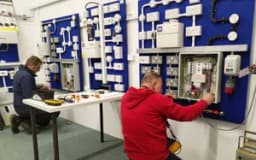
Inspecting bathroom installations requires detailed knowledge of zone requirements and permitted equipment.
Supplementary Bonding in Bathrooms
Regulation 701.415.2 addresses supplementary equipotential bonding in bathrooms. Supplementary bonding connects the protective conductor terminals of the circuits supplying equipment in the room to the accessible extraneous-conductive-parts — such as metallic water, gas, and waste pipes, central heating pipework, and accessible structural metalwork — to ensure they are all at the same electrical potential. This reduces the risk of electric shock from a voltage difference between simultaneously accessible metallic parts.
When Is Supplementary Bonding Required?
The 18th Edition allows supplementary bonding to be omitted in a bathroom if all of the following conditions are met:
- ✓All circuits in the location are protected by a 30mA RCD (see our guide to earthing and bonding for more on supplementary bonding)
- ✓All final circuits comply with the requirements for automatic disconnection per Regulation 411.3.2
- ✓Main protective bonding conductors are connected to all extraneous-conductive-parts entering the location (water, gas, etc.)
If any one of these conditions is not met, supplementary bonding must be installed. In older properties undergoing periodic inspection, it is common to find that these conditions are not fully satisfied, in which case supplementary bonding is still required.
Check Before Removing Bonding
Never remove existing supplementary bonding without verifying that all three conditions for its omission are met. During an EICR, if you identify that supplementary bonding is absent and the conditions for omission are not satisfied, this should be recorded as a deficiency. It is safer to install bonding than to assume the conditions are met.
Part P and Bathroom Electrical Work
Electrical work in bathrooms may be notifiable under Part P of the Building Regulations (England and Wales). Part P applies to electrical installation work in dwellings and requires that certain types of work are either carried out by a person registered with a competent person scheme or notified to the local authority building control before work begins.
What Is Notifiable?
In a bathroom (a special location), the following work is notifiable:
- ✓Installing a new circuit (e.g., a new shower circuit or new lighting circuit)
- ✓Consumer unit replacement (if the bathroom circuit is affected)
- ✓Any work that involves a new circuit in a special location
What Is Not Notifiable?
- ✓Like-for-like replacement of accessories (e.g., replacing a light fitting in the same position)
- ✓Replacing a damaged cable section on an existing circuit
- ✓Adding a fused spur to an existing circuit outside the zones
The most common route for compliance is registration with a competent person scheme such as NICEIC or NAPIT. Scheme members can self-certify their own work without needing to involve building control. Non-registered electricians must notify building control, who will arrange for the work to be inspected — this adds cost and delay.
Qualification Requirement
To register with a competent person scheme and self-certify bathroom electrical work, you will need the 18th Edition qualification (City & Guilds 2382) as a minimum. Most schemes also require the Inspection & Testing qualification (City & Guilds 2391) to demonstrate competence in testing and certification.
Related Course
18th Edition (2382)
The 18th Edition qualification is the minimum requirement for competent person scheme registration.
Related Course
Inspection & Testing (2391)
The 2391 qualification demonstrates competence in testing and certification, required by most competent person schemes.
Frequently Asked Questions
Can you have a socket outlet in a bathroom?
What IP rating do I need for a bathroom light?
Do all bathroom circuits need RCD protection?
Is bathroom electrical work notifiable under Part P?
Can I install a heated towel rail in a bathroom?
Ready to Start Training?
Browse our City & Guilds accredited courses and take the next step in your electrical career.
Related Guides
Kitchen Electrical Regulations: Circuits, RCDs & Positioning
Electrical requirements for kitchens — circuit design, RCD protection, socket positioning, and common installation mistakes.
Read guideOutdoor & Garden Electrical Regulations
Regulations for outdoor electrical installations — garden lighting, outbuilding supplies, IP ratings, RCD protection, and Part P requirements.
Read guideHot Tub Electrical Requirements: Supply, RCD & Installation
Electrical requirements for hot tub installations — supply sizing, RCD protection, cable selection, and BS 7671 compliance.
Read guideSwimming Pool Electrical Regulations (BS 7671 Section 702)
Electrical regulations for swimming pools and fountains — zones, equipotential bonding, permitted equipment, and testing requirements.
Read guide