
Swimming Pool Electrical Regulations (BS 7671 Section 702)
Electrical regulations for swimming pools and fountains — zones, equipotential bonding, permitted equipment, and testing requirements.
In this guide
Swimming Pools as Special Locations
Swimming pools present one of the highest electrical risks of any installation. The combination of large volumes of water, wet surroundings, bare skin, and reduced body resistance makes the potential for fatal electric shock far greater than in most other environments. A fault current that might cause only a mild sensation in a dry room can be lethal when a person is immersed in or standing near a body of water.
For this reason, BS 7671 Section 702 imposes some of the most restrictive requirements of any special location. Section 702 applies to the basins of swimming pools, paddling pools, and fountain basins, as well as the surrounding areas where people may be wet or barefoot. The regulations cover private domestic pools, commercial leisure centres, hotel pools, and decorative fountain installations alike. Similar zone-based requirements apply in bathrooms and outdoor installations, though swimming pool zones are more extensive.
Section 702 defines specific zones around the pool, restricts the types of equipment and wiring methods permitted in each zone, mandates supplementary equipotential bonding, and requires thorough testing and certification. Any electrician working on pool installations must have a detailed understanding of these requirements before starting work.
Swimming Pool Zones Explained
BS 7671 Section 702 divides the area in and around a swimming pool into three zones. Each zone has different requirements for the types of equipment permitted, voltage limits, and IP ratings. The zones are more extensive than bathroom zones, reflecting the greater risk associated with swimming pools.
Zone 0 — Inside the Pool Basin
Zone 0 is the interior of the swimming pool, paddling pool, or fountain basin itself. This includes any recesses in the pool walls or floor, such as those for underwater lighting or water inlets. Zone 0 is the highest-risk area, where people are fully or partially immersed in water.
Zone 0: Maximum Restriction
Only SELV equipment at a maximum of 12V AC or 30V DC is permitted in Zone 0. Equipment must be specifically designed for use inside the pool basin — such as underwater luminaires and pool pumps — and must be rated for permanent submersion. The SELV safety source must be installed outside Zones 0, 1, and 2.
Zone 1 — Up to 2m Horizontally from the Pool Rim
Zone 1 extends 2m horizontally from the rim of the pool (or the edge of the water surface for pools without a defined rim) and 2.5m vertically above the floor level. If the ceiling is lower than 2.5m, Zone 1 extends to the ceiling. This zone covers the immediate poolside area where people are likely to be wet, barefoot, and in close proximity to the water.
- ✓Only equipment specifically designed for the location is permitted
- ✓SELV at a maximum of 25V AC or 60V DC is permitted
- ✓Minimum IP rating: IPX4 (IPX5 where water jets are used for cleaning)
- ✓No socket outlets permitted
- ✓No switchgear or controlgear permitted
- ✓Fixed equipment such as pool pumps and filtration units may be installed if specifically designed for the purpose
Zone 1 Height Limit
Zone 1 extends to 2.5m above floor level, or to the ceiling if the ceiling is lower than 2.5m. In indoor pool halls with high ceilings, this means equipment installed above 2.5m (such as high-level lighting or ventilation) is outside Zone 1. For outdoor pools, there is no ceiling — Zone 1 extends to 2.5m above the surrounding ground level.
Zone 2 — 1.5m Beyond Zone 1
Zone 2 extends 1.5m horizontally beyond the boundary of Zone 1 (i.e., 3.5m total from the pool rim) and to the same height as Zone 1 (2.5m above floor level, or to the ceiling if lower). This zone provides a transitional area with somewhat relaxed requirements compared to Zones 0 and 1, but restrictions still apply.
- ✓Equipment must have a minimum IP rating of IPX2 indoors or IPX4 outdoors (IPX5 where water jets are used)
- ✓Socket outlets are permitted only where the circuit is protected by SELV, electrical separation, or a 30mA RCD
- ✓Switching devices are permitted under the same conditions as socket outlets
- ✓Equipment should be suitable for the humid environment
No Zone 2 for Fountains
For fountain basins in public areas, BS 7671 does not define a Zone 2 — only Zones 0 and 1 apply. This is because fountain basins are often in open public spaces where defining an extended zone would be impractical. However, the supplementary bonding and other protective requirements still apply.
Related Course
18th Edition (2382)
Swimming pool zone definitions and permitted equipment are covered in detail in the 18th Edition course.
What Is Permitted in Each Zone
The type and voltage of equipment permitted in each zone is strictly defined by Section 702. Getting this wrong creates a serious risk of fatal electric shock. Here is a summary of what is and is not permitted in each zone.
Zone 0
- ✓Only SELV equipment rated at maximum 12V AC or 30V DC
- ✓SELV safety source must be located outside Zones 0, 1, and 2
- ✓Equipment must be fixed and specifically designed for use in the pool (e.g., underwater luminaires, pool circulation pumps)
- ✓Equipment must be rated for permanent submersion (typically IPX8)
- ✓No mains-voltage equipment of any kind
Zone 1
- ✓SELV at a maximum of 25V AC or 60V DC
- ✓Fixed equipment specifically designed for the location
- ✓Minimum IP rating: IPX4 (IPX5 where water jets are used for cleaning)
- ✓No socket outlets permitted
- ✓No switchgear or controlgear permitted
- ✓Pool pump control units and filtration equipment if specifically designed for poolside installation
Zone 2
- ✓Equipment with minimum IP rating of IPX2 indoors or IPX4 outdoors (IPX5 where water jets are used)
- ✓Socket outlets permitted only where the circuit is protected by SELV, electrical separation, or a 30mA RCD
- ✓Luminaires and other fixed equipment suitable for the conditions
- ✓Switching devices and accessories suitable for the humid environment
SELV Safety Source Location
The safety source (transformer or driver) for any SELV circuit serving Zones 0 or 1 must be installed outside all three zones. This is a critical requirement — placing a mains-connected transformer inside Zone 1 defeats the purpose of using SELV in the first place. The transformer must also comply with BS EN 61558-2-6 for swimming pool applications.
Supplementary Equipotential Bonding
Regulation 702.415.2 requires supplementary equipotential bonding in swimming pool installations. This is one of the most important safety measures for pool locations. Unlike bathrooms, where supplementary bonding may be omitted if certain conditions are met, swimming pool installations always require supplementary bonding — there is no exemption. The 18th Edition is clear on this requirement.
What Must Be Bonded?
Supplementary bonding must connect all extraneous-conductive-parts and exposed-conductive-parts within Zones 0, 1, and 2. This includes:
- ✓Metal pool structures, frameworks, and reinforcement (including steel rebar in concrete pools)
- ✓Metal ladders, handrails, grab rails, and diving board structures
- ✓Metal water pipes, drainage pipes, and heating pipes
- ✓Metal air-conditioning and ventilation ducts
- ✓Exposed metalwork of any electrical equipment in the zones
- ✓Metal window frames, door frames, and structural metalwork within the zones
- ✓Metal grilles, gratings, and drain covers
Bonding in Concrete Pools
In reinforced concrete pools, the steel reinforcing mesh (rebar) within the concrete structure should be connected into the supplementary bonding system. This ensures the pool structure itself is at the same potential as all other metalwork. A bonding connection should be made to the reinforcement and brought out to an accessible point for testing. This is best arranged during construction before the concrete is poured.
A supplementary bonding conductor connecting two extraneous-conductive-parts must have a minimum cross-sectional area of 2.5mm² (copper) if mechanically protected, or 4mm² if not mechanically protected (Regulation 544.2.3). All bonding connections should be accessible for inspection and testing, and must be protected against corrosion — particularly important in the chlorinated, humid environment around a swimming pool.
No Omission for Pools
Unlike bathrooms (where supplementary bonding may be omitted if all circuits have 30mA RCD protection and other conditions are met), there is no provision to omit supplementary bonding in swimming pool installations. Regulation 702.415.2 applies in all cases regardless of other protective measures.
Wiring Methods
The wiring methods used in swimming pool installations must minimise the risk of damage and ensure continued safe operation in a demanding environment. Cables are exposed to moisture, chlorine, heat from plant equipment, and potential mechanical damage. Section 702 sets specific requirements for cable routing and selection.
Cable Routing
- ✓Cables should be routed to avoid Zones 0 and 1 wherever possible
- ✓Where cables must pass through Zones 0 or 1, they should be installed in conduit or trunking to provide mechanical protection
- ✓Cables supplying equipment in Zone 0 may pass through Zones 1 and 2 but must be suitable for the conditions
- ✓Metal conduit and trunking within the zones must be included in the supplementary bonding system
Suitable Wiring Systems
The following wiring methods are suitable for swimming pool installations:
- ✓PVC conduit (non-metallic) — avoids bonding requirements and corrosion issues
- ✓Metallic conduit or trunking — must be bonded and corrosion-resistant
- ✓Steel wire armoured (SWA) cable — provides inherent mechanical protection
- ✓Cables with thermoplastic (PVC) or thermosetting (XLPE) insulation suitable for the ambient temperature
- ✓Mineral-insulated cable (MICC) — excellent for high-temperature and corrosive environments
Chlorine Corrosion
The atmosphere around indoor swimming pools is highly corrosive due to chlorine vapour. Standard steel accessories, conduit, and fixings will corrode rapidly. Specify stainless steel or plastic accessories, and ensure all metalwork is rated for use in corrosive environments. Galvanised steel is not sufficient — chlorine attacks the zinc coating.
Junction boxes and connections within the zones should be kept to a minimum. Where they are necessary, they must be suitable for the zone (correct IP rating) and accessible for inspection. Connections should be made using appropriate IP-rated enclosures, not standard domestic junction boxes.
Testing and Certification
Swimming pool installations require thorough testing to verify that all protective measures are in place and functioning correctly. The consequences of a fault in a pool installation can be fatal, so testing must be rigorous and comprehensive. An Electrical Installation Certificate (EIC) must be issued on completion.
Key Tests
- ✓Continuity of protective conductors, including all supplementary bonding connections
- ✓Supplementary bonding resistance — must not exceed the value required by Regulation 415.2 to ensure adequate fault protection
- ✓Insulation resistance of all circuits — particularly important in the humid, corrosive pool environment
- ✓RCD operation — all 30mA RCDs must trip within the required time at rated and five times rated residual current
- ✓SELV circuit verification — confirm separation from mains circuits and correct voltage at the equipment
- ✓Polarity checks on all circuits
- ✓Earth fault loop impedance — to confirm disconnection times are met
Periodic Inspection Frequency
Swimming pool installations should be inspected and tested more frequently than standard domestic installations. The IET Guidance Note 3 recommends a maximum interval of one year for swimming pool installations, compared to five years (or ten years for owner-occupied homes) for general domestic installations. The harsh environment accelerates deterioration of cables, connections, and equipment.
Documentation
On completion of a new swimming pool installation or a significant alteration, an Electrical Installation Certificate (EIC) must be issued. This must include full schedules of test results for all circuits. For periodic inspections, an Electrical Installation Condition Report (EICR) is required. Given the critical nature of pool installations, ensure that all test results are recorded accurately and that the certificate clearly identifies the special location requirements that have been verified.
Related Course
Inspection & Testing (2391)
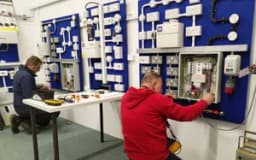
Testing and certifying swimming pool installations requires the 2391 qualification — covering all the specialist tests needed for special locations.
Related Course
18th Edition (2382)
Understanding the regulatory requirements of Section 702 is essential before testing — the 18th Edition course covers all special locations in BS 7671.
Frequently Asked Questions
Can you have a socket outlet near a swimming pool?
What IP rating is required for swimming pool lighting?
Is swimming pool electrical work notifiable under Part P?
Do swimming pool circuits need RCD protection?
What voltage is allowed inside a swimming pool?
Ready to Start Training?
Browse our City & Guilds accredited courses and take the next step in your electrical career.
Related Guides
Bathroom Electrical Regulations: Zones, IP Ratings & Requirements
BS 7671 Section 701 explained — bathroom zones 0 to 2, IP rating requirements, RCD protection, and what can be installed where.
Read guideKitchen Electrical Regulations: Circuits, RCDs & Positioning
Electrical requirements for kitchens — circuit design, RCD protection, socket positioning, and common installation mistakes.
Read guideOutdoor & Garden Electrical Regulations
Regulations for outdoor electrical installations — garden lighting, outbuilding supplies, IP ratings, RCD protection, and Part P requirements.
Read guideHot Tub Electrical Requirements: Supply, RCD & Installation
Electrical requirements for hot tub installations — supply sizing, RCD protection, cable selection, and BS 7671 compliance.
Read guide