
Outdoor & Garden Electrical Regulations
Regulations for outdoor electrical installations — garden lighting, outbuilding supplies, IP ratings, RCD protection, and Part P requirements.
In this guide
Outdoor Electrical Work Overview
Demand for outdoor electrical installations has grown significantly in recent years. Homeowners increasingly want garden lighting, power supplies to sheds and outbuildings, outdoor entertainment areas, hot tub installations, and electric vehicle charging points. All of these require careful consideration of the additional hazards that outdoor environments present — primarily water ingress, mechanical damage, and increased earth fault risk.
The key point for electricians and homeowners alike is that most significant outdoor electrical work — anything involving a new circuit — is notifiable under Part P of the Building Regulations. Any new circuit supplying outdoor equipment, lighting, or socket outlets must either be installed by an electrician registered with a competent person scheme or notified to building control. The regulations exist because outdoor installations are exposed to harsher conditions than indoor wiring, and the consequences of a fault — particularly electric shock — can be more severe when people are in contact with the ground.
BS 7671 (the 18th Edition wiring regulations) contains specific requirements for outdoor installations. Section 702 covers swimming pools and other basins (relevant to hot tubs), while general requirements for IP ratings, RCD protection, cable selection, and earthing apply throughout. Electricians working on outdoor installations need a thorough understanding of these regulations to ensure safety and compliance.
IP Ratings for Outdoor Equipment
IP (Ingress Protection) ratings define how well an electrical enclosure resists the entry of solid objects and water. The rating consists of two digits: the first indicates protection against solids (0 to 6), the second against water (0 to 9). For outdoor electrical installations, the water protection rating is critical.
Minimum Requirements by Location
- ✓IPX4 (splash proof) — minimum for sheltered locations such as under a porch roof, covered patio, or carport where the equipment is protected from direct rainfall
- ✓IP65 or IP66 — recommended for exposed locations where equipment is subject to rain, wind-driven spray, and general weather exposure. IP65 protects against low-pressure water jets; IP66 protects against powerful jets
- ✓IP67 — required for in-ground installations such as recessed ground lights or junction boxes buried at or below ground level. IP67 provides protection against temporary immersion in water
When selecting equipment, always choose the IP rating appropriate to the actual installation conditions, not just the minimum. A socket outlet under a deep porch might technically need only IPX4, but if it is at risk of being hit by a garden hose, IP66 is the safer choice. The IP rating must be maintained after installation — cable entries must use correctly sized glands and any unused knockouts must be blanked off.
Practical Advice
Always check that accessories maintain their stated IP rating once cables are connected. A common mistake is to use an IP66 enclosure but leave cable entries unsealed, which reduces the effective rating to IP00. Use appropriate cable glands or compression fittings rated for outdoor use.
RCD Protection for Outdoor Circuits
BS 7671 is clear on this point: all outdoor circuits require 30mA RCD protection. This applies to every circuit supplying equipment outside the building, whether it is lighting, socket outlets, fixed equipment such as hot tubs, or a supply to an outbuilding. There are no exceptions for outdoor circuits in domestic installations.
The 30mA RCD is specifically designed to protect against electric shock. It detects an imbalance between the line and neutral conductors — indicating that current is flowing to earth through an unintended path, potentially through a person. The device must disconnect the supply within 40 milliseconds at five times the rated residual operating current (150mA for a 30mA device).
RCD Protection Is Non-Negotiable
Every outdoor circuit in a domestic installation must be protected by a 30mA RCD. This is a firm requirement of BS 7671 and applies regardless of the type of outdoor equipment being supplied. Failure to provide RCD protection on an outdoor circuit is a serious defect that would be coded C1 (danger present) or C2 (potentially dangerous) on an EICR.
Best practice is to use an individual RCBO for each outdoor circuit rather than a shared RCD protecting multiple circuits. This ensures that a fault on the outdoor circuit does not trip other indoor circuits. It also makes fault-finding easier because the tripped device immediately identifies the affected circuit.
Related Course
18th Edition (2382)
Understanding RCD protection requirements for outdoor circuits requires thorough knowledge of BS 7671.
Power to Outbuildings and Sheds
Supplying electricity to a detached outbuilding — whether a garden shed, workshop, summer house, or garage — is one of the most common outdoor electrical jobs. There are two principal methods: underground cable and overhead cable. Each has specific requirements.
Underground Supply (SWA Cable)
The preferred method is to run steel wire armoured (SWA) cable underground. SWA cable has a steel wire armouring layer that provides mechanical protection, making it suitable for direct burial. The key requirements are:
- ✓Minimum burial depth of 500mm below finished ground level
- ✓Cable laid on a bed of fine sand or sifted soil (no sharp stones)
- ✓Covered with a further layer of sand or sifted soil above the cable
- ✓Yellow and black electrical warning tape placed approximately 250mm below the surface, above the cable
- ✓Cable route recorded on installation drawings and provided to the property owner
- ✓SWA glands correctly fitted at both ends to maintain earthing continuity through the armour
Burial Depth Is Critical
The 500mm minimum burial depth is essential for protection against accidental damage from digging, garden forks, and rotavators. In areas where deeper cultivation is likely (such as vegetable gardens), consider burying the cable deeper or routing it around the cultivated area. Where the cable passes under a driveway or path, it should be routed through ducting for additional protection.
Overhead Supply
Where underground routing is impractical, cable can be run overhead using a catenary wire (a tensioned steel wire that supports the cable). The cable must be at a height that prevents accidental contact — a minimum of 3.5 metres above ground level for areas accessible only to pedestrians, and 5.2 metres where vehicles may pass underneath. The cable must be UV resistant or enclosed in UV-resistant conduit, as prolonged sunlight exposure degrades standard PVC sheathing.
Outbuilding Distribution
The outbuilding must have its own isolator (a switched fuse or small consumer unit) so the supply can be disconnected locally without returning to the main building. The earthing arrangement is an important consideration. If the main building has a TN-S or TN-C-S supply, the outbuilding earth can be extended from the main building via the SWA armour or a separate protective conductor. However, if there is any doubt about the integrity of the earth path, a separate TT earthing arrangement with its own earth electrode at the outbuilding is the safer option.
Earthing Advice
For outbuildings with a long cable run, consider installing a TT earth arrangement with a local earth electrode (rod) at the outbuilding. This provides a reliable earth path independent of the main building and is particularly important where the SWA cable run exceeds 20 to 30 metres. The earth electrode resistance should be verified by testing.
Garden Lighting
Garden lighting is one of the most popular outdoor electrical installations. There are two fundamentally different approaches, and the choice between them has significant implications for safety, regulation, and installation requirements.
Extra-Low Voltage (12V SELV)
SELV (Separated Extra-Low Voltage) lighting operates at 12V AC or DC via a safety isolating transformer or LED driver. At this voltage, there is no risk of electric shock, even in wet conditions or if the cable insulation is damaged. This makes SELV the preferred choice for garden lighting wherever possible.
- ✓No risk of electric shock — safe even if cables are accidentally cut
- ✓No RCD protection required for the low-voltage side
- ✓Cables can be buried at shallow depth or laid on the surface under mulch
- ✓Easy to install, reposition, and extend
- ✓The transformer or driver feeding the SELV circuit must be supplied from an RCD-protected indoor socket or fused connection unit
- ✓Wide range of LED fittings available (path lights, spike lights, deck lights, uplighters)
Mains Voltage (230V)
Mains voltage garden lighting provides more power and is necessary for high-output floodlights, large installations, or where long cable runs would cause excessive voltage drop on a 12V system. However, mains voltage outdoor lighting carries all the risks of any outdoor mains circuit and must meet full regulatory requirements.
- ✓Must be on a dedicated circuit protected by a 30mA RCD (or RCBO)
- ✓All fittings must have appropriate IP ratings for their location
- ✓Cable must be suitable for outdoor use — SWA for buried runs, or PVC in conduit
- ✓Buried cable must be at minimum 500mm depth with warning tape
- ✓The circuit is notifiable under Part P
- ✓Switching can be via outdoor IP-rated switches, indoor switches, photocells, PIR sensors, or time clocks
Design Consideration
For most domestic garden lighting, 12V SELV is the better choice. It is safer, easier to install, and does not require Part P notification. Reserve mains voltage for situations where the additional power is genuinely needed, such as security floodlights or large feature lighting schemes with long cable runs.
Outdoor Socket Outlets
Outdoor socket outlets provide convenient power for garden tools, pressure washers, lighting, and entertainment equipment. They are one of the most requested outdoor electrical installations, and the requirements are straightforward.
Installation Requirements
- ✓The socket must be housed in a weatherproof enclosure rated at least IP66
- ✓The circuit must be protected by a 30mA RCD — ideally a dedicated RCBO
- ✓Position the socket where it is sheltered from direct rain where possible
- ✓Mount at a practical height (typically 450mm to 1200mm above ground level)
- ✓Consider a lockable enclosure if the socket is accessible to children or the public
- ✓A dedicated outdoor circuit is best practice — avoid extending an existing indoor ring final to supply an outdoor socket
The socket enclosure must maintain its IP66 rating with the lid closed and, ideally, while a plug is inserted. Many weatherproof socket enclosures have a hinged cover with a cable entry slot that allows the cover to close with the plug in use, maintaining weather protection during operation.
Dedicated Circuit Recommended
While it is technically possible to spur an outdoor socket from an existing indoor ring final circuit, best practice is to install a dedicated circuit from the consumer unit. This provides independent RCD protection (via RCBO), makes fault-finding easier, and means a fault on the outdoor circuit does not affect indoor circuits.
Part P Notification Requirements
Part P of the Building Regulations covers electrical safety in dwellings. It requires that certain types of electrical work are either carried out by a person registered with a competent person scheme or notified to the local authority building control department.
What Is Notifiable?
For outdoor electrical work, the following are notifiable:
- ✓Installation of a new outdoor circuit (lighting, sockets, or fixed equipment)
- ✓Running a supply to an outbuilding, shed, or garage
- ✓Any new circuit in a special location (including locations containing hot tubs, which are treated similarly to bathrooms)
- ✓Addition of a new circuit to the consumer unit
- ✓Replacement of the consumer unit itself
How to Comply
There are two routes to compliance. The first is to use an electrician registered with a competent person scheme such as NICEIC or NAPIT. Registered electricians can self-certify their work and issue the appropriate certificates directly. The second route is for the homeowner or an unregistered electrician to notify building control before starting work, pay an inspection fee, and have the completed work inspected by a building control officer.
After completion, the electrician must issue an Electrical Installation Certificate (EIC) covering the new work. This certificate records the design, construction, and test results of the installation. A copy must be provided to the customer and, where applicable, to building control.
Related Course
Inspection & Testing (2391)
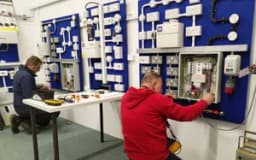
Full testing and certification of outdoor installations requires the 2391 qualification.
Frequently Asked Questions
Do I need an electrician for outdoor garden lighting?
What IP rating do I need for outdoor sockets?
How deep should outdoor electrical cable be buried?
Is running power to a shed notifiable under Part P?
Can I use a normal extension lead outside?
Ready to Start Training?
Browse our City & Guilds accredited courses and take the next step in your electrical career.
Related Guides
Bathroom Electrical Regulations: Zones, IP Ratings & Requirements
BS 7671 Section 701 explained — bathroom zones 0 to 2, IP rating requirements, RCD protection, and what can be installed where.
Read guideKitchen Electrical Regulations: Circuits, RCDs & Positioning
Electrical requirements for kitchens — circuit design, RCD protection, socket positioning, and common installation mistakes.
Read guideHot Tub Electrical Requirements: Supply, RCD & Installation
Electrical requirements for hot tub installations — supply sizing, RCD protection, cable selection, and BS 7671 compliance.
Read guideSwimming Pool Electrical Regulations (BS 7671 Section 702)
Electrical regulations for swimming pools and fountains — zones, equipotential bonding, permitted equipment, and testing requirements.
Read guide