
Electrical Exam Tips: How to Pass City & Guilds Exams
Practical exam tips for City & Guilds electrical qualifications — revision strategies, time management, and common pitfalls.
In this guide
Passing Your Electrical Exams
City & Guilds exams can feel daunting, especially if you have been out of education for a while. But with the right preparation, they are very achievable. Thousands of people pass these exams every year, and the key to success is understanding the exam format, preparing effectively, and managing your time on the day.
This guide covers practical exam tips for the three main City & Guilds electrical qualifications: the 18th Edition (2382-26), the Inspection and Testing (2391-52), and the Diploma in Electrical Installations (2365). Each has a different format and requires a different approach to revision.
The most important tip
Start revising early and spread your preparation over weeks, not days. Cramming the night before rarely works for technical exams. Regular, shorter revision sessions are far more effective than occasional marathon sessions.
18th Edition Exam (2382-26)
The 18th Edition exam is an open-book exam, meaning you can bring your copy of BS 7671 (the wiring regulations book) into the exam room. This makes preparation fundamentally different from a closed-book exam — the focus is on knowing where to find information quickly rather than memorising every regulation.
Exam Format
- ✓Online or paper-based multiple-choice exam
- ✓Approximately 60 questions
- ✓Two-hour time limit
- ✓Open book — BS 7671 is allowed
- ✓No other reference materials permitted
- ✓Pass mark typically around 60 percent
How to Tab Your BS 7671
Tabbing your BS 7671 is the single most important preparation step. Use coloured adhesive tabs to mark the sections you are most likely to need. The key chapters to tab are:
- ✓Chapter 41: Protection against electric shock (automatic disconnection of supply)
- ✓Chapter 42: Protection against thermal effects
- ✓Chapter 43: Protection against overcurrent
- ✓Chapter 52: Selection and erection of wiring systems
- ✓Chapter 53: Switching and control (includes RCD selection)
- ✓Part 6: Inspection and testing
- ✓Part 7: Special locations (bathrooms, swimming pools, etc.)
- ✓Appendix 4: Current-carrying capacities of cables
Use different coloured tabs for different sections so you can navigate quickly. The time saved by efficient tabbing can make the difference between passing and failing. Practise finding regulations before the exam — ask yourself questions and time how quickly you can locate the answer.
Revision Tips for 2382
- ✓Do not try to memorise the entire book — focus on understanding key principles
- ✓Practise using the book to answer questions quickly
- ✓Complete at least three full practice papers under timed conditions
- ✓Focus on calculation-type questions (cable selection, fault current)
- ✓Understand the definitions in Part 2 — questions often hinge on exact wording
- ✓Pay attention to Amendment 4 changes — recent amendments feature heavily
Related Course
18th Edition (2382)
Our 18th Edition course includes comprehensive exam preparation and practice papers.
Inspection & Testing Exam (2391-52)
The 2391-52 is widely considered the most challenging of the City & Guilds electrical exams. It has two components: a written paper and a practical assessment. Both require thorough preparation, but the practical element is where most candidates struggle.
Written Paper
- ✓Approximately two hours
- ✓Mix of multiple-choice and short-answer questions
- ✓Covers testing procedures, regulation references, and certification
- ✓BS 7671 and the IET Guidance Note 3 are allowed
- ✓Questions focus on why you test, not just how
Practical Assessment
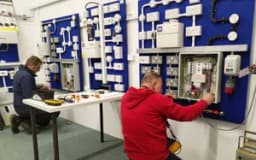
The practical assessment is typically a full day, approximately six hours. You are given a real electrical installation to inspect and test. You must carry out a complete sequence of tests, record all results accurately, and complete either an EICR or EIC depending on the scenario.
- ✓Carry out a visual inspection of the installation
- ✓Perform dead tests: continuity of protective conductors, ring circuit continuity, insulation resistance
- ✓Perform live tests: earth fault loop impedance, RCD operation, prospective fault current
- ✓Record all results on the correct forms
- ✓Identify defects and assign appropriate observation codes
- ✓Complete the certification (EIC or EICR) accurately
Key Tips for the 2391 Practical
- ✓Practise the full test sequence until it becomes second nature
- ✓Know the correct order of tests (dead before live, always)
- ✓Bring your own multifunction tester and know how to use it efficiently
- ✓Write neatly — illegible results lose marks
- ✓Check your readings make sense (an insulation resistance of 0.5 megohms should ring alarm bells)
- ✓Manage your time — do not spend too long on any single test
- ✓Practise safe isolation every time, even if it feels slow
Common pitfall
The most common reason for failing the 2391 practical is running out of time. Candidates who are not fluent with their test equipment waste minutes on each measurement, which adds up over a full day of testing. Practise until you can perform each test quickly and confidently.
Related Course
Inspection & Testing (2391)
Our 2391 course includes extensive practical sessions and a mock exam to prepare you thoroughly.
Diploma Exams (2365)
The 2365 Diploma in Electrical Installations includes a mix of assessment types at both Level 2 and Level 3. These include online multiple-choice tests, written exams, and practical assessments completed during the course.
Assessment Types
- ✓Online GOLA tests: multiple-choice, computer-based, completed during the course
- ✓Written end-of-unit exams: short answer and scenario-based questions
- ✓Practical assessments: observed installation tasks in the workshop
- ✓Portfolio evidence: documented work and assignments throughout the course
Tips for 2365 Level 2
- ✓Focus on understanding electrical science fundamentals (Ohm's law, power formula, series and parallel circuits)
- ✓Learn the colour codes for cables and wiring systems
- ✓Understand health and safety requirements thoroughly
- ✓Practise practical skills (terminations, wiring accessories) outside of class time
- ✓Keep your portfolio organised and up to date throughout the course
Tips for 2365 Level 3
- ✓Understand three-phase systems and how they differ from single-phase
- ✓Focus on fault diagnosis techniques and logical fault-finding approaches
- ✓Be confident with design calculations (cable sizing, volt drop, circuit protection)
- ✓Practise reading electrical drawings and schedules
- ✓Understand the theory behind inspection and testing procedures
General Exam Day Tips
Regardless of which exam you are sitting, the following tips apply to all City & Guilds electrical assessments.
Before the Exam
- ✓Get a good night's sleep — tired brains make more mistakes
- ✓Arrive at least 30 minutes early to settle in
- ✓Bring all required materials: ID, calculator, BS 7671, stationery
- ✓Eat a proper breakfast or lunch — exams are mentally demanding
- ✓Review your notes briefly, but do not try to learn new material
During the Exam
- ✓Read every question twice before answering
- ✓Look for key words: always, never, must, should, may — these change the meaning
- ✓Eliminate obviously wrong answers to improve your odds on difficult questions
- ✓Do not spend too long on any single question — move on and come back
- ✓Manage your time: if there are 60 questions in 120 minutes, you have 2 minutes each
- ✓Check your answers if you finish early — first instincts are usually right, but catch careless errors
If You Do Not Pass
Failing an exam is not the end of the world. Many successful electricians did not pass every exam on the first attempt. Analyse which areas you were weakest in, get additional support from your training provider, and rebook the exam once you feel confident. The resit fee is £60 at our centre for written and multiple-choice exams.
Revision sessions
Many training providers offer free or low-cost revision sessions before exams. These are invaluable because they focus on the most commonly tested topics and give you a chance to ask questions about anything you find confusing. Always attend revision sessions if they are available.
Recommended Revision Resources
Good revision materials make a significant difference to your exam performance. Here are the most useful resources for each qualification.
For All Electrical Exams
- ✓City & Guilds official practice papers (available from their website)
- ✓IET Guidance Notes (especially GN3 for inspection and testing)
- ✓Brian Scaddan textbooks (widely used and clearly written)
- ✓Online practice tests (websites like SparkyFacts and Electrical Exam Academy)
- ✓YouTube tutorials for visual learning of practical skills
For the 18th Edition Specifically
- ✓A clean, well-tabbed copy of BS 7671
- ✓IET On-Site Guide (companion to BS 7671)
- ✓18th Edition practice exams (multiple books available)
- ✓The IET website has free resources and regulation updates
Combining self-study with course attendance, practice papers, and revision sessions gives you the best chance of passing every exam on the first attempt. Most people who fail do so because of insufficient preparation, not because the exams are too difficult.
Related Course
18th Edition (2382)
Our 18th Edition course includes all study materials and guided exam preparation.
Frequently Asked Questions
What is the pass mark for City & Guilds electrical exams?
Can I retake a City & Guilds exam if I fail?
Is the 18th Edition exam open book?
How long is the 2391 practical exam?
Are there practice papers available for electrical exams?
What should I bring to an electrical exam?
Ready to Start Training?
Browse our City & Guilds accredited courses and take the next step in your electrical career.
Related Guides
ELCAS Funding for Electrical Training: Full Guide
How Enhanced Learning Credits work, eligibility requirements, and how to use ELCAS funding for electrical training.
Read guideFunding Your Electrician Training: All Options
Every funding option for electrical training — ELCAS, bursaries, payment plans, employer sponsorship, and government schemes.
Read guideFree Electrician Courses UK: What's Actually Available (2026)
Free electrical courses in the UK, explained for 2026 — apprenticeships, FE college funding, Skills Bootcamps and ELCAS, and what "free" actually costs you.
Read guideHow Much Does an Electrician Make? UK Salary Guide 2026
UK electricians make £39,039 on average (ONS 2025) — £18.38–£22.70/hr on JIB 2026 rates, £45k–£70k self-employed. Hourly, monthly, annual and London pay.
Read guide