
How to Become an EV Charger Installer
The qualifications, training, and steps needed to install electric vehicle charging points in the UK.
In this guide
Why EV Charger Installation Is a Booming Career
The UK electric vehicle market is growing at over 30% year on year. In 2023, there were more than one million fully electric vehicles on UK roads, and that number is accelerating rapidly as the government pushes towards its target of banning the sale of new petrol and diesel cars by 2030. Every one of those vehicles needs a way to charge, and the vast majority of EV owners want a dedicated home charger installed by a qualified electrician.
For qualified electricians, EV charger installation represents one of the fastest-growing and most accessible specialisms available. The business opportunity is significant, and the barrier to entry is relatively low compared to other green technologies — if you already hold your 18th Edition and full electrician qualifications, you can complete the City & Guilds 2921-34 course in as little as two days and start installing chargers immediately.
This guide covers everything you need to know: the qualifications required, the training pathway, the regulations you must follow, the available grants, and the earning potential in this rapidly expanding market.
Prerequisites: What You Need Before You Start
EV charger installation is not an entry-level qualification. You cannot take the EV charger installation course without first being a competent, qualified electrician. The prerequisites reflect the fact that installing a charger involves working with your customer's electrical supply, consumer unit, and earthing arrangements — all of which require a thorough understanding of BS 7671 and safe working practices.
Mandatory prerequisites
You must hold one of the following: ECS Gold Card, JIB Electrician Card, JIB Approved Electrician Card, or City & Guilds Level 3 NVQ in Electrotechnical Systems. Your qualification must have been achieved within the last 5 years, or you must provide evidence of remaining current through relevant CPD such as the 18th Edition course (2382-26).
Strongly recommended
- ✓City & Guilds 2391-52 Inspection and Testing — needed to sign off your own work
- ✓Registration with a competent person scheme such as NICEIC or NAPIT — required for Part P self-certification
If you are a career changer who does not yet hold these qualifications, you will need to complete the full electrician training pathway first. The Level 2 and Level 3 Diplomas, 18th Edition, NVQ, and 2391 Inspection and Testing collectively take around 18 to 24 months to complete through the adult diploma route.
Related Course
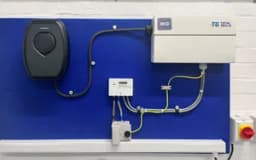
EV Charging (2921)
For qualified electricians meeting the prerequisites above
Important: Part P and notifiable work
The City & Guilds 2921-34 EV Charging Course
The City & Guilds 2921-34 is the recognised qualification for domestic and small commercial EV charger installation — see our EV charging course guide for full course content. The course title is Requirements for Electrical Vehicle Charging Equipment Installation, and it covers the design, installation, and commissioning of EV charging equipment in accordance with BS 7671 and the IET Code of Practice for Electric Vehicle Charging Equipment Installation.
What you will learn
- ✓Types of EV charging equipment: Mode 1, 2, 3, and 4 charging explained
- ✓Design considerations for domestic single-phase installations (up to 7kW)
- ✓Cable selection, circuit design, and protective device coordination
- ✓Earthing requirements and the specific concerns around PME (Protective Multiple Earthing) supplies
- ✓Load management and demand response — ensuring the charger does not overload the supply
- ✓IET Code of Practice requirements for EV charging installations
- ✓Commissioning, testing, and handover procedures
- ✓OZEV scheme requirements for grant-funded installations
Assessment
The 2921-34 is assessed through an online multiple-choice examination. You need to demonstrate an understanding of the relevant sections of BS 7671 (particularly Section 722), the IET Code of Practice, and the practical aspects of EV charger design and installation. Some providers also include a practical element to build hands-on competence.
Related Course
EV Charging (2921)
Our C&G 2921-34 EV charging course — a 2-day intensive course
The IET Code of Practice for EV Charging
The IET Code of Practice for Electric Vehicle Charging Equipment Installation is the essential reference document for anyone installing EV chargers in the UK. Published by the Institution of Engineering and Technology, it provides detailed guidance that goes beyond the minimum requirements of BS 7671 Section 722.
Key areas covered
- ✓Site assessment and survey requirements before installation
- ✓Selection of charging equipment for different scenarios (domestic, workplace, public)
- ✓Cable sizing calculations specific to EV charging loads
- ✓PME earthing arrangements and when a separate earth electrode is required
- ✓Load management strategies to prevent supply overload
- ✓Communication protocols between chargers and vehicles
- ✓Signage, labelling, and documentation requirements
PME earthing: a critical concern
OZEV Grants and Approved Installer Schemes
The Office for Zero Emission Vehicles (OZEV), previously known as OLEV, administers government grants to support EV charger installation. Understanding the grant landscape is important because it affects both your customers and the schemes you may need to join.
Current grant availability (2024 onwards)
The Electric Vehicle Homecharge Scheme (EVHS) grant for homeowners ended in April 2022. However, grants remain available for several categories:
- ✓Renters and flat owners: up to 75% of costs, capped at 500 pounds per socket (from 1 April 2026), through the EV chargepoint grant
- ✓Residential car parks for flats: grants for chargepoints in residential buildings with dedicated parking
- ✓Workplace Charging Scheme (WCS): businesses can claim up to 500 pounds per socket for up to 40 sockets
- ✓On-street residential chargepoint scheme: local authorities can apply for funding for chargepoints near residential areas
Becoming an OZEV-approved installer
To carry out grant-funded installations, you must be registered with an OZEV-approved installer scheme. This typically requires you to be a member of a competent person scheme (such as NICEIC or NAPIT), hold the relevant EV charging qualification (C&G 2921-34 or equivalent), and comply with the OZEV Minimum Technical Specification for chargepoint installations.
Commercial opportunity
The EV Charging Market: Growth and Opportunity
The UK government has confirmed that the sale of new petrol and diesel cars will be banned from 2030 (with new hybrids permitted until 2035). This means the number of electric vehicles on UK roads will continue to grow dramatically over the next decade, driving demand for charging infrastructure at an unprecedented rate.
Key market statistics
- ✓Over 1 million fully electric vehicles registered in the UK by the end of 2024
- ✓EV sales growing at over 30% year on year
- ✓Approximately 80% of EV charging happens at home, creating massive demand for domestic installations
- ✓The UK needs an estimated 300,000 public chargepoints by 2030, up from around 50,000 in 2024
- ✓The government has committed 1.6 billion pounds to charging infrastructure
- ✓New building regulations require all new homes with parking to have an EV chargepoint from June 2022
For electricians, this represents a generational shift in the type of work available. EV charger installation is not a niche specialism — it is rapidly becoming a core part of what domestic and commercial electricians do every day. Those who qualify now will be well positioned as demand continues to accelerate.
Earning Potential
EV charger installation is well-paid work that can be completed efficiently by an experienced installer. The combination of high demand and a still-limited pool of qualified installers means that day rates and per-job earnings are strong.
Typical earnings
- ✓Average domestic installation charge to customer: 800 to 1,500 pounds (depending on complexity and location)
- ✓A straightforward installation takes 3 to 5 hours, meaning experienced installers can complete two per day
- ✓Typical day rate for EV-qualified electricians: 300 to 500 pounds
- ✓Commercial installations (workplace, fleet) command higher prices: 1,500 to 5,000 pounds per project
- ✓Ongoing maintenance and inspection contracts provide recurring revenue
The key to maximising earnings is efficiency and reputation. Installers who build relationships with EV charger manufacturers, property developers, and fleet operators can secure a steady pipeline of work at premium rates.
Related Course
EV Charging (2921)
Start earning in the EV charging market with the right qualification
Step-by-Step: How to Become an EV Charger Installer
Here is the complete pathway from deciding to specialise in EV charging to carrying out your first installation:
Step 1: Ensure your core qualifications are current
You need Level 2 and Level 3 electrical qualifications (C&G 2365 or equivalent), a current 18th Edition (C&G 2382-26), and ideally the 2391-52 Inspection and Testing. If your 18th Edition has expired, renew it before proceeding.
Step 2: Complete the C&G 2921-34 EV Charging course
This is the core qualification. The course typically takes 2 days and covers design, installation, and commissioning. Choose a training provider that includes practical hands-on elements alongside the theory and exam.
Step 3: Register with a competent person scheme
If you are not already registered with NICEIC, NAPIT, or another Part P scheme, do so. This allows you to self-certify your EV charger installations without involving building control. See our ECS cards explained guide for more on card and scheme requirements.
Step 4: Register as an OZEV-approved installer (optional but recommended)
If you want to carry out grant-funded installations for landlords, tenants, and workplaces, register with an OZEV-approved scheme. This opens up a significant stream of work.
Step 5: Build manufacturer relationships
Many EV charger manufacturers (Zappi, Wallbox, Easee, Pod Point, Tesla) have their own installer networks. Becoming an approved installer for one or more manufacturers gives you access to referrals, warranty work, and sometimes preferential equipment pricing.
Step 6: Start installing
With your qualifications, scheme registration, and manufacturer approval in place, you are ready to start. Market yourself to EV owners, property developers, and businesses. Word of mouth and online reviews are powerful drivers of new business in this sector.
Domestic vs Commercial: Which Route?
The C&G 2921-34 covers domestic and small commercial EV charger installation (single-phase units up to 7kW). If you want to install larger commercial and rapid chargers (22kW to 150kW and above), you will need additional training.
Domestic (2921-34)
- ✓Single-phase installations up to 7kW
- ✓Typical home wall-box chargers (Zappi, Wallbox, Easee, etc.)
- ✓Most common type of work — high volume, predictable
- ✓Lower barrier to entry
Commercial (2921-32/33)
- ✓Three-phase installations: 22kW to 150kW+ rapid chargers
- ✓Workplace, fleet, and public charging infrastructure
- ✓Load management systems and multiple charger coordination
- ✓Higher complexity, higher earnings per project
Related Course
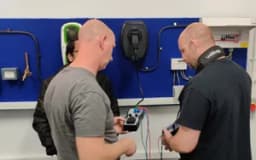
Large-Scale EV (2921)
For commercial and large-scale EV charging infrastructure
Key Regulations You Must Know
EV charger installation sits at the intersection of several regulatory frameworks. As an installer, you must understand and comply with all of them:
- ✓BS 7671 Section 722: the specific requirements for EV charging installations within the Wiring Regulations
- ✓IET Code of Practice for EV Charging Equipment Installation: detailed guidance beyond BS 7671
- ✓Part P of the Building Regulations: EV charger installation is notifiable electrical work
- ✓OZEV Minimum Technical Specification: required for grant-funded installations
- ✓Approved Document S: new buildings must have EV chargepoints (from June 2022)
- ✓The Electricity at Work Regulations 1989: general duty of care for all electrical work
Approved Document S
Getting Started: Your Next Steps
If you are already a qualified electrician with a current 18th Edition, the fastest route into EV charger installation is to complete the C&G 2921-34 course. At Total Skills, we run this course regularly at our Nottingham training centre, and it can be completed in as little as two days.
If you are not yet qualified as an electrician but want to work towards EV charger installation, start with the Level 2 Diploma and work through the full qualification pathway. The EV specialism can be added once you have your core qualifications in place.
Related Course
EV Charging (2921)
View dates, pricing, and payment plans for our EV charging course

Related Course
Level 2 & 3 Package
Starting from scratch? Our Level 2 & 3 Diploma package is the fastest route
Frequently Asked Questions
What qualifications do I need to install EV chargers?
Can I install EV chargers without being a fully qualified electrician?
How long does it take to get qualified for EV charger installation?
Is the OZEV grant still available?
How much can I earn installing EV chargers?
Do I need to join a specific scheme to install EV chargers?
Ready to Start Training?
Browse our City & Guilds accredited courses and take the next step in your electrical career.
Related Guides
EV Charging Courses Explained: 2921-34 & What You Need
Which EV charging course do you need? C&G 2921-34 covers domestic and small commercial installs — prerequisites, content, and comparisons.
Read guideEV Charger Installation Regulations UK
The regulations, standards, and codes of practice that govern EV charger installation in the UK.
Read guideStarting an EV Charging Installation Business
The business case for EV charger installation — market size, earning potential, and how to get started.
Read guideCommercial EV Charger Installation vs Domestic: Key Differences
Commercial EV charger installation vs domestic — three-phase supply, load management, DNO applications, and qualifications beyond the 2921-34 explained.
Read guide