
How to Become a Heat Pump Engineer in the UK (2026 Guide)
Routes into heat pump work — heating/plumbing vs electrical — plus MCS certification, the Heat Training Grant, salaries, and long-term demand.
In this guide
What a Heat Pump Engineer Does
A heat pump engineer installs, commissions and maintains heat pump systems in homes and businesses. Unlike a gas boiler, a heat pump moves heat rather than burning fuel to create it, and the work of fitting one splits into two distinct halves.
The first half is the mechanical and refrigerant side — the heat pump unit itself and its refrigerant circuit. The second half is the electrical side: every installation needs a dedicated electrical circuit, consumer unit work, controls wiring between indoor and outdoor units, and often a wider supply upgrade. Some engineers cover both halves themselves; many specialise in one and partner with someone qualified in the other.
If you already work as an electrician and are weighing up whether to add heat pumps to your existing trade, see heat pumps as an opportunity for electricians. This guide is for anyone not yet in a trade who is deciding how to get into heat pump work in the first place.
Why Demand Is Growing
The Warm Homes Plan, published in January 2026, set an official target of 450,000 heat pump installations per year by 2030. This replaced the earlier target of 600,000 installations a year by 2028. There is no gas boiler ban date — the previous 2035 phase-out pledge was dropped, and the plan now works through incentives rather than a ban.
No boiler ban — but the direction of travel is clear
It is worth being accurate about this: there is currently no date set for banning gas boilers. What has changed is the Future Homes Standard, which comes into force on 24 March 2027. It does not ban gas boilers by name, but its performance targets are modelled on a home heated by a heat pump — a standard gas boilers cannot meet. In practice, new-build homes will be built with heat pumps as a result.
Grants driving installations today
The Boiler Upgrade Scheme (BUS) currently offers a £7,500 grant towards an air source heat pump, open until 2028. From 21 July 2026, homes currently heated by oil or LPG qualify for an increased £9,000 grant, available until 31 March 2027. MCS certification is required for any installation claiming the grant.
There is also a Heat Training Grant — government-subsidised heat pump training worth around £500 off eligible courses. Thousands of installers have been trained through it since 2023.
The market so far
- ✓Over 250,000 cumulative certified heat pump installations in the UK
- ✓A record 57,918 certified installations in 2024
- ✓Boiler Upgrade Scheme applications up 54 per cent year on year in the first half of 2025
- ✓Around 9,000 MCS-certified heat pump installers currently in the UK
- ✓Industry bodies estimate 4,000 to 6,000 new installers are needed each year
The Three Routes Into Heat Pump Work
There is more than one way in, and none of them is a shortcut on its own. A heat pump-specific short course, taken with no underlying trade behind it, is rarely enough by itself to get hired. All three routes below lead somewhere real if you follow them through.
1. Heating and plumbing background
The traditional route: a heating or plumbing background, topped up with a manufacturer or awarding-body heat pump course. Short courses exist from bodies such as BPEC and LCL Awards, and City & Guilds also offers air source heat pump qualifications. This suits people already drawn to heating systems and mechanical work.
2. Electrical background
Every heat pump installation needs a dedicated circuit, consumer unit work, controls wiring and often a supply upgrade — all of which require a qualified electrician. This route starts with a recognised electrical qualification rather than a heat pump-specific course, because the electrical work is the part that every single installation requires, regardless of who fits the unit itself.
3. Plumbing or building services apprenticeship
An apprenticeship in plumbing or building services is a structured, employer-led way in, combining on-the-job experience with formal training and giving you a recognised trade before you specialise further into heat pumps.
None of these routes is wrong, and none should be dismissed. The right one depends on which side of the installation — mechanical or electrical — you want to build your career around.
Qualifications and MCS, Explained
Heat pump work involves a mix of qualifications, and it helps to be clear about which one covers which part of the job.
F-Gas covers the refrigerant circuit
The refrigerant circuit of a heat pump — the part that actually moves heat — requires an F-Gas qualification (City & Guilds 2079). This sits separately from electrical qualifications and is specific to handling refrigerants safely.
Electrical qualifications cover the electrical work
The electrical connection — the dedicated circuit, consumer unit work and controls wiring — does not require F-Gas. It requires electrician qualifications instead. This is the part of every installation that a heat pump installer cannot legally do themselves without being a qualified electrician.
MCS is a business-level certification
MCS certification applies to the business carrying out grant-funded installations, not to an individual as a personal qualification. It matters because it is required for installations claiming schemes such as the Boiler Upgrade Scheme grant.
Two different skill sets, one installation
A single heat pump installation typically needs both an F-Gas qualified engineer for the refrigerant circuit and a qualified electrician for the electrical connection. Many businesses in this space are built around exactly that pairing — which is one reason the electrical route into heat pump work stands on its own, independent of F-Gas training.
Realistic Salaries
Heat pump engineers earn around £42,700 on average as of 2026. Entry-level roles typically start at around £30,000, experienced engineers typically earn £35,000 to £45,000, and commercial specialists can earn £50,000 or more.
These figures cover heat pump work broadly — they are not specific to one route in. Someone entering via the electrical route earns as an electrician first, with heat pump work as part of (or an addition to) that career, rather than as a stand-alone job title.
The Electrical Route
If you are starting from scratch with no trade behind you yet, the electrical route — City & Guilds 2365 Level 2 followed by Level 3 — is one of the strongest entries into heat pump work available today, for three straightforward reasons.
- ✓Electricians are needed on every single heat pump installation — not just some of them — because the dedicated circuit, consumer unit work and controls wiring cannot be done without one.
- ✓The same electrical skills transfer directly into EV charging and solar PV work, so your career is not tied to one technology.
- ✓Demand does not depend on the heat pump market alone growing exactly as forecast — a qualified electrician has work across the wider electrical trade regardless.
This is not a claim that the plumbing or heating route is inferior — it is a genuine, well-established path for people drawn to heating systems specifically, and it leads to real heat pump installation work. The electrical route is simply the broader entry: it gives you a recognised trade that heat pump installers structurally cannot do without, plus the flexibility to work across the wider green skills economy rather than one product category.
What Total Skills offers
Total Skills does not offer heat pump-specific, plumbing or F-Gas training. Our courses are electrical qualifications — the City & Guilds 2365 Level 2 and Level 3 Diplomas — which put you on the electrical route into heat pump work described above, alongside the wider career an electrical qualification opens up.

Related Course
Level 2 Diploma (2365)
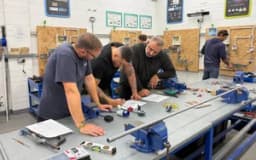
The Level 2 Diploma is the entry point into electrical work — the trade every heat pump installation needs
Related Course
Level 2 & 3 Package
The Level 2 & 3 package takes you from complete beginner to a fully qualified electrician
If you are still weighing up the heating engineer route against the electrical route more broadly, see electrician vs gas engineer for a direct comparison.
Frequently Asked Questions
How long does it take to become a heat pump engineer?
Do I need to be a plumber or an electrician first?
What is MCS certification?
Is there really a shortage of heat pump installers?
What does a heat pump engineer earn?
Do heat pump engineers need an F-Gas qualification?
Ready to Start Training?
Browse our City & Guilds accredited courses and take the next step in your electrical career.
Related Guides
F-Gas Certification UK: Courses, Costs & Who Needs It
What F-Gas certification is, C&G 2079 categories, course costs (£400–£900), who legally needs it, and how it compares with an electrical qualification.
Read guideHow to Become an Air Conditioning Engineer in the UK
Apprenticeship and fast-track routes into air conditioning, the F-Gas qualification you legally need, ~£41,000 salaries, and the electrical crossover.
Read guideHow to Become a Wind Turbine Technician in the UK
GWO training, entry routes and salaries for wind turbine technicians — and why electrical qualifications are a strong route into onshore and offshore wind.
Read guideHow to Become an Energy Assessor (EPC Assessor) in the UK
The DEA route — ABBE Level 3 qualification, £1,000–£1,500 cost, accreditation schemes, and why pairing EPC work with electrical qualifications earns more.
Read guide