
Part P Certificate Guide: How to Get Part P Registered (2026)
What is a Part P certificate? How to become Part P registered through competent person schemes, the qualifications you need, costs, and Part P vs BS 7671.
In this guide
What Is Part P?
Part P is a section of the Building Regulations that covers electrical safety in dwellings in England and Wales. Introduced on 1 January 2005, it was created to reduce deaths, injuries, and fires caused by unsafe electrical installations in homes. Despite the common search for a "Part P certificate", Part P is a regulation — not a qualification or certificate you can obtain.
Part P requires that certain types of domestic electrical work — known as notifiable work — are either carried out by a member of a competent person scheme (who can self-certify compliance) or notified to the local authority building control department. The regulation itself does not specify which qualifications are needed, but competent person schemes set their own entry requirements.
England and Wales Only
What Work Is Notifiable Under Part P?
Not all domestic electrical work requires building control notification. Part P distinguishes between notifiable work (which must be reported) and non-notifiable work (which can proceed without notification, though it must still comply with BS 7671).
Always Notifiable
- ✓Installation of a new circuit from the consumer unit
- ✓Consumer unit replacement (see our consumer unit replacement cost guide)
- ✓Rewiring a house (involves multiple new circuits)
Notifiable in Special Locations
- ✓In England (since April 2013): additions and alterations within the zones around a bath or shower, and in rooms containing a swimming pool or sauna heater
- ✓In Wales (which kept the original 2005 scope): work in bathrooms, near kitchen sinks, outdoors (garden lighting, shed supplies, outside sockets), and in swimming pool, sauna, and hot tub areas
Generally Not Notifiable
- ✓Like-for-like replacement of sockets, switches, and light fittings (not in special locations)
- ✓Adding a spur to an existing circuit (not in special locations)
- ✓Replacing a damaged cable on a single circuit
- ✓Installing or upgrading main or supplementary bonding
For a detailed breakdown of which jobs are notifiable, see our complete guide to notifiable electrical work.
Competent Person Schemes: How to Get 'Part P Registered'
The phrase "Part P registered" is commonly used but technically inaccurate. What people mean is membership of a competent person scheme — a government-authorised scheme that allows registered electricians to self-certify their domestic electrical work as compliant with building regulations, without needing a separate building control inspection.
Recognised Schemes
The main competent person schemes for domestic electrical work are:
- ✓NICEIC — the largest and most widely recognised scheme
- ✓NAPIT — the second largest scheme, competitive fees
- ✓ELECSA — a former third option, now absorbed into NICEIC (both run by Certsure)
For a detailed comparison of the two most popular schemes, see our NICEIC vs NAPIT guide.
Membership Costs
Annual membership fees typically range from 600 to 1,000 pounds or more, depending on the scheme, membership tier, and the size of your business. This fee covers building control notifications for all notifiable work you complete during the year, periodic reassessment, and use of the scheme logo. Compared to the building control route (200 to 400 pounds per job), scheme membership is cost-effective for any electrician doing regular domestic work.
No Shortcuts to Scheme Membership
Since September 2021, short courses and fast-track certificates are no longer accepted for competent person scheme entry. You need the full set of qualifications — there is no "Part P course" that grants scheme membership. Schemes assess your qualifications, practical competence, and a sample of your completed work before granting membership.
What Qualifications Do You Need?
To join a competent person scheme and self-certify domestic electrical work, you typically need the following qualifications:
- ✓18th Edition wiring regulations (City & Guilds 2382) — understanding of BS 7671
- ✓Inspection and Testing (City & Guilds 2391-52) — ability to test and certify installations
- ✓Evidence of practical competence — usually Level 2 and Level 3 Diplomas (City & Guilds 2365) or equivalent
- ✓Public liability insurance (minimum cover varies by scheme, typically 2 million pounds)
- ✓An initial assessment of your work by the scheme assessor
The 18th Edition qualification provides the regulatory knowledge, while the 2391 Inspection and Testing qualification proves you can test installations and issue the correct electrical certificates.
Related Course
18th Edition (2382)
The 18th Edition qualification is essential for understanding Part P and BS 7671 requirements.
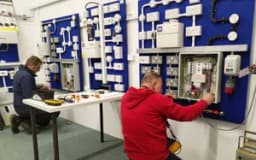
Related Course
Inspection & Testing (2391)
The 2391 qualification enables you to test, certify, and self-certify domestic installations.
The Building Control Route
If you are not a member of a competent person scheme, notifiable work can still be carried out legally — but the homeowner must notify the local authority building control department before the work starts. Building control will charge a fee (typically 200 to 400 pounds per job) and will inspect the completed work before issuing a completion certificate.
When the Building Control Route Is Used
- ✓The electrician is not a competent person scheme member
- ✓A homeowner is doing their own notifiable electrical work (not recommended)
- ✓The work is carried out by a general builder who is not scheme-registered
This route is more expensive and less convenient than using a scheme-registered electrician. Most homeowners prefer to hire a registered electrician who can self-certify, saving them the building control fee and the hassle of arranging inspections. For electricians, scheme membership is a significant competitive advantage — customers actively seek out NICEIC or NAPIT registered contractors.
Part P vs BS 7671: What Is the Difference?
Part P and BS 7671 are often confused, but they serve different purposes:
Part P (Building Regulations)
Part P is a legal requirement under the Building Regulations. It specifies that certain domestic electrical work must be notified to building control. It is about compliance and notification — ensuring that someone checks the work meets safety standards. Part P applies only to domestic dwellings in England and Wales.
BS 7671 (IET Wiring Regulations)
BS 7671 is the technical standard for electrical installations. It covers how electrical work should be designed, installed, inspected, and tested. BS 7671 applies to all electrical installations — domestic, commercial, and industrial — across the entire UK. Compliance with BS 7671 is how you demonstrate that the work meets the safety requirements of Part P.
Both Always Apply
Next Steps: How to Register as an Electrician
If you are working towards competent person scheme membership, the typical path is:
- ✓Complete the Level 2 and Level 3 Diplomas (City & Guilds 2365) to build technical knowledge and practical skills
- ✓Pass the 18th Edition exam (City & Guilds 2382) to understand BS 7671
- ✓Complete Inspection and Testing (City & Guilds 2391-52) to learn testing and certification
- ✓Gain practical experience through employment or supervised domestic work
- ✓Apply to a competent person scheme (NICEIC or NAPIT)
- ✓Pass the scheme initial assessment and begin self-certifying your work
For the complete step-by-step process, see our how to register as an electrician guide.
Frequently Asked Questions
Is there a Part P certificate?
How do I become Part P registered?
How much does it cost to join a competent person scheme?
Does Part P apply in Scotland?
Can I do domestic electrical work without being Part P registered?
What qualifications do I need for Part P compliance?
Ready to Start Training?
Browse our City & Guilds accredited courses and take the next step in your electrical career.
Related Guides
Electrical Safety Checks at Home: What to Check & When
Home electrical safety checks explained — warning signs, DIY limits, and when to get a professional EICR. Landlord and rental property checks covered.
Read guideUK Electrical Regulations: A Complete Timeline
The history of electrical regulation in the UK from 1882 to the present day — key milestones, editions, and amendments.
Read guideNotifiable Electrical Work: What Requires Building Control?
Which types of electrical work must be notified to building control, who can self-certify, and the penalties for non-compliance.
Read guideHow Much Does an Electrician Make? UK Salary Guide 2026
UK electricians make £39,039 on average (ONS 2025) — £18.38–£22.70/hr on JIB 2026 rates, £45k–£70k self-employed. Hourly, monthly, annual and London pay.
Read guide