
PAT Testing Explained: What It Is & How to Get Qualified
What PAT testing is, who needs it, legal requirements, and why 2391 is the professional next step.
In this guide
What Is PAT Testing?
PAT testing stands for Portable Appliance Testing. It is the process of checking electrical appliances that have a plug and can be moved — such as kettles, computers, power tools, extension leads, and phone chargers — to make sure they are safe to use. PAT testing involves a combination of visual inspection and electrical tests carried out with a dedicated PAT testing instrument.
The term "PAT testing" is technically a tautology (it literally means "Portable Appliance Testing testing"), but it has become the universally recognised term in the UK. The formal process is described in the IET Code of Practice for In-Service Inspection and Testing of Electrical Equipment (5th Edition), which provides guidance on how to carry out inspections and tests, how often they should be done, and how to record the results. The 5th Edition (2020) formally renamed the process from "Portable Appliance Testing" to In-Service Inspection and Testing of Electrical Equipment, though "PAT testing" remains the universally used term across the industry.
It is important to understand that PAT testing only covers portable and movable appliances — items that plug into a socket and can be disconnected and moved. It does not cover the fixed electrical installation (the wiring, consumer unit, sockets, and circuits in the walls). That is a completely different inspection covered by an EICR, which requires the City & Guilds 2391 Inspection and Testing qualification.
What does a PAT test check?
A PAT test typically involves two stages — understanding electrical testing procedures is helpful background. First, the tester carries out a visual inspection of the appliance, its plug, and its cable. They are looking for obvious damage — cracked casings, frayed cables, bent plug pins, missing cable grips, signs of overheating, and evidence of DIY repairs. Many faults can be identified through visual inspection alone.
Second, the tester uses a PAT testing instrument to carry out a series of electrical tests. These typically include an earth continuity test (checking the earth connection is intact), an insulation resistance test (checking that the internal wiring is not breaking down), and for some appliances, a lead leakage test. Class II (double-insulated) appliances do not have an earth connection, so the test sequence is different.
PAT testing vs fixed installation testing
Related Course
PAT Testing (2377-77)
Get qualified for PAT testing with our City & Guilds accredited course
Who Needs PAT Testing?
PAT testing is relevant to anyone who has a duty of care for electrical equipment used by employees, tenants, customers, or members of the public. While there is no single law that says "you must PAT test", the legal duty to maintain electrical equipment in a safe condition applies to a wide range of organisations and individuals.
Employers (all workplaces)
Every employer has a legal duty under the Health and Safety at Work Act 1974 and the Electricity at Work Regulations 1989 to ensure that electrical equipment in the workplace is safe. This includes offices, factories, warehouses, shops, restaurants, and any other premises where employees use electrical appliances. PAT testing is the standard method for demonstrating that portable equipment is maintained safely.
Landlords (rental properties)
Landlords who provide electrical appliances with a rental property (such as a washing machine, fridge, or microwave) have a duty to ensure those appliances are safe. For landlord-specific requirements, see our electrical safety for landlords guide. While the Electrical Safety Standards in the Private Rented Sector Regulations 2020 focus on the fixed installation (requiring an EICR every 5 years), the general duty of care under consumer protection and housing legislation extends to any appliances the landlord supplies.
Schools, hospitals, and public venues
Public sector organisations such as schools, hospitals, care homes, and leisure centres have a particularly high duty of care because members of the public — including vulnerable people — use their premises. Regular PAT testing of all portable appliances is standard practice and is typically required by their health and safety policies and insurance providers.
Self-employed with client-facing premises
If you are self-employed and clients visit your premises — for example, a hairdresser, therapist, personal trainer, or workshop owner — you have the same duty of care as an employer. Any electrical appliances your clients may come into contact with should be regularly inspected and tested.
Events and exhibitions
Temporary installations at events, exhibitions, markets, and festivals are a particular area of concern. Equipment is frequently transported, set up, and dismantled in challenging conditions, increasing the risk of damage. Most event venues and organisers require proof of PAT testing before they will allow exhibitors to connect electrical equipment.
- ✓Office-based businesses — computers, monitors, printers, kettles, desk fans
- ✓Construction sites — power tools, extension leads, transformers, site lighting
- ✓Hospitality — kitchen appliances, food service equipment, till systems
- ✓Retail — point-of-sale equipment, display lighting, demonstration products
- ✓Healthcare — patient-connected equipment, laboratory instruments, IT systems
Legal Requirements for PAT Testing
One of the most common misconceptions about PAT testing is that it is a specific legal requirement with mandatory intervals. This is not the case. There is no single UK law that mandates PAT testing at set intervals. However, several pieces of legislation create a legal framework that makes PAT testing the practical standard for compliance.
The Electricity at Work Regulations 1989
Regulation 4(2) states: "As may be necessary to prevent danger, all systems shall be maintained so as to prevent, so far as is reasonably practicable, such danger." This regulation applies to all electrical equipment in the workplace, including portable appliances. The duty holder (usually the employer) must be able to demonstrate that they have taken reasonable steps to maintain equipment safely. PAT testing is the most widely accepted way to demonstrate this.
The Health and Safety at Work Act 1974
This Act places a general duty on employers to ensure, so far as is reasonably practicable, the health, safety, and welfare of employees at work. It also requires employers to ensure that non-employees (visitors, customers, contractors) are not exposed to risks. Unsafe electrical equipment is a clear breach of this duty.
The Provision and Use of Work Equipment Regulations 1998 (PUWER)
PUWER requires that work equipment is maintained in an efficient state, in efficient working order, and in good repair. Portable electrical appliances are work equipment, and regular inspection and testing is part of meeting this requirement.
HSE guidance on testing frequency
The Health and Safety Executive (HSE) does not specify fixed testing intervals. Instead, it recommends a risk-based approach where the frequency of testing depends on the type of equipment and the environment in which it is used. The IET Code of Practice (5th Edition, 2020) recommends a risk-based approach. The fixed interval tables from the previous 4th Edition remain widely used as industry benchmarks.
Commonly used testing frequencies
PAT Testing vs EICR — Key Differences
PAT testing and EICRs are often confused, but they are fundamentally different inspections that cover different parts of the electrical system. Understanding the distinction is important whether you are a business owner trying to comply with regulations or a professional considering which qualification to pursue.
What each inspection covers
PAT testing covers portable appliances — anything with a plug that can be disconnected and moved. This includes kettles, toasters, computers, monitors, desk lamps, power tools, extension leads, phone chargers, and similar devices. The test checks the appliance itself, its cable, and its plug.
An EICR (Electrical Installation Condition Report) covers the fixed electrical installation — the permanent wiring in the walls, floors, and ceilings, the consumer unit (fuse board), socket outlets, light fittings, switches, circuit breakers, and RCDs. It assesses whether the entire electrical system is safe and compliant with BS 7671.
Qualification requirements
PAT testing has no legally mandated qualification requirement. The standard industry qualification is the City & Guilds 2377, which is a one-day course. Anyone deemed "competent" can carry out PAT testing, though demonstrating competence without formal training can be difficult.
An EICR must be carried out by a qualified and competent person — in practice, this means an electrician who holds the City & Guilds 2391-52 Inspection and Testing qualification (or equivalent), along with a current 18th Edition qualification. Most clients, landlords, and scheme providers (NICEIC, NAPIT) require the 2391.
Scope and complexity
- ✓PAT testing is relatively quick — a typical appliance takes 2 to 5 minutes to inspect and test
- ✓An EICR is a thorough, time-consuming process — 2 to 4 hours for a standard domestic property
- ✓PAT testing uses a dedicated PAT tester (a single portable instrument)
- ✓EICR testing requires a multifunction tester, insulation resistance tester, and other specialist instruments
- ✓A PAT tester cannot issue an EICR — the qualifications and skills are completely different
- ✓A 2391-qualified electrician can easily carry out PAT testing as well
Earning potential
PAT testing is a lower-value service. Testers typically charge 1 to 2 pounds per item or a flat rate per visit. A full day of PAT testing might generate 150 to 300 pounds in revenue. EICR work commands significantly higher rates — a domestic EICR typically costs the customer 150 to 350 pounds, and a commercial EICR can cost considerably more. A 2391-qualified electrician can earn 250 to 500 pounds or more per day from inspection and testing work.
Bottom line
How to Become a PAT Tester
Becoming a PAT tester is one of the quickest and most accessible routes into electrical testing work. There are no formal entry requirements, and the standard training course can be completed in one day. However, there are important considerations around competence, insurance, and the long-term viability of PAT testing as a career.
No formal qualification is legally required
Unlike EICR work (which effectively requires the 2391), there is no legal requirement to hold a specific qualification to carry out PAT testing. The law requires that the person doing the testing is competent — meaning they have sufficient knowledge and experience to carry out the work safely and correctly. In practice, this means you need to understand basic electrical principles, know how to use a PAT tester, and be able to interpret the results.
City & Guilds 2377
The City & Guilds 2377 (In-Service Inspection and Testing of Electrical Equipment) is the standard PAT testing qualification. It is a one-day course that covers the theory and practice of portable appliance testing, including visual inspection techniques, the use of PAT testing instruments, understanding Class I and Class II appliances, recording results, and applying the IET Code of Practice.
Competence and insurance
While you can legally PAT test without a qualification, there are practical reasons to get trained. Most insurance companies will want to see evidence of competence before they will provide public liability cover for PAT testing work. Commercial clients, landlords, and facilities managers will also ask for proof of training. The 2377 certificate provides this evidence and is widely recognised across the industry.
Equipment needed
- ✓A PAT testing instrument (typically 200 to 600 pounds — see our testing equipment guide for recommendations)
- ✓PAT testing labels (pass/fail stickers applied to tested appliances)
- ✓A record-keeping system (paper-based or digital)
- ✓Public liability insurance (essential for commercial work)
- ✓Basic electrical knowledge and an understanding of the IET Code of Practice
Important consideration
Why 2391 Is the Professional Next Step
If you are interested in electrical testing as a career — rather than just a side service — the City & Guilds 2391-52 Inspection and Testing qualification is the natural progression from PAT testing. It opens up an entirely different level of work, earning potential, and professional recognition.
What the 2391 covers
The 2391-52 is the Level 3 Award in Initial Verification and Periodic Inspection and Testing of Electrical Installations. It covers the full range of electrical testing — not just portable appliances, but the entire fixed electrical installation. You will learn to carry out continuity tests, insulation resistance tests, earth fault loop impedance measurements, RCD testing, and how to produce compliant certification including EICRs and Electrical Installation Certificates.
A 2391-qualified electrician can also do PAT testing
If you hold the 2391, you are more than competent to carry out PAT testing. The 2391 covers far more advanced testing than PAT, so portable appliance testing is well within your capabilities. This means you can offer PAT testing as an additional service alongside your main inspection and testing work, giving you a broader range of revenue streams.
Much broader scope of work
- ✓EICRs (Electrical Installation Condition Reports) for landlords, homeowners, and businesses
- ✓Initial verification of new electrical installations
- ✓Condition reporting for commercial and industrial premises
- ✓Signing off your own work with Electrical Installation Certificates
- ✓Joining competent person schemes (NICEIC, NAPIT) to self-certify notifiable work
- ✓Compliance work for lettings agents, property management companies, and local authorities
Higher earning potential
The earning difference between PAT testing and 2391-qualified inspection work is substantial. A PAT tester might earn 150 to 300 pounds per day, often testing dozens or hundreds of appliances. A 2391-qualified electrician can earn 250 to 500 pounds or more per day from EICR work alone, with the added benefit that unsatisfactory reports often lead to remedial work — creating further revenue from the same client.
Professional recognition
The 2391 is recognised across the UK electrical industry as the standard qualification for inspection and testing. It is required by most competent person schemes, expected by clients and insurers, and is a prerequisite for many employed positions in electrical testing and compliance. PAT testing certification, while useful, does not carry the same level of professional weight.
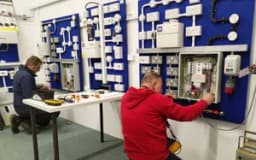
Related Course
Inspection & Testing (2391)
The 2391 covers full electrical inspection and testing — not just portable appliances
Career Comparison: PAT Testing vs Full Electrical Testing
If you are weighing up whether to focus on PAT testing or pursue the full 2391 qualification, a direct career comparison helps illustrate the difference in scope, earning potential, and long-term prospects.
PAT testing as a career
PAT testing can be a viable business, particularly if you focus on volume. Many PAT testers work on a per-item pricing model, charging 1 to 2 pounds per appliance. A busy day testing 150 to 200 items at a large office or school can generate 200 to 400 pounds in revenue. However, the market is competitive, barriers to entry are low, and clients often shop on price. Typical earning potential:
- ✓Day rate: 150 to 300 pounds (depending on volume and location)
- ✓Annual income potential: 25,000 to 40,000 pounds (full-time, self-employed)
- ✓Scope: portable appliances only — kettles, computers, tools, extension leads
- ✓Qualification: 2377 (one-day course, around 260 pounds)
- ✓Market: high competition, price-sensitive clients
2391-qualified electrical testing as a career
Holding the 2391 opens up a much wider range of work with significantly higher day rates. EICR work is legally required for landlords (every 5 years), recommended for commercial premises, and in demand for property sales and insurance compliance. Initial verification work is needed for every new electrical installation. The market is less competitive because the qualification barrier is higher.
- ✓Day rate: 250 to 500 pounds or more
- ✓Annual income potential: 40,000 to 70,000 pounds or more (self-employed)
- ✓Scope: full electrical installations — domestic, commercial, industrial
- ✓Qualification: 2391-52 (5 days, requires 18th Edition prerequisite)
- ✓Market: strong demand, legally mandated work, less price competition
- ✓Bonus: unsatisfactory EICRs lead to remedial work, creating additional revenue
The long-term view
PAT testing is often seen as a stepping stone or a supplementary service rather than a primary career. The low entry barrier means the market is saturated in many areas, and clients treat it as a commodity service. The 2391, by contrast, positions you as a qualified professional carrying out legally required compliance work. The demand for EICRs is growing — driven by landlord regulations, insurance requirements, and an ageing UK housing stock — and the supply of qualified inspectors has not kept pace.
Our recommendation
Related Course
Inspection & Testing (2391)
Ready for the professional qualification? View dates and pricing for our 2391 course
Frequently Asked Questions
Do you need a qualification to do PAT testing?
How often should PAT testing be done?
Can an electrician do PAT testing?
What is the difference between PAT testing and an EICR?
How much does PAT testing training cost?
Is PAT testing a legal requirement?
Ready to Start Training?
Browse our City & Guilds accredited courses and take the next step in your electrical career.
Related Guides
EICR Explained: Electrical Installation Condition Reports
Everything about EICRs — what they are, when they are required, who can carry them out, costs, and observation codes.
Read guideWhat Is the City & Guilds 2391 Qualification? (2391-52 Explained)
What the City & Guilds 2391-52 inspection and testing qualification covers, who needs it, entry requirements, and how it is assessed — plus where to book the course.
Read guideEICR Codes Explained: C1, C2, C3 and FI
What the observation codes on an EICR mean, how they are classified, and what action is required for each.
Read guideElectrical Testing Sequence: Dead & Live Tests in Order
The BS 7671 testing sequence in order: dead tests (continuity, ring circuit, insulation resistance, polarity), then live tests (Zs, PFC, RCD trip times).
Read guide