
TESP Training Routes Explained: Paths to Becoming an Electrician
The official TESP training routes mapped out — apprenticeship, college, self-funded adult learner, and experienced worker assessment.
In this guide
Understanding the TESP Training Routes
If you want to become a fully qualified electrician in the UK — meaning you can join a competent person scheme, self-certify Part P work, and hold an ECS gold card — there are specific qualification routes you must follow. These routes are defined by TESP (The Electrotechnical Skills Partnership) through the Electrotechnical Assessment Specification (EAS).
The EAS is the single specification that all competent person schemes (NICEIC and NAPIT) follow. There are no alternative standards. Understanding the TESP routes is essential for anyone planning their path into the electrical trade, because choosing the wrong training can waste thousands of pounds and years of time.
This guide maps out every recognised route, explains what each requires, and helps you identify which one fits your situation. For a visual walkthrough of the full qualification pathway, see our qualification pathway diagram.
Route 1: Apprenticeship
The apprenticeship route is the traditional path into the electrical trade and remains the preferred route by many employers. An apprentice works for an electrical contractor while attending college or a training provider on a day-release or block-release basis.
How It Works
- ✓Duration: typically 3 to 4 years
- ✓You are employed by an electrical contractor throughout
- ✓You earn a wage while training (JIB apprentice rates apply)
- ✓College or training provider delivers the theory and practical training
- ✓Your employer provides on-site experience and supervision
- ✓You complete the Level 2 and Level 3 Diplomas in Electrical Installations as part of the programme
- ✓You complete the NVQ Level 3 through on-site assessment of your real work
- ✓The AM2 practical assessment is taken towards the end
Qualifications Gained
- ✓Level 2 Diploma in Electrical Installations (City & Guilds 2365)
- ✓Level 3 Diploma in Electrical Installations (City & Guilds 2365)
- ✓NVQ Level 3 in Electrical Installation (City & Guilds 2357) with AM2
- ✓18th Edition Wiring Regulations (City & Guilds 2382)
- ✓Inspection and Testing (City & Guilds 2391)
The apprenticeship route is funded by the employer (often through the Apprenticeship Levy for larger companies). The apprentice earns while they learn and graduates with the full set of qualifications needed for scheme membership.
Finding an Apprenticeship
Route 2: College (Full-Time)
The college route involves studying the electrical installation diplomas full-time at a further education college. This route is less common than it used to be, as most colleges now focus on apprenticeship delivery. However, some colleges still offer full-time courses.
How It Works
- ✓Duration: 2 to 3 years full-time
- ✓You attend college full-time (not employed)
- ✓College delivers both theory and practical workshop training
- ✓You complete Level 2 and Level 3 Diplomas through the college
- ✓You still need to gain on-site experience separately for the NVQ
- ✓The NVQ Level 3 requires evidence from real electrical work on real sites
Key Limitation
The college route gives you the diploma qualifications but does not automatically include the NVQ Level 3. The NVQ requires on-site evidence from real electrical installations — college workshops alone are not sufficient. This means you need to find employment or work experience in the trade to complete the NVQ afterwards — or, until 31 October 2026, alongside your college studies under the current 2357 route. An industry-wide reform (the new 5357 qualification) then makes the on-site competence stage sequential — a minimum of two years after your diplomas.
College vs Private Training Provider
Route 3: Self-Funded Adult Learner
Route 3 is the most common path for adult career changers following the diploma route. You fund your own training through a private training provider and complete the qualifications at an accelerated pace compared to the college route. This is the route that Total Skills UK specialises in.
How It Works
- ✓Duration: typically 12 to 24 months (depending on intensity)
- ✓You pay for your training courses directly
- ✓Intensive, focused delivery — often full-time blocks of 2 to 4 weeks per course
- ✓You complete each qualification step by step through the training provider
- ✓NVQ Level 3 is completed through on-site assessment once you are working
- ✓Payment plans and finance options are often available
The Full Qualification Pathway
The self-funded route requires exactly the same qualifications as the apprenticeship route. There are no shortcuts and no reduced requirements. The EAS specification is identical regardless of how you fund your training.
- ✓Step 1: Level 2 Diploma in Electrical Installations (City & Guilds 2365) — foundational electrical theory and practical skills
- ✓Step 2: Level 3 Diploma in Electrical Installations (City & Guilds 2365) — advanced theory, design, fault diagnosis
- ✓Step 3: 18th Edition Wiring Regulations (City & Guilds 2382) — the current edition of BS 7671
- ✓Step 4: Inspection and Testing (City & Guilds 2391) — testing, certification, and condition reporting
- ✓Step 5: NVQ Level 3 (City & Guilds 2357) with AM2 practical assessment — on-site competence

Related Course
Level 2 Diploma (2365)
The Level 2 Diploma is the essential first step on the self-funded route.

Related Course
Level 3 Diploma (2365)
The Level 3 builds on Level 2 with advanced theory and design.
Related Course
18th Edition (2382)
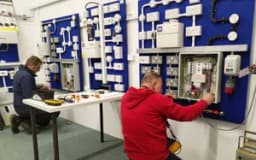
The 18th Edition is mandatory for all practising electricians.
Related Course
Inspection & Testing (2391)
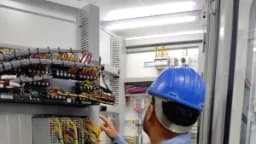
The 2391 is required for scheme membership and signing off your own work.
Related Course
5357 Level 3 Electrotechnical
The NVQ Level 3 with AM2 proves on-site competence — the final step to your gold card.
No Shortcuts Since September 2021
Route 4: Experienced Worker Assessment (EWA)
The EWA route is designed for people who are already working competently in the electrical industry but lack formal qualifications. It is not a shortcut — it assesses experienced workers to the same industry standard as the diploma route.
EWA Requirements
- ✓Minimum 3 to 5 years of documented electrical industry experience
- ✓At least a Level 2 qualification (or equivalent)
- ✓Current 18th Edition certificate (City & Guilds 2382)
- ✓Inspection and Testing qualification (City & Guilds 2391)
- ✓AM2E practical assessment (the EWA version of the AM2)
- ✓Portfolio of evidence from real electrical work
- ✓On-site assessment by a qualified assessor
Two EWA Qualification Routes
City and Guilds offers two EWA qualifications:
- ✓City & Guilds 2346-03: Standard EWA covering domestic and commercial installations
- ✓City & Guilds 2347-03: Domestic-only EWA for electricians working exclusively in dwellings
The EWA route still requires the 18th Edition and 2391 qualifications. Total Skills offers both of these courses. We do not offer the EWA assessment itself, but we provide the prerequisite qualifications that EWA candidates need.
EWA Is Not a Fast Track
Comparing the Routes
All four routes lead to the same outcome — the full set of qualifications needed for competent person scheme membership and the ECS gold card. The difference is in how you get there.
Route 1: Apprenticeship
- ✓Best for: school leavers and young entrants
- ✓Duration: 3 to 4 years
- ✓Cost: funded by employer
- ✓Earn while you learn: yes
- ✓On-site experience: built in
Route 2: College (Full-Time)
- ✓Best for: young people who cannot find an apprenticeship
- ✓Duration: 2 to 3 years
- ✓Cost: free for 16-18, fees for adults
- ✓Earn while you learn: no
- ✓On-site experience: must be arranged separately
Route 3: Self-Funded Adult Learner
- ✓Best for: adult career changers
- ✓Duration: 12 to 24 months
- ✓Cost: self-funded (payment plans available)
- ✓Earn while you learn: possible alongside training
- ✓On-site experience: NVQ completed once working
Route 4: Experienced Worker Assessment
- ✓Best for: experienced workers without formal qualifications
- ✓Duration: varies (requires existing experience)
- ✓Cost: self-funded
- ✓Requirements: 3 to 5 years documented experience minimum
- ✓On-site experience: must already have it
The End Goal: What All Routes Lead To
Regardless of which route you take, the end goal is the same. Once you hold the full set of qualifications defined by the EAS, you can:
- ✓Apply for your ECS gold card — the industry-standard proof of competence
- ✓Join a competent person scheme (NICEIC or NAPIT) to self-certify Part P work
- ✓Work as a fully qualified electrician on any domestic or commercial project
- ✓Sign off your own work and issue electrical certificates
- ✓Set up your own electrical business with full professional credibility
There is no alternative specification and no shortcut. The EAS managed by TESP is the single standard that the entire industry follows. For a closer look at how apprenticeships compare with other entry routes, see our electrical apprenticeships guide. Any training provider promising a faster or cheaper route to full qualification is not being transparent about what the industry actually requires.
Frequently Asked Questions
What is TESP?
What is the EAS?
Which route is best for adult career changers?
Can I skip qualifications if I have experience?
How long does the self-funded route take?
Do all competent person schemes follow the same TESP requirements?
Ready to Start Training?
Browse our City & Guilds accredited courses and take the next step in your electrical career.
Related Guides
Become an Electrician Without an Apprenticeship: Diploma Route
Yes — become an electrician without an apprenticeship via the C&G 2365 diploma route. Full-time training, no employer needed, qualified in 8–12 months.
Read guideNVQ Level 3 Electrical: Everything You Need to Know
A complete guide to the City & Guilds 2357 NVQ Level 3 — who it is for, how it works, evidence requirements, and how it leads to your gold card.
Read guideCity & Guilds 5357: New Level 3 Electrotechnical Qualification
What City & Guilds 5357 (5357-95 and 5393-43) means — the qualification replacing the 2357 NVQ from 31 October 2026, and the new ECS Gold Card route.
Read guideNVQ Level 2 Electrical: Why It Doesn’t Exist & What You Need
There is no NVQ Level 2 in Electrical Installation. The qualification you need is the C&G 2365-02 Level 2 Diploma — we explain the difference.
Read guide