
UK Electrical Industry Bodies: JIB, IET, NICEIC, NAPIT & More
Every major UK electrical industry organisation explained — what they do, whether you need to join, and when each matters in your career.
In this guide
Who Does What in the Electrical Industry
The UK electrical industry has a confusing number of organisations — awarding bodies, competent person schemes, trade associations, regulatory bodies, and professional institutions. Each serves a different purpose, and understanding who does what is important for navigating your career.
This guide explains every major organisation that affects working electricians in the UK: what they do, whether you need to join them, and when each one matters in your career. For details on the card scheme, see our ECS cards explained guide.
Awarding Bodies
Awarding bodies create and manage the qualifications you study for. They set the exams, approve training centres, and issue the certificates.
City & Guilds
Founded: 1878 | The dominant awarding body for electrical qualifications in the UK. City & Guilds developed and manages the 2365 Diploma, 2382 18th Edition, 2391 Inspection & Testing, 2357 NVQ, 2921 EV Charging, 2922 Solar PV, and 2923 EESS qualifications. The vast majority of UK electricians hold City & Guilds certificates.
EAL (Excellence, Achievement & Learning)
EAL is the main alternative awarding body for electrical qualifications. They offer equivalent qualifications to City & Guilds (same levels, same content, same Ofqual regulation). EAL qualifications are fully recognised by the JIB, competent person schemes, and employers. The choice between City & Guilds and EAL usually depends on which body your training centre is approved by.
Ofqual
Ofqual (Office of Qualifications and Examinations Regulation) is the government regulator for qualifications in England. It does not create qualifications — it regulates the awarding bodies (City & Guilds, EAL, and others) to ensure standards are maintained. Every qualification that appears on the Regulated Qualifications Framework (RQF) has been approved by Ofqual.
The JIB (Joint Industry Board)
The Joint Industry Board for the Electrical Contracting Industry is the body that sets grading, pay rates, and working conditions for electricians in England and Wales (Scotland has the SJIB). The JIB also administers the ECS card scheme.
What the JIB does
- ✓Sets the JIB grading system: Apprentice, Trainee, Electrician, Approved Electrician, Technician
- ✓Publishes annual pay rates for each grade (national agreed rates for JIB-registered firms)
- ✓Administers the ECS (Electrotechnical Certification Scheme) card — the industry ID card for electricians
- ✓Provides the Benefits & Travel Scheme for JIB-graded operatives
- ✓Handles industrial relations and dispute resolution between employers and employees
Not all electrical firms are JIB-registered, but the JIB pay rates are widely used as benchmarks across the industry. See our JIB grading explained guide for a full breakdown of grades and pay. The 2026 JIB Approved Electrician rate is £20.08 per hour.
The IET (Institution of Engineering and Technology)
The IET is a professional institution for engineers and technologists. Founded in 1871 as the Society of Telegraph Engineers (which later became the IEE, the Institution of Electrical Engineers), it took its current form in 2006 when the IEE merged with the Institution of Incorporated Engineers. The IET has over 167,000 members worldwide.
Why the IET matters to electricians
- ✓Publishes BS 7671 — the IET Wiring Regulations, which is THE regulatory document for all UK electrical installation work
- ✓Publishes the Guidance Notes series (8 volumes), the On-Site Guide, and other technical references
- ✓Publishes the Code of Practice for In-Service Inspection and Testing (PAT testing)
- ✓Provides CPD (continuing professional development) resources for electricians
- ✓Offers professional registration: TMIET (Technician Member), MIET (Member), and FIET (Fellow)
IET membership is not required to work as an electrician, but many professionals find it valuable for access to the Wiring Regulations, technical guidance, and professional recognition. Membership grades include Student, TMIET, MIET, and FIET.
Competent Person Schemes
Under Part P of the Building Regulations (England and Wales), certain electrical work in dwellings must be notified to Building Control. Electricians who are members of a competent person scheme can self-certify their own work without involving Building Control — saving time and cost for both the electrician and the customer.
NICEIC
The National Inspection Council for Electrical Installation Contracting was founded in 1956 and is the largest and most established electrical competent person scheme. It is operated by Certsure LLP (jointly owned by Electrical Safety First and the ECA). Approximately 38,000 businesses are registered with NICEIC.
- ✓Approved Contractor: commercial, industrial, and domestic work. From £1,240 + VAT/year.
- ✓Domestic Installer: domestic electrical work only. From £670 + VAT/year.
- ✓Both schemes require a Qualified Supervisor with relevant qualifications and 2+ years experience
- ✓Annual assessment by a NICEIC assessor at your place of work
- ✓Members can self-certify Part P notifiable work
NAPIT
NAPIT is the main alternative to NICEIC. For a detailed comparison, see our NICEIC vs NAPIT guide. It offers the same government approval for Part P self-certification and the same core requirements (qualified supervisor, annual assessment). NAPIT tends to be slightly less expensive than NICEIC and is growing its market share.
ELECSA (now part of NICEIC)
ELECSA was a separate competent person scheme also operated by Certsure. In 2021, Certsure consolidated the brands and transferred all ELECSA members to NICEIC. ELECSA no longer accepts new registrations.
When to join a scheme
Most electricians join a competent person scheme once they are self-employed or running their own business. You typically need the 18th Edition (2382) and Inspection & Testing (2391) plus at least 2 years of experience. During your early career working for an employer, their scheme registration covers your work.
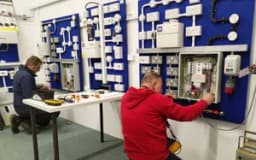
Related Course
Inspection & Testing (2391)
Inspection & Testing (2391) is required for most competent person scheme applications
Trade Associations
ECA (Electrical Contractors' Association)
Founded in 1901, the ECA is the UK's leading trade association for electrical contracting businesses. It is one of the two owners of Certsure (which operates NICEIC). ECA membership provides access to technical support, legal advice, contract templates, and industry representation. The ECA also jointly manages the JIB.
Electrical Safety First
A registered charity (formerly the Electrical Safety Council) dedicated to reducing electrical injuries and deaths. It is the other co-owner of Certsure alongside the ECA. Electrical Safety First campaigns for better electrical safety standards, publishes safety guidance, and funds research into electrical safety.
SELECT (Scotland)
SELECT is the trade association for the electrical contracting industry in Scotland. It jointly manages the Scottish Joint Industry Board (SJIB) and provides a competent person scheme for Scottish electricians.
TESP (The Electrotechnical Skills Partnership)
TESP is the sector skills body for the electrotechnical industry in the UK. It is jointly funded by the ECA, Unite the Union, and the JIB. TESP manages the Electrotechnical Assessment Specification (EAS) — the single document that defines what qualifications and competence evidence are required for electricians to obtain their ECS Gold Card and join competent person schemes.
Why TESP matters
- ✓Manages the EAS — the definitive specification for electrician qualification routes in England, Wales, and Northern Ireland
- ✓Defines the approved training routes: apprenticeship (Route 1), employer-sponsored (Route 2), and self-funded adult learner (Route 3)
- ✓Sets the requirements for the AM2 end-point assessment — the practical test every aspiring electrician must pass
- ✓Works with awarding bodies (City & Guilds, EAL) to ensure qualifications meet industry needs
- ✓Advises on competence standards used by NICEIC, NAPIT, and other competent person schemes
TESP Route 3 — the adult career changer route
Most adult career changers follow TESP Route 3: Level 2 Diploma (2365-02), Level 3 Diploma (2365-03), 18th Edition (2382), Inspection & Testing (2391), NVQ Level 3 (2357) with AM2, all completed through a training provider. This is the route Total Skills specialises in.

Related Course
Level 2 & 3 Package
The Level 2 & 3 Diploma package covers the first two qualifications in the TESP Route 3 pathway
When Each Organisation Matters
During training
- ✓TESP: defines the qualification route you are following (Route 1, 2, or 3) and what you need to achieve
- ✓City & Guilds or EAL: your training centre determines which awarding body you study under
- ✓Ofqual: ensures your qualification is legitimate and nationally recognised
Starting your career
- ✓JIB: sets your grade and minimum pay rate — see our registration guide
- ✓ECS: provides your industry card (via the JIB) — required for site access
Going self-employed
- ✓NICEIC or NAPIT: required for Part P self-certification if doing domestic work
- ✓IET: useful for technical guidance and professional standing
- ✓ECA: optional but provides business support and industry representation
Specialising
- ✓NICEIC MCS scheme: required for MCS certification (solar PV, battery storage, heat pumps)
- ✓BAFE: third-party certification widely demanded by clients and insurers for fire alarm system work
- ✓IET: professional registration (TMIET, MIET) enhances your credentials
Related Course
18th Edition (2382)
The 18th Edition is required by virtually every industry body and competent person scheme
Frequently Asked Questions
Do I need to join NICEIC or NAPIT?
What is the difference between NICEIC and NAPIT?
What happened to ELECSA?
Is City & Guilds the only awarding body for electrical qualifications?
Do I need IET membership?
What is TESP and why does it matter?
What qualifications do I need for NICEIC Approved Contractor?
Ready to Start Training?
Browse our City & Guilds accredited courses and take the next step in your electrical career.
Related Guides
How to Become an Electrician in the UK: 4 Routes Compared (2026)
Four routes to becoming a qualified electrician: apprenticeship, fast-track diploma, FE college, or experienced worker assessment. Costs from £0–£11k.
Read guideHow Much Does It Cost to Become an Electrician? (2026)
Training costs ~£8,050 (£7,750 via the L2 & L3 package, saving £300). Overall budget £9,700–£11,200 including the AM2 assessment, ECS card, and tools.
Read guideHow Much Does an Electrician Make? UK Salary Guide 2026
UK electricians make £39,039 on average (ONS 2025) — £18.38–£22.70/hr on JIB 2026 rates, £45k–£70k self-employed. Hourly, monthly, annual and London pay.
Read guideCareer Change to Electrician at 30, 40 or 50: A Realistic Guide
Honest advice for adults retraining as an electrician — no experience needed. Train part-time around your job, qualify in 18–24 months, earn £35k–45k.
Read guide